When Cities Drown and Wells Run Dry: The Water Paradox India Must Confront
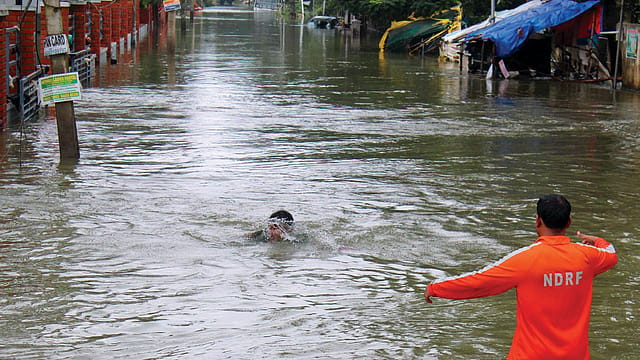
Every monsoon, Mumbai performs a grim ritual. The first serious cloudburst arrives, arterial roads vanish under brown water, local trains halt, and the financial capital of the country discovers once again that it cannot drain a single day of hard rain. The reference date is still 26 July 2005, when the Santa Cruz observatory recorded 944 millimetres in 24 hours, while Colaba, a few kilometres away, received barely 70 millimetres. More than a thousand lives were lost across Maharashtra. Two decades later, the pattern repeats in smaller keys almost every year.
Mumbai isn't the exception, and neither is India. Cities across the world are running into the same wall. Dubai got more than a year's worth of rain in a single day in April 2024, and a city built for the desert simply stopped working. Lagos floods after ordinary showers now. Dhaka has been dealing with the same short, violent bursts of rain for years. So have New York and London, whose Victorian drains were never designed for what a warming atmosphere is delivering.

The Health and Wellness Issue
25 Sep 2026 - Vol 05 | Issue 39
These cities differ in climate, geography, and wealth, but they share a common vulnerability: drainage is still treated as a utility rather than as the basis for resilience. The problem is not a lack of engineering or technology. It is that modern urban planning has come to treat drainage as little more than an underground utility, rather than recognising it as the foundation of a resilient city. When water has no space to spread, slow down, or soak into the ground, it inevitably finds its own path.
India's version of the problem is the sharpest, though, because here the cities that drown in July are often the same ones desperate for water by April. That contradiction is the point.
Take Chennai. It went under in December 2015 after extreme rain, with more than 400 lives lost across Tamil Nadu and damages running into billions of dollars. The deeper cause was quieter, and older: the Pallikaranai marsh, once spread across 5,000 hectares, had shrunk to a fraction of that, its expanse taken up by an IT corridor, a dumping ground, and highways. That loss turned flooding into the outcome.
Bengaluru told the same story in September 2022, when its gleaming technology corridor disappeared beneath floodwaters. A city once sustained by a network of nearly a thousand interconnected lakes had gradually built over its rajakaluves—the ancient stormwater channels that carried excess water from one lake to the next. When heavy rains arrived, the water simply reclaimed the paths it had always known. Barely two years later, the same city was rationing water and drilling ever deeper borewells. Flood and drought had become two expressions of the same failure.
Delhi's Yamuna hit 208.66 metres in July 2023. It had never touched that level before. Years of construction on the floodplain the river used to spill safely into had left the water no room to spread out. Hyderabad's history runs deeper. Its Qutb Shahi and Nizami rulers had left behind a chain of interconnected tanks that once held the monsoon. By October 2020, most of them were silted up or built over, and when the rain arrived, it went where it wasn't wanted. Kolkata is the exception in this list. It still holds together partly because it has, so far, refused to fully destroy the East Kolkata Wetlands, a Ramsar site that quietly cleans the city's sewage and takes the edge off its floods.
The paradox deserves a number. India's per capita water availability has fallen from over 5,000 cubic metres in 1951 to under 1,500 cubic metres today. That pushes the country firmly into water stress. NITI Aayog warned in 2018 that hundreds of millions of Indians face high to extreme water stress, and that several major cities were racing towards the day when their groundwater would run out. Chennai reached its own day zero in the summer of 2019, reservoirs cracked and empty. Only a few years after it had drowned. This is the crux, and it's the point that water researchers such as Nitin Bassi of the Council on Energy, Environment and Water have pressed: a rapidly drying India cannot afford to keep flushing its monsoon out to sea.
That is exactly what an impervious city does, though. When concrete and asphalt seal the ground, rain can't seep into the aquifer below to recharge it. It races across the surface instead. First overwhelming the drains, then draining away, lost. The water that floods the street in the morning is the same water the city will lack in the dry months. Flood control and water security aren't two separate problems. They're one problem, and they demand one answer.
The answer isn't new. It is, in fact, very old, and India wrote it first. The Harappan cities of the Indus Valley, more than four thousand years ago, laid streets along the natural slope and built covered structures, drains fed by household channels, dug soak pits, and set inspection chambers at intervals to allow the system to be cleaned. Long before that, at Dholavira on the edge of the Kutch, someone had already cut a chain of reservoirs into the bare rock to catch every drop of a desert monsoon. Over the next two thousand years, the same idea kept surfacing across the subcontinent, adapted to whichever geography it landed in. Tanks. Johads. Kunds. Baolis. Temple ponds. Eris across Tamil Nadu. Each was a small, patient piece of equipment for holding water long enough for it to soak into the ground and refill the aquifer beneath. None of it worked on its own, though. Every year, before the rains came, someone had to walk down into these structures with a shovel and clear the silt and repair the walls that had cracked in the heat. Usually the same people who would be drinking from them a few months later. In that older way of thinking, water wasn't a utility provided by someone else. It was something you owed back, in labour and in care.
Modern science is now rediscovering, and measuring, what that tradition already knew. China's much-studied sponge cities report that rain gardens, wetlands, and permeable surfaces can substantially reduce floods. Nature-based drainage consistently outperforms pipe-only systems during extreme rainfall that a warming climate is making more frequent, a trend documented by the Intergovernmental Panel on Climate Change. Indian recharge tanks- the old Indian recharge tanks are a piece of distributed green infrastructure- and manage floods and refill aquifers in the same stroke. They manage a flood and refill an aquifer in the same stroke.
The policy lesson follows. India's urban missions, from AMRUT to the Smart Cities programme, should treat each city as a watershed rather than a grid of wards. Which means aligning roads and drains with the land's natural slope. Protecting and reviving lakes, tanks and wetlands as working infrastructure rather than real estate in waiting. Restoring permeable ground. Enforcing the floodplain and drain boundaries that are routinely encroached today. Mumbai's own storm-water network, much of it colonial, was designed to carry only about 25 millimetres of rain an hour, a fraction of what the new cloudbursts deliver, and the long-promised upgrade has crawled for years. The National Disaster Management Authority issued urban-flooding guidelines as far back as 2010. The gap has always been in enforcement, not in ideas. Hyderabad's recent drive to demolish encroachments on its lakes shows both how far the rot has gone, and that reversal remains possible.
Mumbai's flooded platforms. Bengaluru's dry borewells. Different cities, different seasons, one act of forgetting.
The country that built the world's first water-sensitive cities now paves over the ponds that once saved it and treats the paving as progress. There's nothing nostalgic about reversing that. It's the most practical piece of climate preparation available to us. The blueprint isn't lost. It's under the streets, waiting to be dug up again.