Scripting A New Chapter In India-Israel Partnership, the Modi Way
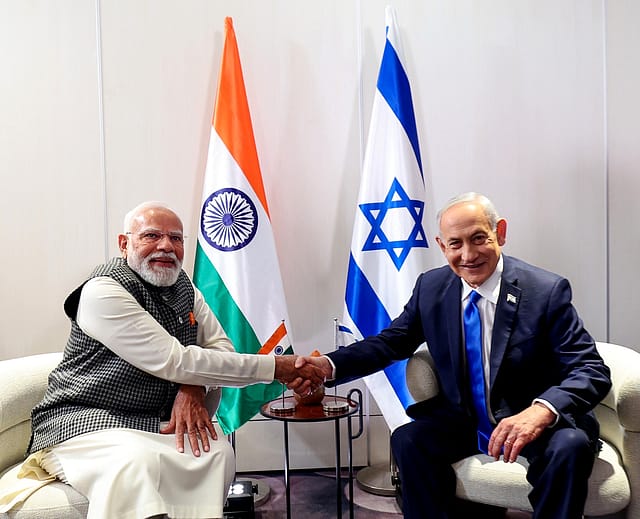
Away from the din and delirium of warmongering, a new script of mutually empowering partnership between India and Israel was carved in Jerusalem that elevated a hitherto defence-centric relationship to one that will be increasingly driven by technology, innovation, and shared security interests.
Israel’s Prime Minister Benjamin Netanyahu serenaded his Indian counterpart, “Dear Friend” Narendra Modi as the two leaders shared a car ride and bonded over a private dinner before they sat down for talks in Jerusalem, the homeland of three major religions, on a chilly morning punctuated by bursts of sunshine.
The sense of connect between the two leaders was instantaneous as they picked up from where they left like old friends and reaffirmed their commitment to this crucial partnership amid growing volatility in a crisis-stricken region.
The talks upgraded ties to the level of “Special Strategic Partnership” wherein the two like-minded democracies will support and reinforce each other’s core priorities and interests in areas ranging from trade and technology to trade and innovation. The talks were followed by the signing of sixteen pacts, covering diverse sectors including agricultural innovation and technologies, the use of civilian drones, satellite data, irrigation and fertilization management and the transfer of knowledge in advanced agricultural technologies.
Look Who's Talking Regime Change
23 Oct 2026 - Vol 05 | Issue 43
Encapsulating the essence of his talks with PM Modi, Netanyahu said: “This is an amazing visit with an amazing result. It was short but very productive and moving.”
United Against Terror
As the two fellow co-sufferers of terrorism, the two leaders took a strong stand against the scourge. In a compelling address to Knesset on February 25, PM Modi reaffirmed India’s solidarity with Israel in the wake of the Hamas slaughter of young Israelis over two years ago, saying “With a heavy heart, we share your grief.” “India stands with Israel – firmly, with full conviction – in this moment and beyond.”
A day later, with Netanyahu at his side, PM Modi told journalists at a joint press conference: Israel and India agree there is “no place for terrorism in the world, in any form.” “We will oppose it shoulder to shoulder. We will always oppose it in the future. Humanity must never become a victim of conflict,” he said.
Technology, the new driver
Defence, the bedrock of India-Israel ties, will acquire a new dimension as the two sides decided to accelerate joint development, joint production, and transfer of technology, with the overarching goal of bolstering “Aatmanirbhar Bharat,” – India’s ongoing quest for self-reliance in indigenous defence technology.
Going beyond defence and counter-terror cooperation, the two sides unveiled a Critical and Emerging Technologies Partnership, which will impart fresh momentum to cooperation in emerging frontiers such as Artificial Intelligence, Quantum technologies, and Critical Minerals. Another important pact was signed to enable the use of UPI in Israel.
Put together, these outcomes in diverse areas have paved the way for a lasting transformation of India-Israel relations, making Tel Aviv a key partner in India’s developmental journey.
Changing the Narrative
The messaging from Modi’s visit aimed at changing the narrative of India-Israel partnership, with the net result being the decisive end of equivocation and defensiveness on part of New Delhi to embrace Israel as a key partner in “Viksit Bharat” and “Surakshit Bharat.” This change of narrative is significant and has to be seen historically, as it was only in 1950 that India officially recognised Israel and it took another 42 years for New Delhi and Tel Aviv to establish formal diplomatic relations. In this process of rapprochement and recalibration, PM Modi has played a pivotal role – as he himself told Knesset that India recognised Israel on the day he was born, drawing resonant applause from parliamentarians.
While some critics have questioned the timing of the visit, the real strategic significance of PM Modi’s Israel journey lies precisely in choosing this particular juncture to visit the country at a time when the geopolitical churn in Middle East is intensifying with Israel getting isolated and speculation about an imminent attack on Iran by the US. In a compelling gesture of solidarity and strategic autonomy, Modi’s second visit to Israel was a sort of payback time as Israel has supported India unambiguously against the scourge of cross-border terror. Israel was the only country that did not mince words and overtly came out in support of India during “Operation Sindoor” – the retaliatory strikes launched by India against Pakistan for choreographing the Pahalgam terror attack, in the summer of 2025.
Obliquely responding to critics who accuse him of ignoring the Palestinian cause, PM Modi stressed that “peace and stability in West Asia are directly linked to India’s security interests.” “Therefore, from the very beginning, we have supported dialogue and a peaceful resolution of issues. This is the call of the Global South and of humanity.”
Having first shattered the precedent by becoming the first Indian prime minister to visit Israel in 2017, in his latest outing he became the first Indian prime minister to address the Knesset. PM Modi’s speech in Knesset crystallizes the transformation in India-Israel relations, from the once diplomatically distant countries to partners in shared development journey.
Invoking “tikkun olam,” the Hebrew term for repairing the world, and “Vasudhaiva Kutumbakam,” an ancient Sanskrit phrase meaning, “The World is One Family,” PM Modi concluded his speech with “Am Yisrael Chai,” (The People of Israel Live) followed by the Hindi salutation “Jai Hind” (Long live India). This was not just feel-good talk designed to elicit applause, but an apt way of capturing the paradigm-changing turnaround in India Israel relations in the more than 12 years he has been at helm as the leader of the world’s most populous democracy.