Why We Still Need Nehru
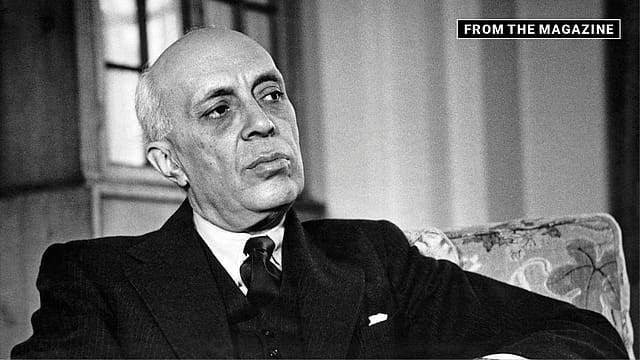
Upon Mahatma Gandhi’s assassination in 1948, just five months after Independence, Jawaharlal Nehru, the country’s first prime minister, became the keeper of the national flame, the most visible embodiment of India’s struggle for freedom. The patrician Nehru, born a child of privilege, had risen to the pinnacle of the nationalist movement with a vision to build a secular, democratic, and industrialised India. He championed parliamentary democracy, secularism, and socialism, focusing on economic development through state intervention and planning, and seeing the Constitution as an instrument of social and economic transformation. Gandhi’s death could have led Nehru to assume untrammelled power. Instead, he spent a lifetime immersed in the democratic values Ambedkar had codified, trying to instil the habits of democracy in his people—a disdain for dictators, a respect for parliamentary procedures, an abiding faith in the constitutional system.
For the first seventeen years of India’s independence, the paradox-ridden Nehru—a moody, idealist intellectual who felt an almost mystical empathy with the toiling peasant masses; an aristocrat, accustomed to privilege, who had passionate socialist convictions; an Anglicised product of Harrow and Cambridge who spent over ten years in British jails; an agnostic radical who became an unlikely protégé of the saintly Mahatma Gandhi—was India. Incorruptible, visionary, ecumenical, a politician above politics, Nehru’s stature was so great that the country he led seemed inconceivable without him. A year before his death a leading American journalist, Welles Hangen, published a book entitled After Nehru, Who? The unspoken question around the world was: ‘After Nehru, what?’
Today, looking back more than six decades after his death, we have something of an answer to the latter question. As an India still seemingly clad in many of the trappings of Nehruvianism stepped out into the 21st century, a good deal of Jawaharlal Nehru’s legacy appeared intact—and yet hotly contested. In the last quarter of a century, India has moved away from much of Nehru’s beliefs, and so (in different ways) has the rest of the developing world for which Nehruvianism once spoke. As India nears its 80th anniversary of Independence from the British Raj, a transformation—still incomplete—has taken place that, in its essentials, has changed the basic Nehruvian assumptions of post-colonial nationhood.
In my 2003 biography, Nehru: The Invention of India, I sought to examine this great figure of 20th-century nationalism from the vantage point of the beginning of the 21st. Jawaharlal Nehru’s life is a fascinating story in its own right, and I tried to tell it whole, because the privileged child, the unremarkable youth, the posturing young nationalist, and the heroic fighter for independence are all inextricable from the unchallengeable prime minister and peerless global statesman. At the same time, I sought to analyse critically the four principal pillars of Nehru’s legacy to India—democratic institution-building, staunch pan-Indian secularism, socialist economics at home, and a foreign policy of non-alignment—all of which were integral to a vision of Indianness that is fundamentally challenged today. Of these, it is the edifice of liberal democracy that Nehru constructed that remains the most indispensable pillar of his contributions to India.
It was by no means axiomatic that a country like India, riven by so many internal differences and diversities, beset by acute poverty and torn apart by Partition, would be or remain democratic. Many developing countries found themselves turning in the opposite direction soon after independence, arguing that a firm hand was necessary to promote national unity and guide development. With Gandhi’s death, and two years later, Vallabhbhai Patel’s, Nehru could have very well assumed unlimited power within the country. And yet, he himself was such a convinced democrat, profoundly wary of the risks of autocracy, that, at the crest of his rise, he authored an anonymous article warning Indians of the dangers of giving dictatorial temptations to Jawaharlal Nehru. “He must be checked,” he wrote of himself. “We want no Caesars.” And indeed, his practice when challenged within his own party was to offer his resignation; he usually got his way, but it was hardly the instinct of a Caesar.
Nehru—a moody, idealist intellectual who felt an almost mystical empathy with the peasant masses; an agnostic radical who was an unlikely protégé of Mahatma Gandhi—was India. Incorruptible, visionary, ecumenical, a politician above politics, Nehru’s stature was so great that the country he led seemed inconceivable without him
In the mid 20th century, the global environment was inhospitable to democratic experiments. Across Asia, Africa, and Latin America, post colonial states gravitated towards one party rule, charismatic authoritarianism, or military intervention. India, too, faced conditions that could easily have justified a concentration of executive power: Partition, mass displacement, food shortages, the integration of princely states, and the administrative challenge of governing a vast, impoverished, and diverse society. Lesser challenges in other newly freed colonies led to the proclamation of autocratic one-man rule.
Nehru resisted these temptations. He insisted that democracy was not a luxury but a necessity—an ethical commitment rooted in India’s civilisational pluralism and a practical mechanism for managing diversity. He accepted the constraints of electoral politics, tolerated dissent within Congress, and refused to personalise power even when his popularity might have allowed it. The first General Election of 1951-52, conducted under universal adult franchise, was itself a monumental liberal act: a leap of faith in the political agency of a largely illiterate population.
The most striking liberal achievement of Nehru’s career was his unwavering commitment to parliamentary democracy. Under Nehru, Parliament functioned as a genuine deliberative body; the press remained free; opposition parties operated without fear; and the Election Commission, under Sukumar Sen, established a global benchmark for electoral integrity. These were not inevitable outcomes. They were the result of deliberate political choices that reflected a liberal imagination of the Indian state. As prime minister, Nehru carefully nurtured the country’s infant democratic institutions. He paid deference to the country’s ceremonial presidency and even to its largely otiose vice presidency; he never let the public forget that these notables outranked him in protocol terms. He subjected himself and his government to cross-examination in Parliament by the small, fractious but undoubtedly talented opposition, allowing them an importance out of all proportion to their numerical strength, because he was convinced that a strong opposition was essential for a healthy democracy.
Nehru’s liberalism also manifested in his respect for constitutionalism and institutional autonomy. Although he was not the principal drafter of the Constitution, his influence on the Constituent Assembly was profound. His Objectives Resolution articulated the republic’s commitment to justice, liberty, equality, and fraternity—values that would later be enshrined in the Preamble. He supported the inclusion of Fundamental Rights, even when they constrained executive authority, and he defended the independence of the judiciary as essential to the rule of law.
In office, Nehru strengthened institutions that embodied liberal principles: the Election Commission was allowed to function with remarkable independence; the Comptroller and Auditor-General remained insulated from political interference; the Public Service Commissions were protected from patronage; the judiciary was respected as a co equal branch of government; and the civil service was encouraged to maintain neutrality and professionalism. Nehru’s own conduct reinforced these norms. He did not pack the courts, manipulate electoral boundaries, or use the police and intelligence agencies as instruments of partisan control. In a newly independent nation with no prior experience of self-government, these choices helped entrench a culture of institutional restraint that would prove vital for the republic’s stability.
He took care not to interfere with the judicial system; on the one occasion that he publicly criticised a judge, he apologised the next day and wrote an abject letter to the chief justice, regretting having slighted the judiciary. And he never forgot that he derived his authority from the people of India; not only was he astonishingly accessible for a person in his position, but he started the practice of offering a daily darshan at home for an hour each morning to anyone coming in off the street without an appointment, a practice that continued until the dictates of security finally overcame the populism of his successors.
The one blot on his impeccably liberal record of instilling democratic culture in India was the First Amendment to the Constitution, enacted in 1951 just a year after the Constitution was adopted, which significantly curtailed the freedom of speech and expression originally guaranteed under Article 19(1)(a). Driven by Nehru’s desire to overcome legal challenges to key government initiatives, specifically land reform legislation struck down by courts, public order disruptions following Partition, and critical press commentary on some of his most cherished policies, Nehru pushed through an amendment introducing “reasonable restrictions” on grounds such as public order, friendly relations with foreign states, and incitement to violence. While Nehru viewed these curbs as pragmatic necessities to maintain stability, foster national unity, and implement socio-economic reforms in a nascent, fragile republic, the amendment remains an enduring blot on his legacy as a champion of democratic ideals and unfettered civil liberties. By institutionalising mechanisms to muzzle dissent in the Constitution itself, Nehru opened a Pandora’s Box. The expanded state power he engineered to safeguard the nation has since been repeatedly weaponised by political successors lacking his democratic sensibilities, to suppress free expression, target political opponents, and censor press freedom.

Yet it was Nehru who, by his scrupulous regard for both the form and the substance of democracy, instilled democratic habits in our country. His respect for Parliament, his regard for the independence of the judiciary, his courtesy to those of different political convictions, his commitment to free elections, and his deference to institutions over individuals, all left us a precious legacy of freedom.
With Gandhi’s death, and two years later, Vallabhbhai Patel’s, Nehru could have assumed unlimited power within the country. Yet he, wary of the risks of autocracy, authored an anonymous article warning Indians of the dangers of giving dictatorial temptations to Jawaharlal Nehru
The long legislative struggle over the Hindu Code Bill, which led to Ambedkar’s resignation from the Cabinet, serves as a compelling historical testament to Jawaharlal Nehru’s deep-seated liberal constitutionalism in practice. Nehru was as fiercely committed as Ambedkar to reforming Hindu personal law to expand vital individual rights for women, specifically targeting deep inequalities in matters of inheritance, marriage, and property ownership. Yet, despite holding unmatched political dominance within the early republic, he encountered formidable resistance from traditionalists within Parliament and from conservative factions inside his own ruling party. A lesser democrat might have sought to bypass the arduous legislative process through high-handed executive actions, and indeed Ambedkar would have wanted him to ride roughshod over his own colleagues’ objections, but Nehru chose to spend years meticulously negotiating, debating, revising, and repeatedly reintroducing the reforms until their key provisions were ultimately enacted. This protracted episode perfectly captures the dual pillars of Nehruvian liberalism: an unyielding commitment to foundational individual rights, particularly gender equality, balanced by an equally rigorous fidelity to liberal democratic procedure. By seeking sweeping social transformation through legislative consensus rather than executive fiat, Nehru demonstrated the quintessential liberal insight that lasting political legitimacy must be derived from parliamentary approval rather than personal authority.
Yet, as I admit in my forthcoming book The Fight for Indian Liberalism, to characterise Jawaharlal Nehru purely as a liberal is to enter a terrain of paradox that lies at the very heart of the Indian liberal project itself. Nehru, along with Ambedkar, presents a profound challenge to how we conceptualise the relationship between Indian liberalism and statism. To put it more provocatively: without the bedrock commitment to liberal values that both men possessed, how much more unbridled, authoritarian, and dangerously statist would the post-colonial Indian state have become?
Nehru’s economic illiberalism lay in his deep conviction that classical, laissez-faire liberalism in a desperately poor country would only entrench existing inequalities. Inspired by the rapid modernisation of the Soviet Union, Nehru pioneered a top-down, state-controlled planned economy. By seizing the “commanding heights” of the economy for the state, his administration placed heavy restrictions on private enterprise and property rights. For Nehru, individual freedom was a luxury that could only be sustained if the state first engineered a socialist foundation of collective economic welfare. Nehru believed that a large measure of statism was essential to temper the extravagantly unmoored individualism of extremist liberals who ignored the crushing structural inequalities of caste and poverty. At the same time, his unshakeable liberal commitment to rights, dissent, and constitutionalism was the only force capable of keeping a totalising statism under democratic control.
If one examines Nehru’s liberal contributions across five domains—democratic consolidation, constitutionalism, institutions, secularism, and political culture—one could argue that while Nehru was a socialist rather than a liberal in the classical economic sense, he played a decisive role in embedding liberal values in the Indian republic. It is unarguable that his economic worldview was shaped by Fabian socialism, his admiration for the Soviet experiment was sincere (if qualified by his commitment to democracy), and the economic architecture he built after 1947 was unmistakably statist. Yet the political order he nurtured—parliamentary democracy, constitutionalism, secular citizenship, institutional autonomy, and a culture of rational public debate—was profoundly liberal in its foundations and aspirations. In the Indian context, where liberalism has always been more a political constitutional ethos than a purely economic doctrine, Nehru emerges as one of its principal architects.
The most striking liberal achievement of Nehru’s career was his commitment to parliamentary democracy. Under him, Parliament functioned as a genuine deliberative body; opposition parties operated without fear; and the Election Commission, under Sukumar Sen, established a global benchmark for electoral integrity
If there is one domain where Nehru’s liberalism was explicit and programmatic, it was secularism. For Nehru, secularism was not merely the separation of religion and state; it was a commitment to equal citizenship in a religiously diverse society. The trauma of Partition had demonstrated the destructive potential of communal politics. Nehru believed that only a secular state—neutral among religions, protective of minorities, and committed to rational public policy—could prevent India from descending into sectarian conflict.
He resisted demands to make India a Hindu state, opposed communal mobilisation of all kinds, and insisted that the state must neither privilege nor persecute any faith. His government enacted the reformist Hindu Code Bills, expanding women’s rights within Hindu personal law—a reform grounded in liberal principles of equality and individual autonomy. He also defended the rights of minorities, both constitutionally and politically, even when doing so invited criticism from majoritarian quarters.
Critics have argued that Nehru’s secularism was overly statist, insufficiently attentive to the need for reform within minority communities, and sometimes blind to the political uses of religious identity. Yet the normative framework he established—of a state committed to neutrality, equality, and pluralism—remains one of the most enduring liberal legacies of the Indian republic.
The most challenging aspect in looking back on Nehru today lies in reconciling his political liberalism with his economic socialism. His intellectual formation was steeped in Fabian socialism; his economic instincts were statist; his admiration for the Soviet experiment, though tempered by democratic commitments, was genuine; and his early decades in office were marked by a dirigiste economic model that placed the state at the commanding heights of development. However, to reduce Nehru purely to a socialist is to miss the deeper, more enduring imprint he left on the Indian republic. For if liberalism in the Indian context is understood not merely as an economic philosophy but as a political and moral framework, anchored in liberal democracy, constitutionalism, individual rights, secularism, and institutional restraint, then Nehru emerges as one of its principal architects. His legacy, in this sense, lies less in the five-year plans he issued as prime minister than in the habits of mind and structures of governance that helped embed liberal values in the political culture of a newly independent nation.
It is true that Nehru’s economic model—state led industrialisation, import substitution, and extensive regulation—was far from liberal in the classical sense. Yet even here, his socialism was tempered by liberal instincts. Nehru rejected the authoritarianism of communist regimes, insisted on the protection of private property (albeit with restrictions), and maintained a mixed economy rather than a command economy. His socialism was moral rather than doctrinaire, shaped by concerns about poverty, inequality, and social justice rather than ideological rigidity. Moreover, the very fact that economic policy was debated within Parliament, scrutinised by the press, and contested by opposition parties reflected a liberal political culture. Nehru’s economic choices may not have been liberal, but the framework within which they were made certainly was.
Beyond institutions and policies, Nehru’s greatest liberal contribution may have been the habits of mind he cultivated in the political class and the public sphere. His speeches, writings, and public interventions consistently emphasised rationality, scientific temper, tolerance, and openness to ideas. He wrote regular letters to the chief ministers of the states, explaining his policies and seeking their feedback. He encouraged debate within Congress, welcomed criticism from intellectuals, and engaged with opponents in a spirit of civility. His cosmopolitanism—rooted in Enlightenment thought, yet sensitive to India’s cultural diversity—helped shape a political ethos that valued reason over dogma, dialogue over confrontation, and pluralism over uniformity. These habits did not always permeate the entire political system, nor did they survive unchallenged after his death. But they set a benchmark for political conduct and public discourse that continues to influence Indian liberalism.
It is true that to see Nehru solely as a liberal would be misleading. His economic policies were statist; his party dominated the political landscape; and his vision of secularism was sometimes paternalistic. Yet to deny his liberal contributions would be equally misleading. In a country emerging from colonial rule, riven by communal violence, and burdened by poverty, Nehru chose democracy over authoritarianism, constitutionalism over expediency, secularism over majoritarianism, and institutional autonomy over personal power. These choices were neither inevitable nor universally popular. They were rooted in a liberal imagination of what India could and should be. Nehru’s legacy, therefore, lies not in the economic model he built—much of which was later dismantled—but in the political and moral architecture he bequeathed to the republic.
To characterise Nehru purely as a liberal is to enter a terrain of paradox at the heart of the Indian liberal project. Nehru, along with Ambedkar, presents a challenge to how we conceptualise the relationship between Indian liberalism and statism
He may not have been a doctrinaire liberal, but he implanted the roots of liberal thinking in India’s Constitution, institutions, and political culture. In doing so, he ensured that the world’s largest democracy would be built not merely on electoral arithmetic but on a deeper commitment to liberty, equality, and pluralism.
(Shashi Tharoor, a former UN under-secretary-general, is a Congress MP. He is the author of, most recently, The Sage Who Reimagined Hinduism: The Life, Lessons & Legacy of Sree Narayana Guru)