Courting Bharat: Is Sonia Gandhi’s story more than a memoir?
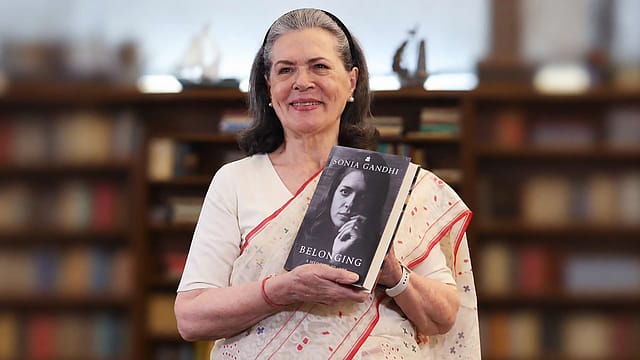
Sonia Gandhi’s journey has been remarkable, and we all have opinions on her story. Some are based on direct observations of her public role, others born of prejudice, and yet others on hearsay. But opinions apart, her influence has had far-reaching consequences for Bharat, which is remarkable given that Sonia Gandhi was not born Indian. For almost six decades, she has chosen to let others shape the narrative around her. No more. Sonia Gandhi has felt compelled to tell her story, which she has done with an easy flourish in her memoir Belonging: A Journey of Love. The book is a cohesive documentation of her “courtship” of Bharat. In seven parts, she paints the chapters of her life: first, as a dutiful daughter to a strict and principled father in a quiet Italian town; then as the object of husband Rajiv Gandhi’s unstinting affection; then as the mother of their two children in a home in a strange but alluring land, where she smoothly transforms into a model daughter-in-law to one of India’s most celebrated prime ministers. Midway, in a “denouement”, Sonia Gandhi recounts her emergence as a powerful public figure who has left an indelible imprint on Congress and the country’s governance architecture.
But the central question is whether Sonia Gandhi’s literary endeavour is a wider political project. The anecdotes and recollections appear carefully selected or curated to recast her political journey as one of sacrifice, duty and reluctant leadership. References to her father, a war veteran who prized these values and inculcated them in his three daughters, make the emphasis clear. These deeply ingrained values, rather than naked ambition or the unflattering instinct to exercise raw power, Sonia Gandhi suggests, prepared her for her political innings in the shadow of life-altering tragedies.
There is also a thinly disguised attempt to rehabilitate Congress through victimhood. One example is particularly striking: Indira Gandhi’s decision to impose Emergency. The assault on constitutionalism is hardly acknowledged as a grave moral failure on the then prime minister’s part. Instead, it is artfully portrayed as Indira Gandhi’s reaction to vilification, political vendettas and threats of personal harm. The effect is to foreground the circumstances surrounding Emergency while relegating the constitutional transgression to the background.
There is also an attempt to redeem Congress and claim ownership of the India story.
Sonia Gandhi leaves no one in any doubt when she claims that “Rajiv took the first steps towards liberalisation. PV Narasimha Rao’s Congress government, with Dr Manmohan Singh as his finance minister, paved the way to the next stage of rapid growth. Our UPA continued with the reforms, putting India on the map as one of the world’s fastest-growing economies.” Till now, the credit for steering India towards globalisation has largely accrued to Manmohan Singh. The economist responded to a calamitous economic situation, the legacy of decades of avoidable policy choices under successive Congress governments. Singh’s prescience was allowed a free hand by his boss Narasimha Rao. The Gandhis were nowhere on the scene. There is, of course, a distinction between acknowledging Rajiv Gandhi’s early economic initiatives and claiming a larger share of the credit for the economic transformation that followed. Other passages and recollections seek to project Congress as the principal architect of modern India and the default party of governance, even though BJP can now lay claim to that title with some justification.
In the final analysis, the debate is destined to rage on: whether Sonia Gandhi’s work is an honest reckoning with the past or an attempt to restore the standing of the Nehru-Gandhi family and Congress for what is still to follow. Is Belonging simply a personal account, or is it also an attempt to shape the political inheritance of the family she married into and the party she came to lead?
(Rahul Shivshankar is Consulting Editor, Network 18)