Of Modi, Godi And Buddhi Media
This story may well be apocryphal, but it was doing the rounds on social media. A young journalist working for a leading news magazine was assigned to cover an event. Excited, he reached the venue and struck up conversations with a few people. One of them asked, "Which media are you from — pro-Modi or anti-Modi?"
That simple question mirrors the intense debate surrounding the Indian media landscape today, often reduced to the divide between independent journalism and what has come to be known as "Godi media".
To my mind, however, the media broadly falls into three buckets:
Modi Media: Those rooting for Prime Minister Narendra Modi and his government. They seldom write, report or speak against it.
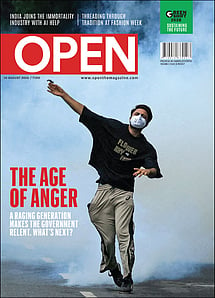
The Age of Anger
31 Jul 2026 - Vol 05 | Issue 31
A raging generation makes the government relent. What's next?
Godi Media: Those constantly baiting the Modi government but rarely question Opposition leaders. They constantly interview commentators — often portrayed as part of a larger "deep state" narrative — who cite statistics and global rankings to argue that Indian democracy is under threat under the current dispensation.
Buddhi Media: Independent journalists who are neither for nor against anyone, but judge every issue on its own merits. At one time, The Hindu largely belonged to this category.
Today, if you write or speak in favour of the Modi government, you are labelled part of the saffron brigade. If you criticise it, then you are secular.
But was journalism always as sharply divided and polarised as it is today? Not really.
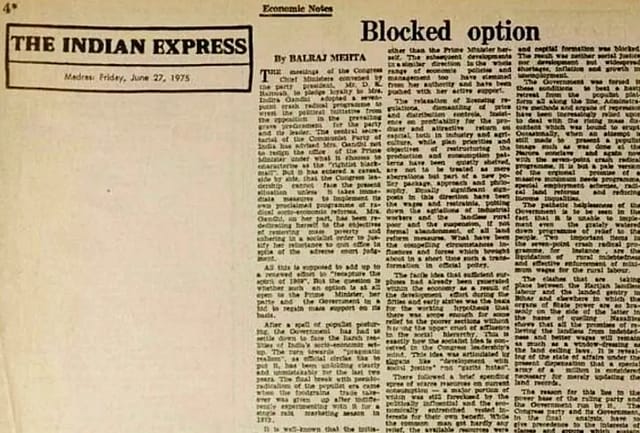
On the 51st anniversary of the Emergency imposed by Indira Gandhi's government in 1975, I thought it opportune to walk down memory lane — the year I entered journalism — and trace how the profession has evolved over the past five decades. I must candidly admit that this account has a Mumbai bias and focuses largely on the English-language media. Incidentally, Mumbai is the Mecca of Indian media.
Back then, journalism meant only print. Newspaper stands across the country reflected that reality. AH Wheeler book stalls at railway stations overflowed with newspapers and magazines. That picture has largely disappeared today as print has steadily ceded ground to digital media.
While still in college, I got my first break at Business India as a sub-editor in 1979. The fortnightly, which pioneered business journalism in India, was founded by Ashok H Advani. Dilip Thakore was its first editor. The magazine had an eclectic mix of journalists — many with foreign degrees or MBAs — and they were among the best-paid professionals in the industry.
Articles were either handwritten or typed. Every newsroom had a pool of typists who painstakingly typed stories in double spacing, leaving generous margins on both sides for editing and subbing.
Today, technology has transformed everything. Journalists work on laptops, dictate stories into smartphones and have them instantly converted into text. Research no longer requires trips to libraries or searches through bulky clipping files. ChatGPT or Gemini hai na. Digitalisation and artificial intelligence are now the order of the day.
Business India's office was located in Wadia Building on Dalal Street, Fort, next to The Free Press Journal, where Bal Thackeray began his career as a cartoonist. FPJ also published a fortnightly news magazine called Onlooker, which was first edited by M J Akbar, later by S Venkat Narayan, who was then considered close to Indira Gandhi, and subsequently by Rajat Sharma.
Akbar quit Onlooker to join Aveek Sarkar's ABP Group and launch Sunday, a weekly political magazine. Priced at just Re 1, it redefined political journalism in India. Akbar was an institution in himself; some of the country's finest journalists trained under him.
A stone's throw from Business India stood the Somani Group, which published Eve's Weekly, Star & Style and Mirror. The first two were edited by Gulshan Ewing. Star & Style featured the immensely popular gossip column 'Frankly Speaking', written by Devyani Chaubal.
I vividly remember the day Devyani and another well-known journalist, M S Krishna of Blitz, found themselves in trouble after writing a story on Hema Malini. Dharmendra allegedly chased both of them, intent on assaulting them. Devyani managed to escape, but Krishna bore Dharam paji's fury and had to be hospitalised.
A little further down Cawasji Patel Street stood the office of the legendary Blitz, the sensational tabloid weekly edited by R K Karanjia. Published in English, Hindi, Marathi and Urdu, Blitz was unlike any other publication of its time. People often spoke about Karanjia's alleged Russian connections. His daughter, Rita Mehta, later edited Cine Blitz. Years later, Karanjia launched The Daily, styling it as "The Bulldog of Newspapers" because of its aggressive watchdog journalism.

Opposite VT station, now CST, stood the Old Lady of Bori Bunder, the popular moniker for The Times of India. The group also published The Illustrated Weekly of India, edited by Khushwant Singh, besides Femina, Filmfare, Science Today, Evening News of India, The Economic Times and several language dailies.
The main newspaper was edited by Girilal Jain, a towering intellectual who commanded enormous respect for his political commentary. The Times was generally regarded as a pro-establishment newspaper, and our parents advised us to read its editorial page to improve our English. Its evening newspaper was equally popular, thanks largely to Busybee's celebrated 'Round and About' column. Busybee or Behram Contractor, later quit the Times to launch Mid-Day and subsequently The Afternoon Despatch & Courier.
Another man who made waves in the media world was Nari Hira, who also ran the advertising agency Creative Unit. He launched Stardust, India's first bold, irreverent and gossipy film magazine, edited by Shobha De. Her immensely popular column, 'Neeta's Natter', accompanied by the famous cat logo, became a talking point across the country. Stardust sold like hot cakes, and Nari Hira went on to build a media empire with magazines such as Society, Savvy, Showtime and Parade.
At Nariman Point's Tulsiani Chambers was Gentleman, owned and edited by Minhaz Merchant. From nearby Nariman Bhavan, Ayub Sayed published Current, another tabloid weekly that competed with Blitz. Living Media, headed by Aroon Purie, operated from Jolly Maker II. Chander Uday Singh was the Mumbai Bureau Chief of India Today, then a fortnightly magazine, while its sister publication Bombay was edited by Vir Sanghvi. Mohini Bhullar admirably ran the magazine group's Mumbai operations for decades.
Nariman Point's most recognisable landmark was Express Towers, home to the Indian Express Group led by the legendary Ramnath Goenka. Every journalist worth his salt aspired to work for The Indian Express. It stood for courage—frank, fearless and fiercely anti-establishment. Over the years, it was helmed by distinguished editors such as B G Verghese, S Nihal Singh, Arun Shourie, Prabhu Chawla and Shekhar Gupta.
Goenka famously defied Indira Gandhi during the Emergency by deliberately leaving the editorial space blank in The Indian Express. For standing up to the Congress government, he paid a heavy price.
The Indian Express always led from the front. In 1981, it published a landmark investigation in which reporter Ashwini Sarin purchased a woman named Kamla for Rs 2,300 in the Dholpur flesh market, exposing a thriving human trafficking network. Arun Shourie's investigation into the cement scandal eventually led to Maharashtra Chief Minister A R Antulay's resignation. S Gurumurthy's investigative series on Reliance Industries rattled the corporate world and saw a dramatic drop in RIL’s share price.
One story, however, went badly wrong. A report claimed that a housewife had committed suicide after being abducted while returning from Bandra's Drive-In theatre with her husband. If I remember correctly, this happened in 1982. The story became a national sensation because Prime Minister Indira Gandhi was then visiting Mumbai and sought a detailed report. It later turned out to be fabricated, and the editor paid the price.
In the early 1990s, the Ambanis entered the media business by acquiring The Sunday Observer and Commerce magazine. These were later merged to launch Business and Political Observer. They hired some of the country's finest journalists and invested in the best technology, yet it failed to take off. At the time, readers were perhaps uncomfortable with a newspaper owned by a corporate house. Ironically, much of today's media is owned by business groups.
Sensing another opportunity, Raymond's Vijaypat Singhania persuaded Vinod Mehta, who had earlier edited Debonair and The Sunday Observer, to launch the Indian Post. It was an instant success but reportedly fell out of favour with the Rajiv Gandhi government. Eventually, Singhania sold the newspaper to the Ahmedabad-based Gujarat Samachar. Vinod Mehta later went on to launch Outlook, the weekly magazine funded by Rajan Raheja.
The purpose of this journey down memory lane is simple. Every publication had carved out its own identity. Some merely survived; many flourished. Together, they kept the spirit of good journalism alive.
There was tremendous romanticism associated with journalism in those days. People genuinely loved the profession. There was also a remarkable sense of camaraderie across newsrooms. Healthy competition certainly existed, but there was very little bitterness or ideological polarisation.
If Business World got wind that Business India was planning a cover story on the Tata Group, it would try to pre-empt it. Likewise, India Today and Outlook were fierce competitors. Yet there was mutual respect. Importantly, layoffs were almost unheard of. Journalists found jobs with relative ease. Today, downsizing has become the norm.
The media landscape today is dominated by digital and broadcast journalism. Television news, in particular, has become painfully predictable. Every evening there are shouting matches, the same panellists hop from one studio to another, and viewers are repeatedly told, "We are not Lutyens' media." It has become a dog-eat-dog world. Nationalism certainly has its place, but journalism cannot be practised with the heart overruling the head. Good journalism has undoubtedly suffered. Social media has made matters worse. Public discourse has become increasingly shrill, abusive and toxic.
Why has journalism taken this turn? One possible explanation is that many Delhi-based journalists once enjoyed easy access to ministries and senior ministers without needing appointments. That changed after Narendra Modi became Prime Minister. Likewise, the practice of journalists accompanying the Prime Minister on overseas visits has also ended. To my mind, Modi is simply uncomfortable following many conventions established by his predecessors. Merely because he does not hold press conferences does not automatically mean democracy is under threat or that the Indian economy is heading downhill.
Finally, very few youngsters today view journalism as a lifelong career. For many, it has become a transit lounge before moving into politics, public relations, consulting or corporate communications. Commitment, conviction and a sense of mission have steadily diminished. That, to me, is the greatest tragedy. Fewer and fewer people now aspire to write the first draft of history.