Is The Private Sector Really Shying Away From Capex?
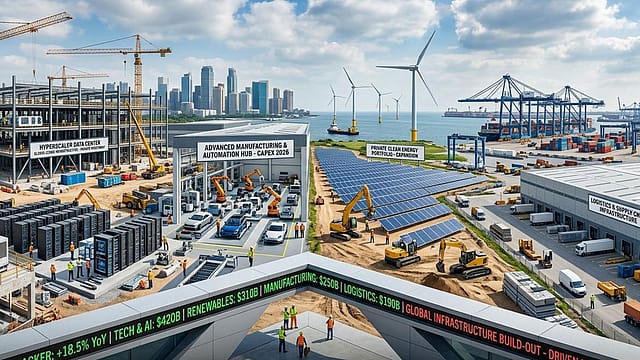
A decade or two ago, business dailies routinely carried stories about companies setting up greenfield projects, their diversification plans, acquisition strategies and fund-raising programmes. Depending on the size of the companies, the stories were either carried on the front page or inside pages. Today, those types of stories are largely missing. Instead, the dailies are featuring stories about the government's aggressive and massive spending on highways, rail corridors, airports, metros, defence manufacturing and power transmission.
Between FY2022 and FY2026, the government's Capex stood at Rs 44.2 lakh crore, while that of the private sector was Rs 32 lakh crore. These numbers belie the perception that India Inc. has gone slow on Capex. If you look at the year-on-year figures for both the government and private sectors, you will notice that in the last two years both have spent nearly Rs 10 lakh crore each. Yes, what comes through loud and clear is that the government, for now, is doing most of the heavy lifting to propel the country's economic growth.

The Health and Wellness Issue
25 Sep 2026 - Vol 05 | Issue 39

Is there some kind of hesitancy on the part of the private sector to invest today? Yes. Many sectors are operating below optimum capacity utilisation levels, so there is little justification for capital expenditure on expansion, diversification or greenfield projects. Since many of these companies are listed, promoters are under pressure from the stock market to focus on higher returns on capital rather than empire-building. In other words, the emphasis has shifted from "growth at any cost" to "profitability first". Such promoters are the darlings of Dalal Street.
Nor can one entirely blame the private sector for not embarking on large Capex programmes. In the last six years, there have been two Black Swan events — Covid-19 and the West Asia war — which shook both the global economy and corporate India. The Russia-Ukraine conflict seems to go on like a never-ending TV serial, while the U.S.-Israel-Iran conflict has also dragged on. Collectively, these developments have thrown a spanner in the works of the global economy.
For instance, we saw how supply chains for rare earth minerals, largely controlled by China, were disrupted during the Covid-19 pandemic. This severely impacted India's automobile sector. Similarly, the West Asia conflict led to the closure of the Strait of Hormuz, pushing Brent crude prices sharply higher — from around $60-80 per barrel before the conflict to as high as $126.41 on April 30. Currently, prices are hovering around $88-93 per barrel. Compounding these problems was U.S. President Donald Trump's unilateral imposition of high tariffs. Collectively, these developments created uncertainty, heightened fears of recession in developed economies and made the cost of doing business increasingly prohibitive.
One reason Indian promoters may have become risk-averse is the memory of the 2008 global financial meltdown, during which many businesses went belly up. Between 2004 and 2012, everything looked hunky-dory, prompting Indian promoters to borrow heavily and expand aggressively. Then came the global financial crisis, triggered by the collapse of the 150-year-old investment bank Lehman Brothers, which filed for the largest bankruptcy in U.S. history. The collapse caused a massive global sell-off, erasing trillions of dollars in market value.
As the saying goes, if the U.S. sneezes, India catches a cold. The crisis slowed India's economic growth and crippled many companies, resulting in defaults that sharply increased banks' non-performing assets (NPAs). For instance, by 2010, NPAs had surged dramatically, severely constraining banks' ability to lend. One may recall that companies such as Reliance ADAG, Jaypee Group, Essar Group and Lanco Infratech suffered major setbacks. To my mind, Indian promoters have not forgotten that bitter period and may therefore be excessively cautious today. Their argument could well be: why build another factory when existing ones can comfortably meet demand?
Interestingly, there is also a contrarian view.
Some economists argue that private sector Capex has not slowed down—it has simply changed form. Instead of steel mills and cement plants, investments are flowing into data centres, software, digital infrastructure, renewable energy and artificial intelligence. These investments may be enormous but are optically less visible than building a giant refinery or an automobile plant.
At this juncture, it is pertinent to ask whether there are inhibiting factors causing the private sector to hold back. An interesting development that has come to light is that while dealing with the Delhi bureaucracy has become easier, obtaining approvals at the state level has become increasingly torturous. However, in terms of ease of doing business, the litany of woes remains the same: land acquisition hurdles, environmental clearances, a slow judicial process, compliance burdens, multiple regulators and sluggish approvals. These issues appear to have disproportionately affected mid-sized companies.
Big businesses, however, continue to invest, come rain or shine. Groups such as Reliance Industries, Adani Group, Tata Group, Vedanta, the Birla Group, L&T, UltraTech Cement and JSW Group continue to make headlines with their investment announcements.
Given this dynamic and fluid state of affairs, can India become a $5 trillion economy without the active participation of the private sector? Not really. The government can lay highways, but only private enterprise can put traffic on them.
Several factors are working in favour of Indian businesses. First, there is political stability. For the last 12 years, India has had a stable government at the Centre whose vision of Viksit Bharat is giving a significant leg up to the economy. Globally, India is taken seriously; it is on the table, not on the menu. Second, India remains one of the fastest-growing major economies in the world, expanding at around 6.6%, driven by robust domestic demand, structural reforms and a resilient services sector. Third, funding is not a major constraint. RBI data show that bank lending to the corporate sector rose from around Rs 30–31 lakh crore in FY2020 to Rs 38–39 lakh crore in FY2025, a net increase of roughly Rs 8 lakh crore. Besides banks, companies also have access to private equity investors and capital markets. That said, the cost of funds remains an issue that needs to be addressed urgently.
Come to think of it, everything is working in India's favour — demography, demand and digitalisation. Though the government has been the biggest investor over the past few years, I am confident that the private sector will catch up if the government creates an enabling environment that unleashes its animal spirits.