India's Healthcare Paradox: World-Class Treatment, But Can Indians Afford It?
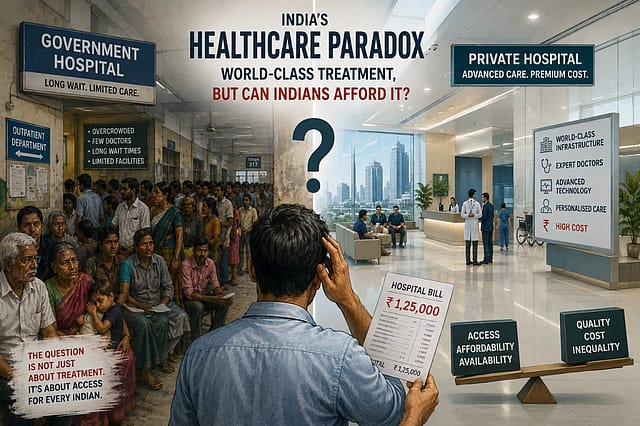
It is sad but true that government spending on healthcare in India remains abysmally low at around 1.43% of GDP. This is well below the 2.5% target envisaged in the National Health Policy, 2017.
This concern is highlighted in the 176th Report of the Parliamentary Standing Committee on Health and Family Welfare, titled “Affordability and Accessibility of Healthcare Facilities in Public and Private Sector.” Its 368 recommendations focus on cost caps, price transparency and insurance expansion to bridge the vast gap between public and private healthcare. At the heart of the report are two persistent problems: prohibitive out-of-pocket expenditure and structural inefficiencies.
Among its key recommendations are caps on costs for essential procedures and diagnostics; limiting the gap between the landing price of medicines and medical devices and their MRP; greater scrutiny of foreign investment exceeding 51% in hospital operational management; setting up Jan Aushadhi Kendras in district hospitals, Community Health Centres and empanelled private hospitals; expansion of low-cost standardised insurance products; and transparent billing before admission.
The Modi Years
02 Oct 2026 - Vol 05 | Issue 40
A Nation Rebuilt
Basically, everybody has diagnosed the problem correctly, but no holistic prescription has emerged over the years. Instead, India has adopted a piecemeal approach. My own view is that had healthcare become an electoral issue, as it frequently does in the U.S., government spending would probably have crossed 3% of GDP by now.
Healthcare in India is addressed indirectly through free insurance, medicines, mohalla clinics, subsidised treatment, ambulance services, maternity benefits and numerous state health schemes. These measures are important, but they cannot substitute for a strong public healthcare system.
The private sector has consequently been doing much of the heavy lifting as government hospitals remain overstretched. This demand-supply mismatch gives private hospitals enormous pricing power. According to the Parliamentary Committee's report, the average hospitalisation cost is Rs 6,631 in a government hospital compared with Rs 50,508 in a private hospital — nearly eight times higher. For childbirth, average out-of-pocket spending is around Rs 2,299 in public hospitals against Rs 37,630 in private facilities.
So, what really ails Indian healthcare?
There are essentially five mismatches: money, manpower, beds, geography and price.
India has world-class hospitals, doctors, pharmaceutical companies and sophisticated diagnostic facilities. But these resources are unevenly distributed. The best doctors and hospitals are concentrated in metros and prosperous Tier-I and Tier-II cities, whereas much of the unmet need lies in rural India and smaller towns. Dr Devi Shetty has repeatedly highlighted this lopsided development. There lies the nub of the problem.
The second issue is financing. Insurance largely takes care of hospitalisation, but healthcare expenditure does not end when the patient leaves the hospital. There are medicines, diagnostics and follow-up consultations. Out-of-pocket expenditure, which stood at 62.6% of total health expenditure in 2014-15, declined to 43.4% in 2022-23. That is progress, but serious illness can still financially cripple an Indian family.
According to IBEF, there lies a peculiar Indian paradox. India is among the world's least expensive destinations for a foreigner undergoing major surgery, with treatment costing 1/10th of comparable procedures in the U.S. or Western Europe. That explains the boom in medical tourism. Yet the same treatment can be prohibitively expensive for an average Indian relative to his income.
Another major problem is the demand-supply mismatch involving doctors, nurses and hospital beds. The doctor-population ratio has improved substantially, but shortages and, more importantly, geographical imbalances persist. The availability of hospital beds remains inadequate, particularly in the public sector.
For patients, this translates into long waits and overcrowding in government hospitals, forcing those who can afford it into private hospitals. The mismatch gives private healthcare providers considerable pricing power — and patients are invariably presented with hefty bills.
Can higher government spending solve everything?
Perhaps not everything, but it is certainly the starting point. India's public healthcare expenditure is far too low for a country aspiring to become a developed economy. By comparison, total health spending across OECD countries averaged around 9.3% of GDP, with public financing accounting for the bulk of expenditure in many developed economies.

India cannot replicate Western healthcare models overnight. But surely it can make quality healthcare more affordable, accessible and available.
India has spent decades building prestigious tertiary institutions such as AIIMS. The need of the hour is to strengthen district hospitals and make them the backbone of public healthcare. The Parliamentary Committee has suggested that medical colleges should increasingly be attached to district hospitals rather than being concentrated around established metropolitan centres.
The challenge is not merely producing another 100,000 doctors; it is ensuring that doctors are available where patients actually need them.
The Modi government has already moved significantly in this direction. The number of medical colleges has risen sharply from 387 in 2014 to 823 in 2025-26 while MBBS seats rose from 51,348 to 139,489.
It has also made medicines more affordable through Jan Aushadhi Kendras. As of June 30, 2026, there were 20,149 such outlets across the country, offering medicines generally 50-80% cheaper than branded equivalents. The government estimates that consumers have cumulatively saved around Rs 45,000 crore over the past 12 years.
Insurance penetration has also increased through Ayushman Bharat-Pradhan Mantri Jan Arogya Yojana (AB-PMJAY), which provides cashless hospitalisation cover of up to Rs 5 lakh per family annually to economically vulnerable families. The scheme has touched 12 crore vulnerable families. Coverage has also been extended to citizens aged 70 and above, irrespective of income.
As of June 30, 2026, 12.69 crore hospital admissions worth Rs1.92 lakh crore had been authorised under PM-JAY. By August 12, more than 45.5 crore Ayushman cards had been issued and over 38,000 public and private hospitals were empanelled.
The Modi government deserves credit for tackling several pieces of the healthcare puzzle. But it now needs to take a giant stride by raising public healthcare spending to 2.5% of GDP within a fixed timeframe and thereafter progressively towards 5%. To my mind, this is non-negotiable.
The Supreme Court has repeatedly held that the right to health forms an integral part of Article 21's guarantee of the right to life, placing an obligation on governments to provide adequate medical facilities.
There is no denying that healthcare in India is expensive. Indeed, falling seriously ill has almost become a luxury that millions of Indians simply cannot afford.
That raises the fundamental question: Why does a country well on its way to becoming a global medical and pharmaceutical hub still struggle to provide affordable healthcare to its own citizens?
That is India's healthcare paradox.