Global Rankings: Are Some Indices Stacked Against India?
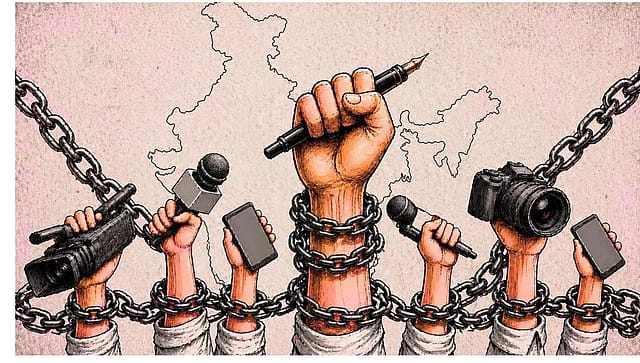
Recently, I came across a video on X relating to a protest by the Cockroach Janata Party (CJP) at Jantar Mantar in New Delhi. At the protest site, a woman in her thirties, who appeared to be a BJP sympathiser, was booed and heckled by a group of male CJP protesters. From the video, I could not decipher what had triggered the confrontation. Then one of the CJP activists, in an admonishing tone, asked her, "Do you know India's ranking in the Press Freedom Index?" Without waiting for an answer, he declared that India ranked 157th out of 180 countries, according to a report published by Reporters Without Borders. In characteristic aplomb, he reeled off more rankings to underline what he described as the Modi government's failures. He told the woman that India ranked 105th (to correct him, it is 102) on the Hunger Index and 85th on the Henley Passport Index (it is 75th).
Looking at his body language and bluster, one would have thought that Prime Minister Narendra Modi and his Council of Ministers had miserably failed the country over the last 12 years.
The issue, however, is not a wet-behind-the-ears CJP activist quoting global rankings and reading the riot act to the Modi government. The larger issue is that sections of the Opposition, civil society, some journalists and even bureaucrats conveniently pick statistics, studies and rankings that suit their narrative. Yet, when multilateral agencies such as the World Bank or the International Monetary Fund release encouraging data on India, the same people maintain a deafening silence—not even offering a grudging word of appreciation.

Zeroing In on ECI
09 Oct 2026 - Vol 05 | Issue 41
Constitutional legitimacy versus political opportunism
Similarly, when the Ministry of Statistics and Programme Implementation releases macroeconomic indicators such as GDP and CPI, the Opposition often accuses the government of manipulating the data or changing the base year to suit its convenience. Anything released by the Modi government is automatically viewed with suspicion—or so Modi's critics would have us believe.
What baffles me is that a section of Indian journalists also appears to accept these global rankings uncritically. Most know that the ground reality is far removed from the "Emergency-like situation" that some of these studies seem to portray.
How can India's Press Freedom index ranking be worse than Pakistan's or be placed so close to countries such as Syria, Iran and Afghanistan? It is indeed difficult to comprehend.
• Syria: 141st
• Pakistan: 153rd
• Egypt: 169th
• Afghanistan: 175th
• Saudi Arabia: 176th
• Iran: 177th
Surprisingly, India ranks lower than most of its neighbours, many of which have witnessed repeated political instability, coups, civil unrest or prolonged conflict.
• Nepal: 87th
• Sri Lanka: 134th
• Bhutan: 150th
• Bangladesh: 152nd
• Pakistan: 153rd
Having spent nearly four decades in journalism, I find it difficult to accept that India's position in the World Press Freedom Index accurately reflects reality. In my view, it suffers from confirmation bias. Therefore, a significant part of this column is focussed on the subject.
India has a vibrant and thriving media ecosystem. I cannot think of many countries that have over 1.55 lakh newspapers and magazines, more than 400 news channels, and over 3,700 digital news platforms operating in multiple languages. If the sole reason India's ranking is so poor is because Prime Minister Modi does not hold regular press conferences, while U.S. President Donald Trump addresses the media almost daily, then logically the United States should have figured among the top five.
For reasons best known to themselves, sections of the Western media have often been hostile towards the present government. This was evident during the Covid-19 pandemic, Operation Sindoor and even earlier when the Indian Air Force carried out strikes on Jaish-e-Mohammed camps. Likewise, a small section of our own media appears to have extra-territorial loyalties. But then, that too is part of a democracy.
What surprises me even more is that the United States—the Mecca of journalism—is ranked 64th in the Press Freedom Index. It is the world's oldest democracy, and in my four decades in journalism, I have rarely come across instances where politicians or businessmen routinely succeeded in suppressing stories across the American media. Yes, President Donald Trump has blacklisted certain media organisations. And yes, several American journalists have been killed while reporting overseas.
• Germany: 14th
• United Kingdom: 18th
• France: 25th
• Australia: 33rd
• United States: 64th
Ironically, the best countries in the world to study journalism remain the United States, the United Kingdom, the Netherlands, Australia and Canada. The U.S. is home to some of the world's finest journalism schools, offering unmatched access to major media markets and strong alumni networks. Yet, it ranks only 64th.
Likewise, the UK is renowned for its practical, newsroom-oriented training and remains an ideal destination for aspiring journalists because of institutions such as the BBC and Reuters.
The burning question, therefore, is: How reliable are some of these global rankings?
Personally, I have serious reservations about the World Press Freedom Index. Informally, many journalists appear to share similar concerns. The only period when India experienced formal censorship was during the Emergency. Without doubt journalists have faced pressure from politicians, businessmen and even the underworld. But that has always been part of the profession. Ultimately, journalists prevail only when their management stands firmly behind them.
To gain a broader perspective, I turned to AI and asked ChatGPT about the credibility of India's Press Freedom ranking. This was its assessment: "It is highly influential but faces significant criticism regarding its reliability, particularly from the Indian government and local think tanks."
More importantly, ChatGPT noted: "A large portion of the score comes from qualitative questionnaires sent to a relatively small pool of anonymous respondents, including journalists, researchers and human rights defenders. Critics argue that this introduces a high degree of perception-based bias."
That, perhaps, explains my own concern. A relatively small sample of subjective responses is extrapolated and triangulated to produce a global ranking that eventually shapes international opinion.
Closer home, I often say that the Indian media today is divided into three broad categories—Modi Media, Godi Media and Buddhi Media. Journalists in the first category get opportunities to interview Prime Minister Modi and his senior ministers. Those in the second category—who, in my view, often sit in the Opposition's lap—rarely get such access and are understandably unhappy.
What I also find curious is that in states such as West Bengal, Tamil Nadu and Maharashtra, when non-BJP governments were in power, ruling parties such as the Trinamool Congress, the DMK and the MVA frequently came down heavily on journalists who wrote against them. Yet many self-styled activist journalists appeared to turn a Nelson's eye, choosing instead to focus almost exclusively on the Modi government.
Several journalists in these states faced harassment, and FIRs were allegedly weaponised against some of them. Surprisingly, even journalists' bodies rarely issued strong protests or letters expressing concern about the so-called threat to press freedom. The case of Republic TV's Arnab Goswami immediately comes to mind.
Finally, since sections of the Opposition and the media often highlight only those rankings that suit their narrative, I decided to cherry-pick a few global indices that present India in a positive light.
India's Ranking in Major Global Indices
• Henley Passport Index: 75th (out of 199 countries). India has jumped 10 places since 2025.
• Global Firepower Index: 4th. The world's fourth most powerful military after the U.S., Russia and China.
• Nominal GDP Ranking: 4th ($4.19 trillion). Behind only the U.S., China and Germany.
• Global Innovation Index: 38th (out of 133 countries), reflecting India's growing strength in technology and knowledge services.
• World Competitiveness Index: 41st, measuring economic performance, government efficiency and business competitiveness.
• Climate Change Performance Index: 10th, placing India among the world's top performers.
Looking at these rankings, I am reminded of Victor Hugo's famous words: "Nothing is more powerful than an idea whose time has come." Perhaps the same can now be said of India.