El Niño Is Not Just a Monsoon Problem. It Is a Whole-Economy Risk
On June 11 this year, America's National Oceanic and Atmospheric Administration upgraded its watch to an El Niño Advisory, its formal notice that the warm phase of the Pacific had taken hold. Two months on, the language has hardened. NOAA now puts the probability above 90 per cent that this grows into a very strong El Niño, the tier that headlines call "super," by the winter of 2026-27. It goes further: it gives the October-to-December season a 69 per cent chance of an event that would exceed every El Niño on record since 1950.
For India, the reflex is to file this under weather and move on. That reflex is the problem. El Niño does not merely threaten the monsoon. It reaches into food prices, groundwater, power demand, rural spending and the Reserve Bank's room to cut interest rates. The question worth asking is not whether the rains will fail. It is what a climate shock does to an economy that is still, in the ways that matter most, built on rain.
The Modi Years
02 Oct 2026 - Vol 05 | Issue 40
A Nation Rebuilt
One thing has to be said at the outset, and it strengthens the case for concern rather than weakening it. El Niño raises the odds of a poor Indian monsoon. It does not decide the outcome on its own. A favourable Indian Ocean Dipole, thin snow cover over the northern hemisphere, or a well-timed spell of rain can all soften the blow. This is an argument about probabilities and preparation, not prophecy.
A little precision on the science helps. NOAA calls an event "very strong" when its Relative Oceanic Niño Index, which measures Pacific warming against the wider tropical average, reaches at least two degrees above normal. Only three events since 1950, in 1982-83, 1997-98 and 2015-16, have reached that top category. What makes 2026 unsettling is both its speed and its shape. The Pacific swung from a weak La Niña, through a brief neutral spell, into a developing El Niño inside a single year, a sequence last seen in the mid-1960s. And the eastern Pacific is already running hot: by July the easternmost benchmark zone had warmed to +2.9 degrees, even as the canonical central index that decides the official label sat at +1.4 and kept climbing toward the very strong mark. The engine is building, and the models expect it to peak between November and January.
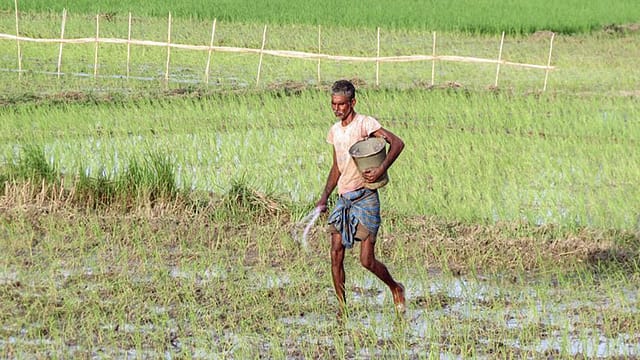
Why a shortfall of even a few percentage points should worry anyone comes down to how exposed Indian farming still is. Close to half the country's net sown area has no irrigation and lives on whatever falls from the sky, and the monsoon delivers about seventy per cent of the year's rain. In its end-of-May forecast, the India Meteorological Department placed the June-to-September rains at about 90 per cent of the long-period average and put the chance of a deficient season near 60 per cent, against a climatological probability of 16 per cent. It expected normal rain over the northeast, but below-normal rain over central, peninsular and northwest India. The season then opened badly, running about a third short through mid-June.
The number to watch, though, is not the seasonal total but the timing. A monsoon that averages ninety per cent can still ruin a crop if it vanishes during the flowering weeks of August and September, precisely when El Niño bites hardest. India's recent trouble has rarely been the headline figure. It has been the long dry spells that punch through the middle of the growing season.
This is where an El Niño year stops being a farm story. Trace the chain. A rainfall deficit sends farmers to their borewells, which lifts electricity demand for pumping just as reservoirs and hydropower run thin and the grid is already strained by heat. Weaker harvests mean thinner rural incomes, and thinner rural incomes drag on demand for two-wheelers, cement, soap and everything else that quietly leans on the village economy. And a poor kharif pushes up food prices, the single most sensitive number in Indian public life.
That last link creates the sharpest dilemma of all, and it lands at the Reserve Bank. A weak monsoon produces a supply-side inflation shock, driven by food, at the same moment it weakens rural demand and farm output. The central bank is then caught between two duties that pull in opposite directions: contain inflation, or support growth. El Niño does not just threaten a harvest. It narrows the country's room to manoeuvre on macroeconomic policy, which is why it belongs on the desk of the finance ministry and the central bank, not only the agriculture ministry.
None of this means India is helpless, and it is better placed than it was a decade ago. The agriculture ministry has flagged 150 to 200 high-risk districts and refreshed contingency plans that had gone stale. It has built up spare seed for re-sowing if early crops fail. Two good monsoons have left granaries well stocked, irrigation cover has widened, and crop insurance and mobile advisories now reach more farmers than before. The tools have improved. The habit of treating El Niño as a whole-economy risk has not caught up with them.
History counsels humility on both counts. The last comparably strong El Niño of the pre-industrial age, in 1877, coincided with a monsoon collapse that, worsened by ruinous colonial food and trade policy, became one of the deadliest famines the subcontinent has known. That was a failure of governance as much as of rainfall. More recently, two straight deficient monsoons in 2014 and 2015 ran into the super El Niño that peaked over the 2015-16 winter, and India came through on stored grain, rationing and imports rather than luck.
The lesson from both is the same. India cannot forecast its way to safety. Even the best models stumble at the spring predictability barrier, and the monsoon's local behaviour stays hard to pin down. What the country can do is prepare in ways that pay off whether or not this particular El Niño turns severe: water conservation and micro-irrigation on a war footing, drought-tolerant seed in every exposed district, early warnings that actually reach the last farmer, and grain reserves sized for a bad year rather than an average one.
The Pacific has sent its signal, and the odds behind it are unusually high. India has weathered such years before. The task now is to stop reading El Niño as a monsoon forecast and start treating it as what it is, a test of the whole economy's ability to absorb a shock it can see coming.