Where China remembers India’s wartime doctors
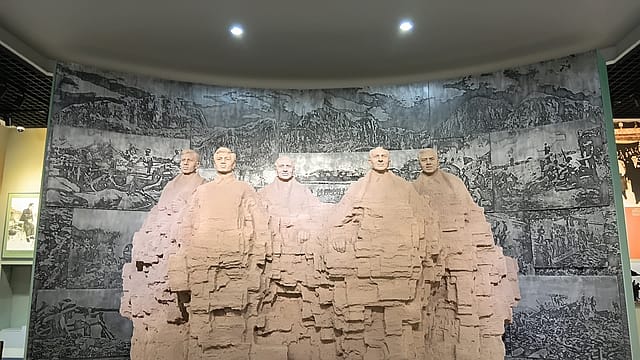
As we got off the bullet train from Beijing in the city of Shijiazhuang, our hosts from the city’s foreign affairs office told us that our first stop in the city would be the memorial to Dr Dwarakanath S Kotnis. The capital of the Hebei province has a population of over 11 million and, in many ways, is indistinguishable from other prosperous large cities that are spread across the length and breadth of China. Our destination, however, was one of the peaceful and revered places in northern China – the North China Military Region Martyrs Cemetery.
Dedicated to the heroes of the Second Sino-Japanese War or what is called the “War of Resistance Against Japanese Aggression” and the Chinese Communist Revolution, the lush green cemetery with its large pine and cypress trees is spread over 52 acres. When our local guides told us that the idea to establish a cemetery at this spot came from General Zhu De, I immediately thought of the book Call of Yanan, a compilation of the diaries of Dr. Bejoy Kumar Basu, a member of the five-member Indian Medical Mission that went to China in 1938. The long out-of-print book, published by the All-India Kotnis Memorial Committee, was dedicated to Zhu De (spelt Chu Teh) and the “Valiant Fighters of the Eighth Route Army” which fought against Imperial Japan.
The Modi Years
02 Oct 2026 - Vol 05 | Issue 40
A Nation Rebuilt
When I mentioned the book to our guides, they expressed a genuine sense of surprise. They’re probably used to Indian delegations visiting the cemetery and following the tour with a fair degree of attention and hearing in detail about the horrible events of the late-1930s and early-1940s without much prior knowledge. The Indian generation that watched the Hindi film Dr Kotnis Ki Amar Kahani in cinemas has long passed on and the memory of the 1962 Sino-Indian War lingers on in Indian public memory.
The supreme sacrifice of Dr Kotnis, who passed away at the age of 32 in the Hebei province in December 1942, is fondly remembered in both India and China. In fact, Chinese leaders have made it a point to visit the Solapur-born doctor’s family members whenever they come to Mumbai. What has gradually faded from public memory in both Asian countries are the details of the Indian Medical Mission and the role of the other four doctors who came to wartime China.
I managed to learn a great deal about these doctors, particularly Dr Madan Mohan Lal Atal, who led the mission and Dr Basu, who stayed on in China after Dr Kotnis died and left only in July 1943, thanks to extensive searches in different archives as well as getting a copy of Call of Yanan.
As we walked towards the grave of Dr Kotnis, we saw a white stone memorial statue of the Indian physician. Right behind the statue is a Chinese-style tomb that has his remains. When the young physician died in the city of Baoding he was buried in a nearby village, but his remains were later transferred to the cemetery in Shijiazhuang. Small Indian and Chinese flags are placed on the tomb, serving as a reminder that the doctor will always serve as a bridge between the countries.
Next to his tomb are samadhis to Atal and Basu. Both of them visited China in the autumn of 1957 for the celebrations of the country’s national day. Dr Atal started feeling unwell almost immediately after he arrived in the country and was hospitalised. He was diagnosed with advanced-stage cirrhosis and passed away on December 1. As per his wishes, half of his ashes were immersed at the Sangam in Allahabad, with the other half flowing in the Yellow River.
Chinese Premier Zhou Enlai, who visited Dr Atal, when he was hospitalised, attended the memorial service and said, “We will never forget the noble and precious support shown to the Chinese people by the great Indian people and their outstanding son, Dr Atal.”
Dr Basu learned Chinese traditional medicine in China in 1958 and set up India’s first clinic to use acupuncture in Calcutta. He was a member of the Communist Party of India and maintained his friendship with China until his death in 1986. In August 2025, the Chinese government honoured him with a commemorative medal for his contribution during the war.
On the walls adjacent to the tomb and samadhis, there are photos of each of the doctors of the mission, mentioning their name, year of birth and death in English and Chinese. There are also photos of eminent Chinese leaders such as Mao Zedong and Zhou Enlai with them.
As members of our group went inside the memorial hall that has some of the medical tools of the Indian doctors, photos and other memorabilia, I noticed a group of local visitors to the tomb. Briefly chatting with them in my very elementary Chinese, I found out that they were from the city of Nanjing and came to pay respects to Dr Kotnis. During the annual Qingming Festival (Tomb-Sweeping Day) in April, when Chinese people make ritual offerings to their ancestors, local officials and children lay wreaths and bow before the statue.
It was a truly moving experience to witness the sheer amount of reverence that China has for the members of the Indian Medical Mission. We were escorted to the section honouring Dr Norman Bethune, the Canadian thoracic surgeon who died from an infection when operating on wounded Chinese troops during the war. Like Dr Atal, the Canadian surgeon had also served in Spain during the country’s civil war, treating Republican soldiers who fought against General Franco’s troops.
Before leaving the cemetery, I overheard a gardener asking one of his co-workers where we were from and when he replied that we were from India, I approached them and confirmed. Again, in my limited Chinese and with the help of an online translator, I told them that the area was kept in impeccable condition. They smiled in a shy manner as a way of expressing their modesty, and were surprised when I asked to be photographed with them. On my visits to China, I have particularly been moved by the sheer dignity of older working-class people, who have witnessed the transformation of the country from far more difficult times. “Yindu Zhongguo Peng You (India and China are friends),” the gardener told me. I nodded as we bade goodbye.
As the early autumn sun was shining brightly over the statue of Dr Kotnis, I thought of this great man who simply refused to abandon what was described as “primitive conditions” and insisted on staying back in China despite Dr Atal trying to get Dr Basu and him to return to India in early 1940.
In Call of Yanan, Dr Basu describes a conversation between Dr Atal and Zhu De, when the latter suggested that the head of the medical mission leave for India without the two youngest doctors (the other two doctors had left China earlier):
“Dr. Atal still insisted that as leader of the mission, he was responsible for the safety of the two youngsters and could order them to go back to India with him.
The commander-in-chief got visibly irritated and took a sip of the tepid green tea and calmly said, ‘Dr Atal, we know you are a great anti-imperialist fighter, working to free India from British Imperialist rule.’ Dr Atal felt flattered. ‘After all,’ Comrade Chu continued, ‘Why do you want your country to be free?’ Before Dr Atal could formulate a suitable reply, Comrade Chu Teh emphasised, ‘Because British rulers have deprived you of elementary democratic rights. Let charity begin at home. Let these two young doctors exercise their democratic rights and you as an exemplary leader, concede to their demands. As for their safety, you may please inform the leaders of the Indian National Congress, that the Eighth Route Army will take full responsibility of escorting you safely out of our war zone, back to KMT rear area and thence to India.”
Apparently, Dr Atal was speechless and had to concede to this request.
More than eight decades after the Indian Medical Mission concluded, their legacy is marked in China with due reverence.
(Ajay Kamalakaran is an author and independent journalist with a special interest in Russia, the former Soviet Union, China and Sri Lanka)