Rules Made Elsewhere
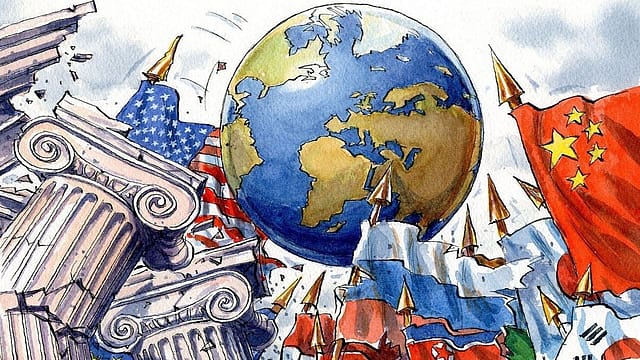
Before the Trump presidency, Americans talked a great deal about values in foreign policy, the Europeans other than the Nordics, less so, and the Asians, after Nehru, hardly at all.
The context of course is colonialism. During the imperial epoch, Western liberalism passed through several centuries of aberration when Europeans had control over power, concepts and yardsticks, at a time when Asian nationalism was impacted by colonial oppression. The overhang of imperialism now affects Asian perceptions of Western values because nearly all Western nations were implicated in the opening up of Asian markets. This historical experience, along with racial stereotyping and antagonisms, is a component of Asian nationalism and leads Asians to believe that the West deploys every resource to frustrate their rise.
Whereas Western liberals prioritise the individual over society and nation and the European Union has moved to certain degree of unity transcending national borders, Asians hold firmly to Article 2 of the United Nations Charter in respect of the sanctity of state sovereignty. Regime change and colour revolutions are unacceptable in Asia whereas for the West, the removal of an undesirable government by open or clandestine means always remains on the table, even in cases where the West is not directly affected. The default Western options are firstly sanctions and then the threat or use of force. Venezuela, Iran and Cuba are current cases in point.
The Modi Years
02 Oct 2026 - Vol 05 | Issue 40
A Nation Rebuilt
Western liberal interventions to export value and political systems to places like the Middle East, Afghanistan, Libya and Kosovo, all with negative outcomes, have undermined their validity; so-called humanitarian interventions are now viewed as failures to establish unofficial protectorates. The West nevertheless persists in believing that international cooperation can only take place under the auspices of a benign Western hegemon and liberal democratic models – though differentiating between unacceptable democrats and acceptable dictators.
The West persists in its self-promoting rubric of personal freedom and free speech over self-restraint, reason over religion, and the sanctity of individual human rights. Ever since the French Revolution, Western values have been secularised. But Asian countries, on the other hand, have a strong sense of religion, or rather, the civilisational impulses flowing from religions or spiritual traditions. Accordingly, the secular liberalism of the West often seems to Asians to be opposed to, or neglectful of, the realities of faith. A replay of Charlie Hebdo or Pussy Riot and the willful sacrilege and mocking of religious icons, would not be acceptable to the people or governments in Asia.
The unequal cultural factor will remain hard to eliminate. Asian countries, due to tradition, history and culture, do not accept every value promoted as liberal and universal by the West. In practice, of course, nations in every part of the globe are not known to pursue normative agendas at the expense of their national interest. Liberal values are put forward as a legitimising pillar of Western foreign policy, but many of the West's standards and norms are viewed in Asia as weakly disguised efforts to protect its hegemony, high-cost manufactures and export markets.
The West presents itself as not only norm-observing but norm-setting, emphasising legal and institutional procedures which they have fashioned and universalised themselves for compliance. No outside power was attempting to check the rise of the USA and the Europeans, and the allure of their markets made access to them conditional on acceptance of their value system. Eighty per cent of the standards of international commerce and global markets have been determined by the West in the areas of labour, governance, environment, sustainable development and international law. "The core of eurocentrism," writes Chinese academic Wang Hui, "was in establishing rules according to the Western interest and then universalising them."
There is tension between liberal universal values and local interpretations of universality, between the post-modern West and pre-modern Asia. For the West, the barbarians were always at the gates. Josep Borrell (former EU High Representative for Foreign Affairs and Security Policy and Vice-President of the European Commission) in 2022 stated "Europe is a garden. Most of the rest of the world is a jungle and the jungle could invade the garden." But the notion of a backward East and progressive West now have far less purchase in the global setting. To a great extent, India and China are responsible for that new perception. It will not be as easy for the "half-way liberal societies" as Jurgen Habermas called the West, to set the global agenda as it was even 50 years ago.
The Individual and Society
The values handed down through successive revolutions in the West, the English under Cromwell, the American, French and Russian, laid down the ultimate goal, the liberty of the individual, whatever the later distortions of this ideal may have been. But there is nothing identifiable as Asian values. Asia does not have the same political valency or discursive cohesion in all parts of the vast region denominated now as Asia. Because of the multiplicity of religious and philosophical traditions, values tend to be national rather than continental. There is certainly a uniform sense of identity from civilisation rather than the state, a work and saving ethic, a family-oriented community, emphasis on education that takes a high proportion of family disposable income, respect for age and hierarchy, and the interest of society over the individual. But the relationship of these with foreign policy is tenuous and nearly impossible to define. Suffice it to say that the important distinction with the West is that Asia does not seek, at least for now, to articulate any universal values or to prescribe and propagate them beyond national borders.
Many Civilisations
Liberalism, republicanism, socialism, communism, nationalism, human rights and multilateralism were all bequeathed to the world as foundational ideas by the West and exported to all parts of the world through imperialism. This has led in recent history to the mental block that other civilisational values might exist. Francis Fukuyama's predication of "the end point of mankind's ideological evolution and universalism of Western liberal democracy as the final form of human government" has been so internalised by the West that in practice, one size fits all. The world has subscribed to the Universal Declaration and the UN Bill of Rights but there cannot be any notion of equity when the West insists on the universality of its liberal norms. International law and rules-based procedures cannot never be grounded on the logic of hard power without
genuine multilateralism. The now declining influence of the West is evident in Europe's goals of peaceful settlement of disputes and free and open trade being in conflict with the America First policies of Donald Trump. We live in an increasingly non-Western world when it is an illusion for the West to claim centrality in world affairs.
Our focus in India should be on a multi-polar world order with the modernisation path ending in different trajectories, various spheres of influence and diverse ways of life. Globalisation will not make political systems more liberal or democratic, and few today can believe in any universal political confluence overcoming particular national interest. Democracy has its own ethnic and cultural characteristics; a more democratic Pakistan or Turkey may be more Islamist, a more pressurised Russia, China or India may become more nationalist and authoritarian. The community of liberal democracies never existed when it came to Asia. In the future we may have a world where national borders become increasingly diffuse, but cultural and civilisational variations are not, creating a permanently unstable compound of heterogenous elements. This is what calls not for convergence, but a greater understanding of the values that underpin public policy.
(Krishnan Srinivasan is a former foreign secretary)