EXPLAINED | Ukraine’s ‘Peaky Blinders’ Hunt Russian Drones. What Does It Cost to Defend a City?
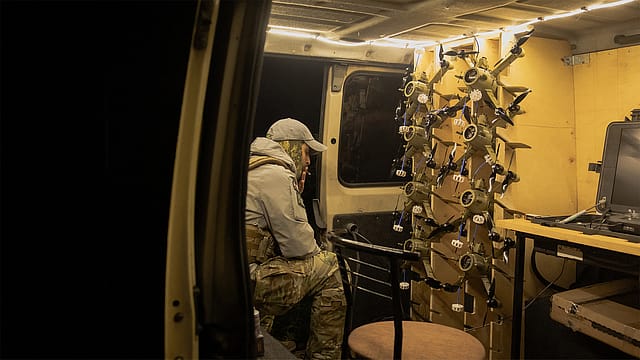
Russia and Ukraine returned to US-mediated talks in Abu Dhabi on November 10 after nine months. A BBC dispatch from Slovyansk, a Ukrainian-held city in the eastern Donetsk region, follows a unit nicknamed the Peaky Blinders that tries to stop Russian drones before they reach their targets. On the day the talks opened, Ukraine’s foreign minister asked Washington to speed up deliveries of air-defence interceptors. How long can a country afford to keep defending its cities from waves of attacks?
Why does Russia want Slovyansk?
Slovyansk, also spelled Sloviansk, is part of a chain of four industrial cities that anchors Ukraine’s defence of Donetsk. The others are Kramatorsk, Druzhkivka and Kostiantynivka. Together they’re known as the fortress belt because the cities and the area around them have been heavily fortified. Russia claims the entire Donetsk region and wants Ukraine to withdraw from the parts it still holds. Giving up the belt would mean surrendering a major line of defence as well as the cities themselves.

The Wealth Issue 2026
06 Nov 2026 - Vol 05 | Issue 45
Portraits of Dreamers and Doers under 35
Who are Ukraine’s Peaky Blinders?
They’re a drone unit in Ukraine’s National Guard special forces. The name comes from the British television series, and their emblem features the show’s familiar flat cap. One of the unit’s jobs is to intercept Russian drones.
Why can a cheap drone be so expensive to stop?
An interceptor is a weapon sent to stop an incoming threat before it reaches its target. When an attacker can send large numbers of relatively cheap drones, a defender can draw down costly missile stocks responding to repeated raids. Interceptor drones give defenders another option. In April, Reuters reported that Japanese company Terra Drone was quoting about $2,500 for one Ukrainian-designed interceptor drone it was marketing abroad.
That figure buys one aircraft. The bill for a successful interception also includes the people and equipment that keep watch, plus the cost of attempts that miss. Over a long campaign, there’s another question. How quickly can the equipment used tonight be replaced? A cheap interceptor can help with that arithmetic, but the price quoted by a supplier tells us little about what Slovyansk spends to defend itself.
Why does Ukraine still need missile defences?
A raid can bring several kinds of threat at once. Glide bombs are dropped from aircraft and can travel towards a target after release. Ballistic missiles can approach at much higher speeds than the slower drones that many low-cost interceptors are designed to stop. Reuters reported that Ukraine was short of weapons to stop fast-moving ballistic missiles and jet-powered drones in November. This is why it can develop cheaper drone defences and still ask Washington to send more air-defence interceptors.
What does an attack on the power grid cost civilians?
A single strike can cut power to people far beyond the site that was hit. A substation helps distribute electricity to homes and businesses. Ukrainian officials said Russian attacks overnight into November 10 targeted five major substations and killed two people. The grid operator reported outages in six regions. As winter approaches, getting the electricity back on is part of protecting people too.
Why did Gulf countries turn to Ukraine?
They faced a threat Ukraine had already spent years dealing with. Russia uses Iranian-designed Shahed attack drones, and Iran fired drones of the same family at its neighbours during the 2026 war. In March, President Volodymyr Zelenskyy said Ukraine had sent specialists to the UAE, Saudi Arabia, Qatar, Kuwait and Jordan. In April, the Japanese supplier told Reuters that the UAE and Saudi Arabia were exploring a cheaper Ukrainian-designed option as Iranian attacks drew down missile stocks.
What did the Red Sea teach the US Navy?
Defending shipping for months can run up a large bill even for a well-equipped navy. In April 2024, US Navy secretary Carlos Del Toro told senators that recent expenditure on munitions was approaching $1 billion and asked for funds to replenish stocks. That spending covered a wider set of engagements, including the defence of shipping against Houthi drones and missiles. An expensive interception can still make sense when a ship and its crew are at risk. Sustaining that defence is the budget question.
Where has India faced the same problem?
During Operation Sindoor, India said Pakistan had tried to hit military targets in northern and western India with drones and missiles on the night of May 7–8, 2025. The Indian defence ministry said a network of anti-drone and air-defence systems stopped the attacks. India’s account illustrates the same problem of different threats arriving in a single episode. Ukraine’s challenge adds years of repeated attacks and the strain of replacing supplies through a long war.
Could the Abu Dhabi talks bring a pause in attacks on the grid?
A pause on strikes against energy infrastructure is among the steps Ukraine says it is prepared to discuss. The first day ended without an announced ceasefire, and a second day was scheduled for November 11. Kyiv wants a ceasefire to open the way to wider negotiations. Moscow wants the outlines of a broader European security deal discussed first. An agreement on energy strikes would give repair crews and households some breathing room. Slovyansk’s future would still depend on what the parties agree about territory.