Dalit Politics and the Limits of Power in Tamil Nadu
From Ambedkar to Uttar Pradesh’s Ravan, Dalit leaders have always had an uphill struggle to gain even a modicum of progress for their community.
Barring Babasaheb himself, the rest have not exactly been able to achieve a broad spectrum acceptability even when they seek to voice the grievances of the marginalized as a whole. Kanshiram’s bahujan experiments did yield some limited dividends, but Mayawati’s greed and quirks have only rolled back the clock yet again. With the reascent or consolidation of the savarnas in the Modi era, the Dalits find what little political power they had achieved being steadily whittled away. Of course the same could be said of Muslims, their persecution getting progressively vicious.
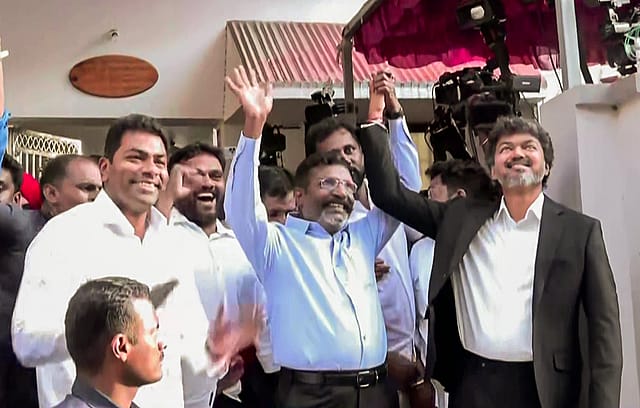
But this column will confine itself to Dalits, particularly of Tamil Nadu, in the context of the short-lived brouhaha over reports that Thol Thirumavalavan of the Viduthalai Chiruthaigal Katchi (VCK) was angling for Chief Ministership or at least the Deputy position, even though his party had won just two seats in the 234-member house – in a hung assembly anyone could seek to vault a great height, and his position as a Dalit leader was seen to provide some heft to his claims, when apparently the two major Dravidian parties, the DMK and the AIADMK, wanted to stall actor Vijay’s fledgling Tamilaga Vetrik Kazhagam from forming the government even though it had emerged the largest single party.
Losing Memory
16 Oct 2026 - Vol 05 | Issue 42
The making of a medical and social emergency
Nothing of course came of it all predictably, for one, the combined strength of the Dravidian parties was nowhere near the majority required, and secondly it would have been laughable for Vijay to cede Chief Ministership to a two-member Dalit party, or even Deputy Chief Ministership. A Dalit leader breathing down his neck all the time would have been too much to bear for him, even otherwise what message such an august position for a marginalized caste would have sent to the OBCs lording it over for decades?
So after a few days of humming and hawing, once even seemingly going underground, not accessible for anyone, particularly for an anxious TVK, Thirumavalavan eventually surfaced to hand over the letter of support.
Predictably many partisans went on an overdrive, crying foul, lamenting that even after nearly eighty years of Independence, so-called progressive states too were reluctant to welcome a Dalit Chief Minister.
But then the bitter truth is barring Ambedkar himself, and to some extent Kanshi Ram, none of the Dalit leaders have exactly been sincere in their claims of working for the empowerment of their long-suffering community, and there is nothing much to grieve over their fate.
But there is a chorus of praise for Thirumavalavan, projecting him as some kind of a latter day Ambedkar and claiming if he hasn’t been able to do much, it is essentially because of the harsh realities of the milieu in which he is operating.
But that is not true. He has come a long way since his political baptism of the late nineties, while the other major Dalit leader of the times, Dr Krishnasamy of Puthiya Thamizhagam, commanding influence essentially among the Pallar segment, has fallen by the wayside.
Actually Thirumavalavan’s current stature is attributable more to his Parayar origins – that community is widely distributed in the state, unlike the Pallars, broadly confined to south and central regions.
Also he is a lot more politically savvy, knows how to negotiate his way in an OBC-dominated electorate, whereas Krishnasamy is perceived as very arrogant and anyway casting his lot with BJP at one stage has lost much of the goodwill he used to enjoy. He failed to win anywhere this time and is considered a very marginal player.
Thirumavalavan’s VCK first tried an alliance with the Pattali Makkal Katchi (PMK), representing the interests of Vanniars, a populous OBC of northern and central districts, it was indeed a masterstroke of sorts, for Vanniars and Paraiyars are generally hostile to each other, and so the coming together of the two parties could usher in a new dawn, it was hoped.
But quickly PMK founder Dr Ramadoss backtracked and the VCK slowly veered towards the DMK and stuck to it, managing to get a few elected to the assembly, thus strengthening its legitimacy as a representative of a major segment of the Dalits.
Unfortunately though, even as he gained ever greater political mileage, Thirumavalavan only belied the fiery rhetoric of his early days, waffling, and didn’t go beyond mouthing platitudes, only complaining that Dalit outfits are not accorded their due by the major parties.
Interestingly he did a lot of sabre-rattling as a champion of the Liberation Tigers of Tamil Eelam (LTTE) of Sri Lanka, but there was not a single significant initiative against the disabilities faced by the Dalits everywhere.
While jumping into the Tiger rebel bandwagon seemed to enrich the VCK coffers, its functionaries began to acquire notoriety as some kind of dons wherever the Parayars are in some considerable number. They even have a TV channel.
Major political parties, controlled by OBCs, could be held responsible for using the VCK to serve their own ends while conveniently turning a blind eye to problems encountered by the Dalits at various levels, even drawing water from a common source is dicey, and in many places tea is served in separate glasses.
No effort is ever made to reappropriate the ‘Panchami’ lands, gifted by our erstwhile colonial masters but since taken away from the Dalits through devious means.
Upper and intermediate caste families literally get away with murder when Dalit boys dare marry or even fall in love with their girls. Why in almost the entire rural Tamil Nadu, Dalits of any and every denomination still live in their own ghettos and there are no common cremation grounds. But barring sotto voce grumblings, rarely is any sustained protest campaign organized.
If Dr Krishnasamy, the Pallar leader mentioned earlier, could be largely to blame for refusing to forge an alliance with the Parayar outfit to fight in their common interests, the VCK itself doesn’t care too very much for the Arundhatiyars, the lowest of the low among the Dalits. No functionaries are drawn from them, and one will not get to see VCK flags in Arundhatiyar colonies.
Not many know that at one stage Thirumavalavan eyed taking to films full time, mercifully his maiden venture flopped.
Ace film director Pa Ranjith is trying to emerge a Dalit leader, organizing workshops, musical events, libraries and so on, but apart from the film glamour he can exploit, he is not able to mobilize much.
There are odd localized Dalit outfits which can channel votes in any direction they want – thus political power is there a bit, if not too very much and Dalits have inched up the social hierarchy, no doubt, but it all remains disparate and incoherent.
In a way Periyar E V Ramasamy, the iconoclastic founder of the Dravidian movement, had set the tone for the Tamil polity, prioritizing the interests of the non-Brahmins - the Dalits themselves did deserve a free life, yes, but nothing should be done to upset the broad coalition he was mobilizing against the Brahmin hegemony.
Consequently since 1967 the DMK and the AIADMK have been ruling the state uninterruptedly, both claiming Periyar’s legacy, the Dalits themselves are only incidental to their agenda of power. And no Dalit leader or outfit is willing to challenge this blatant injustice and prefer to extract what best they could by being on the right side of the rulers, always composed of the dominant non-Brahmin castes.
Unfortunately Thirumavalavan is no exception either and hence tears shed over his being ‘ignored’ in the recent power tussle are pointless bleeding hearts.
The TVK, the new ruling party, has a number of Dalit MLAs who have won from general constituencies, but that doesn’t make it any great champion of the downtrodden. In any case, it has nothing much to speak of as its ideology and is merely coasting on the crest of the charisma of Vijay and on the popular discontent with successive regimes.
Concerned intellectuals tend to be apologetic and gloss over the greed and the failings of the Dalit leaders, instead of trying to push them all together to get under one common umbrella.