India’s Transport future may belong to Flex-Fuel vehicles
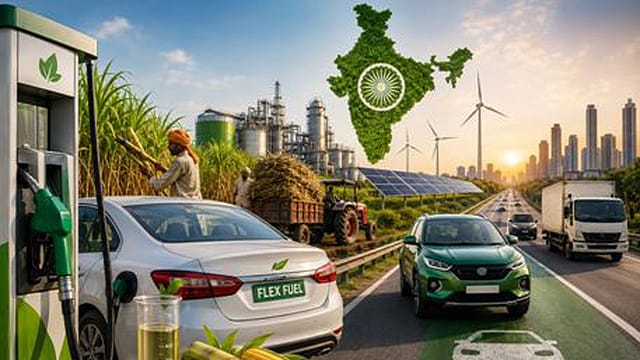
For the better part of the last decade, the conversation around the future of mobility has been dominated by one narrative: the end of the internal combustion engine era is high, and electric vehicles (EVs) will replace gasoline and diesel-fueled transportation. Governments set ambitious targets for electrification, car makers poured billions into battery technology and investors saw EVs as the inevitable future of road transport.
India’s energy revolution, however, is taking a different route. While electric vehicles are getting the focus, regulators are actively pushing flex-fuel vehicles (FFVs) that get far less attention. FFVs that can run on gasoline, ethanol, or varying blends of the two are becoming a key element of India’s broader goal to cut oil dependence, improve energy security and spur rural economic development. The growing interest in flex-fuel technology reflects a reality often omitted from the clean transportation discussion. The energy transformation in India is a matter of more than climate concern. It is also a geopolitical, agricultural and development issue. The solutions that work in Europe, North America or China may not work for India’s unique economic and social characteristics. The appeal of flex-fuel vehicles is that they can meet a variety of policy objectives at the same time.

Zeroing In on ECI
09 Oct 2026 - Vol 05 | Issue 41
Constitutional legitimacy versus political opportunism
India still depends heavily on imports for its crude oil. More than 85% of crude oil needs of the country are sourced from abroad, leaving energy security vulnerable to global market volatility and geopolitical upheavals. We have seen again and again how shocks from abroad can hit home fuel prices and economic stability – conflicts in the Middle East and delays in maritime trade routes, for example. Therefore, the reduction of oil imports has become a strategic goal. The Ethanol Blended Petrol Programme has been one of the most successful government initiatives in this direction. In the past decade, India has significantly increased the amount of ethanol blended in petrol, to levels never seen before. Ethanol, which is primarily produced from sugarcane and other agricultural feedstocks, is becoming an increasingly important part of India’s fuel strategy.
Flexible-fuel vehicles are the next logical step in this evolution. Conventional vehicles are designed to run on specific types of fuel . FFVs , however , are designed to run on anything from regular gasoline to high-ethanol fuels like E85 ( up to 85 % ethanol content ) . Modern engine management systems automatically adjust the fuel injection and combustion parameters to suit the fuel mix. From the driver’s point of view, the change is mostly smooth. It is attractive to politicians because it makes use of existing infrastructure rather than replacing it outright. The biggest barriers to EV adoption are new charging infrastructure, battery supply chains, and changes to the grid. Electric mobility is growing fast in India, particularly in the two-wheeler and three-wheeler segments, but there are still huge gaps in the infrastructure. At times charging availability and reliability can be a challenge in rural and small communities.
Flex-fuel vehicles are not subject to those restrictions. They use proven production capabilities, existing refuelling systems and mature technology. This can make the transition smoother and less disruptive. But the case for flex-fuel vehicles is about more than just transportation. India’s ethanol plan is at its core also an agriculture plan. The ethanol business creates demand for agricultural feedstock and hence aids in the revenue streams of farmers and sugar mills. Another economic possibility for a country in which agricultural incomes remain volatile is ethanol production. This presents a rare confluence of energy ambitions and rural development goals to ponder for policy makers. The political appeal is obvious. Every litre of ethanol made in India will reduce the need for crude oil imports and add to the rural economy of India. This is in contrast to EV supply chains, which remain highly reliant on imported critical minerals and battery components. Lithium, cobalt, nickel and rare earth metals are now critical resources in the global energy transition. The control of these supply chains is increasingly concentrated in a handful of countries, creating new dependencies even as countries try to reduce their dependence on oil.
In this respect, ethanol is an indigenous energy resource. But the excitement about flex-fuel vehicles should not obscure some serious challenges. One issue is the long-term sustainability of feedstock production. Most of India’s ethanol business is based on sugarcane, which needs a lot of water. As climate change worsens water scarcity in much of the country, growing concerns exist about the long-term sustainability of large-scale sugarcane agriculture. The problem is a microcosm of a larger problem in the energy transition. The efforts to reduce dependence on one resource often lead to an increased reliance on another. For ethanol, there is a risk that the pressure on land and water resources will be increased if oil consumption is reduced.
Food-energy competition has also been a concern. Though India has taken steps to utilize surplus agricultural produce for ethanol production, future expansion may pose difficult problems of resource allocation between food and fuel systems. Environmental benefits also need to be carefully assessed. Ethanol is often hailed as a cleaner alternative to traditional fuels, because the CO2 produced from its combustion can be partly offset by the carbon absorbed during crop growth. However, the real emissions profile depends on the growing practices, fertiliser use, irrigation needs, transportation distances and processing methods. The environmental benefits of ethanol adoption are not automatic, but are a matter of how the entire supply chain is managed.
There’s another barrier: infrastructure development. India has made impressive progress in ethanol blending, but the large-scale use of high-ethanol fuels will require substantial investment in storage facilities, distribution networks and fuel retail systems. Car makers will also have to increase production of cars designed to run on higher percentages of ethanol. But the larger question is whether flex-fuel vehicles should be considered competitors to electric vehicles at all. The most likely answer is no. The Indian transport sector is too vast, diverse and unevenly developed for a single technology solution to dominate all segments. Long-haul freight operators, urban commuters, rural residents and commercial fleets all have different economic and infrastructure issues to deal with. This variability has prompted governments to increasingly support a multi-pathway approach to decarbonization. Inner city transport is expected to be dominated by electric vehicles. Green hydrogen is considered as an option for hard-to-abate sectors. There is room in the broader ecosystem for biofuels, compressed natural gas and flex-fuel technologies.
India appears to be chasing both EVs and flex-fuel vehicles, rather than opting for one or the other. It is a pragmatic understanding of the development realities of the country. Energy changes are seldom straightforward. They are driven as much by economics, politics, infrastructure constraints and resource availability as by technology progress. So, the future of mobility in India won’t be a mirror-image of binary debates that dominate global conversations. Instead, it is probable that a variety of technologies will co-exist, each serving a different set of needs and constituencies. Flex-fuel vehicles may not be a replacement for electric vehicles in the future. They do not have to, however. They are relevant because they provide India another route to energy independence, reduced emissions and less dependence on imported oil. Flex-fuel technology is one such experiment to watch at a time when countries around the world are searching for resilient and politically feasible ways to make the transition.
India’s energy transformation will not be a function of any one vehicle, fuel or technological breakthrough. It will depend on its ability to synthesize disparate ideas into a strategy relevant to the specificities of the country. Flex-fuel vehicles are becoming one important piece of the larger jigsaw.