National Talisman: Modi has made the Sangh’s ideology electorally marketable
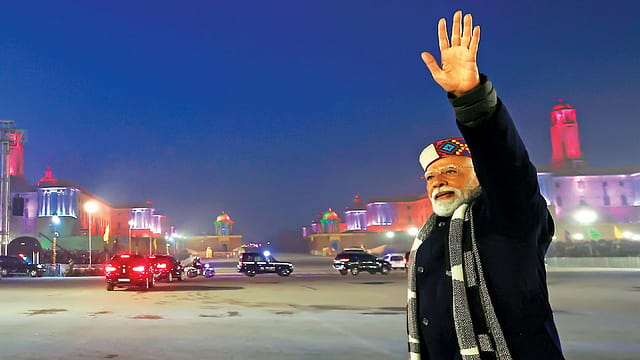
PURISTS WILL TELL YOU that it is heretical to compare professional cricketers plying their trade in different eras. The almanacs that compile “all-time great” rankings may make for great headlines but do a disservice to both the game and the individuals who play it. And because cricket is more than a game, this thumb rule might also logically extend to other contexts. So, if one were to play with the proverbial “straight bat”, then it would be unwise to draw comparisons between India’s first Prime Minister Jawaharlal Nehru and incumbent Narendra Modi. This, even when the moment occasions such a comparison, as Modi becomes the first elected Indian prime minister to serve more days in office than the previous record holder, Nehru.
Even more remarkable is that Modi is the first non-Congress prime minister to have served three consecutive terms in office. During two of the three terms, 2014 and 2019, Modi’s government enjoyed formidable majorities. Modi’s first term snapped a three-and-a-half-decade-long unbroken stretch that saw rickety coalitions dominate the Centre. Astonishingly, Modi’s approval ratings are just as high as they were when he was first elected to office.
This is a comment on the durability of the Modi brand. Its enduring appeal is built on successfully combining pro-market economic reforms and infrastructure-led growth with technology-driven, targeted welfare programmes to ensure widespread financial inclusion and social support. Public faith in the “Modi model” has meant that 70 per cent of Indians residing in two dozen states have entrusted BJP directly or indirectly, as part of NDA, with responsibility for governing their day-to-day lives.
But Modi’s story isn’t only about political dominance acquired through massive mandates. While Modi has catapulted BJP from being a Hindi-belt party to a pan-India force, the default party of governance, his real genius lies elsewhere. Electoral victories can be reversed. Ideological shifts endure across generations. Modi has reshaped India’s political landscape by ensuring that RSS’ core dogma is now electorally marketable.
The consequence has been transformational. India now posits itself as a civilisational power and is arguably no longer apologetic about its Hindu dharmic roots. This constitutes a clean break from Nehru’s view. The grandee of the Indian freedom movement viewed India not as a monolithic cultural entity but as a diverse society.
It is often observed that in his seminal book, The Discovery of India, Nehru championed the idea of a synthetic, inclusive culture.
Nehru’s civic nationalism is not the same as RSS’ cultural nationalism. Founded in Nagpur in 1925, RSS is a cultural and socio-political organisation that serves as the ideological mentor to the ruling BJP, of which Modi is the mascot.
BJP under Modi has channelled the RSS vision into the mainstream. Today, the talk centres around dismantling appeasement politics and the consequent edification of a selective secularism. In practice, this means BJP campaigns to end state-backed laws and policies that, in the guise of the Nehruvian precept “unity in diversity”, advantaged minorities at the expense of the Hindu majority. The state also promotes “Bharatiyata”, a byword for an identity rooted in “Hinduness”. It is not uncommon for senior RSS ideologues to describe India as a “Hindu Rashtra”. Modi has often leaned into this concept, but always adding the caveat that the Sangh’s and BJP’s Bharatiyata has evolved from India’s Sanatani heritage, inspired by a dharma that is at once universal and inclusive.
A consequence of BJP unapologetically embracing the concept of a dharma-centred Bharatiya identity is that the state under Modi is often accused of majoritarianism. Modi’s critics will often resort to terms like “Hindu Pakistan” to suggest India is well on its way to becoming a “Hindu Rajya” where minorities will be constitutionally disadvantaged. While this debate might rage, there is little doubt that India has truly stepped out from the old to the new. Bharat’s reclamation of its civilisational heritage will ensure that Indian polity remains rooted in an Indic cultural nationalism long after Prime Minister Modi— the talisman of Bharat—demits office.