Modi As Democracy's Bestseller
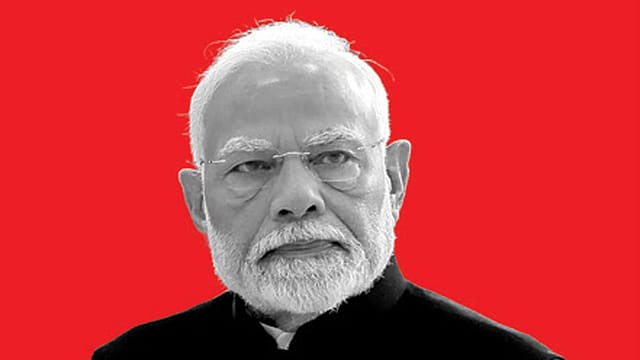
TWELVE SUMMERS AGO, everything changed for India. When he stormed in, as the true outsider before the term began trending in a world disrupted by Brexit and Trump, India was a different place, still steeped in the last residues of Nehruvian-Soviet vintage, and where Indians as a people were tentative about defining themselves in the context of their cultural inheritance. Those were the last days of the acquired habit of Indians resisting an identity that was not tailormade for them by a ruling class that knew better. They knew better what India or Indians ought to be: a lab-perfected country immune to the primordial instincts of its inhabitants. He stormed in to change all that.
Twelve years in power and the most enduring prime minister in an unforgiving democracy is still the man choreographing change. And this is happening at a time when, elsewhere, leaders elected with massive mandates are either shrinking to a size smaller than what history gave them once or hopelessly struggling to postpone political mortality. Power corrodes; excessive power, even if validated by democracy, ends legacies unless wielded with the finer instincts of leadership and a better awareness of the cultural currents beneath the mandate.
Narendra Modi is still there as the helmsman of an India that has not stopped updating its place in the world or its conversation with the past because his own leadership is not static. This is something harder to find in today's world where the distance between the leader who has squandered the mandate and the country is growing so fast that, increasingly, words such as decency, credibility and trust have become incompatible with power. Modi's own evolution in power is in perfect harmony with India’s. The man, the message, and the medium become one.
And it is being played out in a post-ideological India. It is not that, after the reign of borrowed isms, Indian politics has abandoned ideology. BJP may be an ideologically self-conscious party, drawing its sustenance from India's civilisational memory. The government that Modi heads is not ideologically driven. It is ideas-driven.
For any number of reasons, it can be said that India is not governed by a rightwing government, no matter the party that powers it is very rightwing. It is not a contradiction but a consolation because the prime minister, moderniser as administrator and conservative as cultural restorer, has separated governance from his ideological beliefs without diluting either. Something his socialist predecessors could never achieve.
Modi's government is more centrist than rightwing. Twelve years ago quite a few of his ideological endorsers expected him to be a Reagan or a Thatcher in India’s moribund marketplace. Their sentiments were noble: after all, the history of prosperity is written by private enterprise, and apostles of equality cannot deny this without admitting the human cost of socialism. That said, a hugely uneven country like India could not have allowed the state to retreat from the marketplace completely. The question before Modi, who had already made Gujarat a model state of development, in 2014 was: Could he be a compassionate capitalist without being a socialist? Could he reignite the entrepreneurial spirit of India and let the poor too dream?
The dilemma was a creative challenge, and from which was born Modi the gradualist. A nationalist who was not entrapped by ideology but excited by ideas, Modi, unlike the socialist nation builders, saw India not as an experiment but as an emotional engagement. The India story is still a thriller for him, extending from the countryside to the corporate world. He straddles many Indias because the tomorrow he imagines for each of them adds up to an ideal.
It is perhaps the most widely shared ideal in a democracy, and the man who has made it possible continues to be rewarded for his creative process without pause. The very relentlessness of this project in renewal is the measure of a politician for whom power is not an entitlement but a necessity. The preservation of power is a permanent struggle, and that is why Modi's campaign for India is not entirely electoral. Every day in power is just another passage in his argument for India. He keeps winning. The counter-arguments, the polyphony of anyone-but-Modi, have no political clarity or cultural content. They are so struck by the idea of Modi that they cannot even tell us what kind of India they are fighting for. India is still beholden to him, which is a mark of how democracies are validated by their most ingenious practitioners. India’s longest-serving continuously elected prime minister is uninterrupted in his journey for the obvious reason that India finds its most ambitious futures—and its most enchanting past—in his arguments even as the country consistently rejects the ventriloquism of his opponents.
It is the originality of the storyteller that makes India a bestselling story told in a democracy today. To Narendra Modi’s delight, a majority of Indians find their own possible versions in the image of the narrator.