After the Party: What India's Student Protests Reveal About Politics
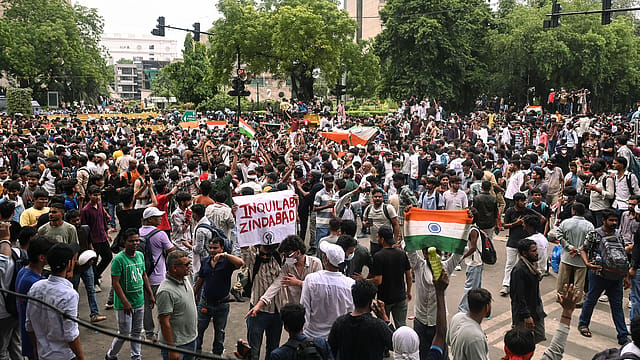
The recent student protests in Delhi and other Indian cities were part of national as well as global history. In national terms they belong to a genealogy of mobilisation going back to the India Against Corruption movement of 2011, in which several of today’s student leaders cut their political teeth, followed by the anti-CAA protests of 2019 and the farmers’ protests of 2020-21. In global terms the student protests are part of a wave of mobilisations that include the so-called colour revolutions of Eastern Europe and Central Asia as well as the Arab Spring uprisings. Among these are the specifically subcontinental protests which brought down the Sri Lankan government in 2022, the Bangladeshi government in 2024 and the Nepalese government in 2025.
While they arose in different circumstances and had varying demands, these movements have all targeted states seen as being corrupt and repressive. But it is not so much the similarity of their causes that I find interesting as their emergence outside institutional politics. Only one of them, India Against Corruption, led to the founding of a new political party. Today’s Cockroach Janata Party, by contrast, exists more as a parody name for a network than as a political party, and is in this way more like other mobilisations around the world than the Aam Admi Party. What does this inability or refusal to enter institutional politics by joining or founding parties tell us about these new mobilisations?

Zeroing In on ECI
09 Oct 2026 - Vol 05 | Issue 41
Constitutional legitimacy versus political opportunism
On the one hand we see the hollowing out of political parties all over the world. No longer linked to specific economic interests with the decline of the working class in post-industrial societies, parties can now appeal to all manner of changing and single-issue constituencies, even abandoning one base for another. This allows them to be taken over from old elites by outsiders in the way that Narendra Modi took over the BJP or Donald Trump the Republicans. On other hand old political parties can suddenly collapse and new ones suddenly rise to power as has been the case in countries as diverse as France and Nepal. This suggests the crisis if not decline of the political party as an organizational form.
Yet by avoiding party politics these great mobilisations might be able to unseat governments but cannot replace them with anything very different. In the Middle East and Eastern Europe, which have little experience of democracy, this has often led to military and other forms of dictatorship, while in the subcontinent such revolutions can actually be termed restorations since they put one party in the place of another. This is the case for Bangladesh, for instance, where the ousting of the Awami League led to the election of the BNP within the same political system, which is also what happened in Nepal and Sri Lanka. These governments might be better than the ones overthrown but are not otherwise very different from them.
The palpable suspicion of political parties was evident in the student protests, which, like the anti-CAA ones, made only for very indirect forms of support by opposition parties. Yet these movements still make use of slogans and icons which had historically belonged to such parties but from which they have been separated. Particularly important are Leftist terms and ideas like revolution or inqilab, though they no longer retain their original meanings. It is almost as if the new movements are in search of an equally novel political language but are forced for the moment to repurpose old ones. Their mobilisations can be seen as experiments in the making of a new politics beyond the party form.