“We Will Never Be a Mass-Market Brand”: Ferrero India's Zoher Kapuswala
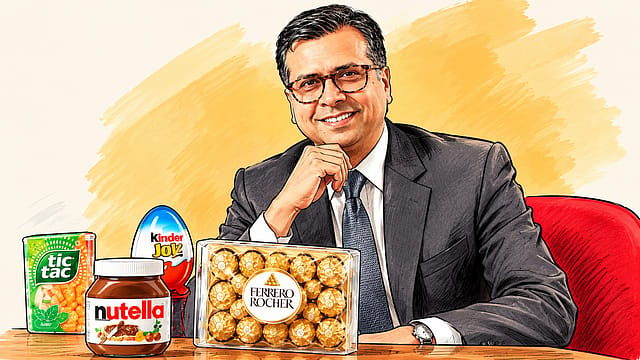
A chocolate brand can be popular without being an everyday purchase. For Ferrero, that is both the opportunity and the challenge in India. Its portfolio spans products with very different consumer propositions, from Ferrero Rocher and Nutella to Kinder Joy and Tic Tac. But building familiarity is one thing; getting consumers to buy across brands, formats and occasions is quite another.
The Italian confectionery major is now looking to widen that relationship. Ferrero Rocher Bars take one of its best-known brands into a new format, while a limited-edition Diwali pack brings a local festive dimension to its portfolio. These are part of a larger push to expand distribution, acquire new consumers and build a more sustained business in India, which is among the group's fastest-growing markets globally.

The Era of Forever Wars
30 Oct 2026 - Vol 05 | Issue 44
Coping with an explosive Middle East
The ambition, however, comes with a caveat: growth cannot come at the cost of brand positioning. Ferrero wants to become more accessible, but has little interest in becoming a mass-market chocolate maker. "We will never be a mass-market product. Ferrero Rocher is premium and will continue to be premium," says Zoher Kapuswala, Marketing Head, Ferrero India Subcontinent, in a conversation with OPEN Digital.
For Kapuswala, the distinction lies in how consumers understand premiumisation. They may not always want the most expensive offering, but they do want value. "The Indian consumer is very value-conscious," he says.
The financial performance offers a measure of both the opportunity and the pressure. Ferrero India's FY25 revenue rose 19.3 per cent to ₹2,647.7 crore, while net profit grew 15.84 per cent to ₹94.9 crore, as per regulatory filings accessed by Tofler. EBITDA, however, fell 4.51 per cent to ₹146.7 crore. The company is growing, but translating that expansion into stronger operating performance remains important.
That makes Kapuswala's emphasis on the pace of growth particularly relevant. "Sometimes brands get caught up in hyper-scaling and trying to do everything immediately. They reach a certain momentum and then fizzle out. We would rather grow steadily, at a pace faster than the category, and build the business over a period of time," he says.
From festive gifting to everyday consumption
The first challenge for Ferrero is to break the association between premium chocolates and special occasions. Ferrero Rocher's growth in India has historically been closely linked to gifting, particularly Diwali, Valentine's Day, New Years, and so. Over the years, the company has expanded its presence to Raksha Bandhan, Christmas and regional celebrations such as Ganesh Chaturthi, Durga Puja and Navratri.
But the larger opportunity, Kapuswala argues, is not restricted to chocolates. It is the expansion of gifting itself.
"We are all getting lost in the world of mobile phones. Good morning greetings and everything else happen through our phones. We are socially connected but, in the physical world, increasingly disconnected. That is why festivals and celebrations have become so important. Consumers are going beyond the usual to express gratitude and show people that they care," he says.
His argument is that the gifting basket is growing as consumers look for more ways to mark relationships and occasions. Ferrero does not necessarily have to displace traditional Indian mithai to benefit from this shift. A consumer buying traditional sweets for one person may choose Ferrero Rocher for another, depending on the recipient's preferences and the impression they want to create.
"If they know the person would appreciate Ferrero Rocher, they will buy it. If they know someone loves traditional mithai, they will continue to buy traditional mithai. We are not necessarily competing with traditional mithai," he says.
This is also why the company is looking at smaller packs and a wider range of price points. A four- or eight-piece pack can serve a different purpose from a larger festive box, allowing consumers to carry the brand into smaller social occasions. The ambition is to expand the frequency of purchase without abandoning the premium cues associated with it.
The launch of Ferrero Rocher Bars is another attempt to move beyond the gifting occasion. A chocolate bar is a more familiar format for individual consumption and sharing, and places the brand in a segment where it can compete for a different kind of purchase. The Indian chocolate bar market, estimated at around ₹20,000 crore, offers a sizeable opportunity for the company to extend its presence beyond boxed chocolates.
The question is whether consumers will accept a brand they have largely associated with gifting in a format meant for more frequent consumption. For Ferrero, as per experts, the challenge is to carry its distinctive product experience into a new format without weakening the equity built around the original.
The marketer behind the expansion
Kapuswala's career has taken him through some very different corners of the consumer business. At Nestlé India, he worked across categories such as spices, culinary pastes and meal embellishments. He later moved into apparel, taking on leadership roles at Dixcy Textiles and Modenik Lifestyles. At Dixcy, he was involved in building Levi's innerwear into a consumer brand. The shift from food to apparel, and now confectionery, has given him experience of marketing products with very different purchase considerations and routes to market.
At Nestlé, his work included the MAGGI cooking range and product relaunches such as Masala-e-Magic and Bhuna Masala. At Ferrero, he has been associated with revitalising Tic Tac and Ferrero Rocher Moments through product innovations, new flavours, locally relevant packaging and consumer activations. In September 2025, his marketing mandate was expanded to cover Ferrero's entire portfolio in the Indian subcontinent, including Ferrero Rocher, Nutella, Tic Tac and Kinder.
That breadth is relevant because Ferrero is not trying to build a single chocolate brand in India. It is managing a portfolio with different consumption propositions. Ferrero Rocher occupies the premium gifting space, Ferrero Rocher Moments addresses more accessible gifting, Raffaello has a premium gifting proposition of its own, Kinder focuses on children and family occasions, while Nutella and Tic Tac operate in different consumption categories.
The task is to give each brand a reason to exist in the consumer's life without making the portfolio compete against itself.
Kapuswala describes a shift in the company's marketing approach over the past four to five years. Earlier, marketing was largely about broadcasting a message to as many consumers as possible. Today, he believes brands need to build conversations and create content that consumers choose to engage with.
"Marketing used to be a lot of spray and pray. Today, it is becoming more quantifiable. Earlier, it was also about one solution fitting all. Now, it has evolved to a different level of mass customisation," he says.
He also sees a shift from interruptive advertising to what he calls permissive marketing. Consumers who pay for premium OTT subscriptions are increasingly avoiding conventional advertising, while those spending hours on social media are quick to swipe past content that looks like an advertisement.
"The content needs to be entertaining and engaging first, with the brand taking a secondary position," he says.
For Ferrero, this has meant a greater reliance on influencers, experiential activities and consumer engagement. Its marketing campaigns are increasingly designed to create experiences that people might discuss and share, rather than simply expose them to a product message.
But Kapuswala does not believe that every marketing activity needs to demonstrate a direct sales conversion. He uses the analogy of a cake to explain how he views marketing budgets. Television, digital and OTT form the main body of the campaign; influencers and out-of-home advertising are the icing; experiential activities are the cherry.
"You cannot measure the ROI of the cherry in isolation. You need to measure the ROI of the overall activation," he says.
His distinction is between activities that create demand and those that convert it. Brand campaigns, influencers and experiential events build consumer interest, while retail media, in-store visibility, coolers and e-commerce advertising help capture that demand. One cannot indefinitely substitute for the other.
It is an important consideration for a business that is simultaneously investing in brand equity and expanding its distribution network.
Premiumisation beyond the metros
Ferrero's next challenge is to take its premium positioning beyond the large metropolitan markets. The company is betting that rising aspirations and greater exposure to digital content are changing what consumers in smaller cities want to buy.
Kapuswala believes consumers across markets are increasingly looking for products that offer an experience, a story and an emotional connection. The company's task is to make its brands available to these consumers without compromising their positioning.
This requires a multichannel strategy. E-commerce and quick-commerce platforms are important because consumers have migrated to them, but modern trade and general trade remain relevant for reaching new buyers. The company is also looking at new retail experiences as organised retail expands.
The question is not simply to put more products on more shelves. It is to ensure that consumers encounter the brand in the right context. A premium gifting product needs visibility and presentation, while a chocolate bar needs to be available when consumers are looking for an individual indulgence or something to share.
Kapuswala believes that the consumer base still has considerable room to expand. In marketing terms, he points to the difference between early adopters and the early and late majority. While some consumers may have discovered Ferrero through e-commerce several years ago, a much larger population still needs to be recruited.
The company is therefore trying to increase penetration among new consumers while encouraging existing buyers to consume its products on more occasions.
The sugar question
There is another challeng that Ferrero cannot entirely sidestep. As health and nutrition conversations become more prominent on social media, confectionery brands are increasingly being scrutinised for their sugar content.
The company says its approach is centred on responsible consumption, particularly for its Kinder portfolio. Kapuswala says the brand's communication is directed at parents and caregivers rather than children, and that portion sizes are part of its approach.
He is less convinced that social media criticism should trigger an immediate change in strategy. Asked whether Ferrero would consider low-sugar or sugar-free variants, he says it is too early to comment.
"Our view is that sugar, when consumed responsibly, is fine. Our entire thought process is centred on responsible consumption. If you look at our advertisements, we never promote overconsumption," he says.
He also argues that brands need to distinguish between a temporary social media controversy and a longer-term shift in consumer behaviour. Ferrero, he says, does not believe in knee-jerk reactions and would rather continue building its brand around its product, ingredients and emotional associations.
That position may help the company maintain consistency, but it does not remove the need to respond to consumers who are becoming more conscious of what they eat. For a confectionery business seeking to grow its reach, the balance between indulgence and responsible consumption will remain a live question.
For now, Ferrero's India strategy is built around a relatively clear proposition: retain the premium identity, widen access, find more occasions to consume and invest in distribution and brand-building. The company is not looking to turn Ferrero Rocher into an everyday mass-market chocolate. It is trying to make premium chocolate relevant to more moments in everyday life.
Whether that can deliver sustained growth without putting pressure on profitability is the larger test.