upGrad to Buy Unacademy: How the ‘Survived’ Unicorns are Eating Each Other
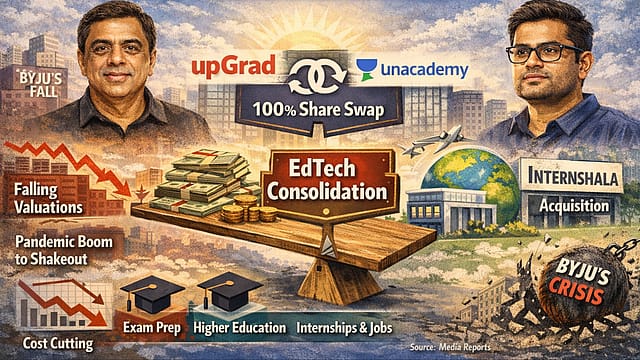
India’s edtech sector, once the darling of pandemic-era venture capital, is now entering a quieter phase defined less by hype and more by consolidation. The latest signal of this shift is a proposed deal in which upGrad, led by entrepreneur Ronnie Screwvala, has signed a term sheet to acquire rival Unacademy in an all-stock transaction.
The proposed acquisition will be structured as a 100% share swap, though the valuation will only be disclosed once the deal closes and formal filings are completed. Both companies have also agreed to a break-fee clause if the transaction does not go through—an unusual feature in startup deals that suggests the negotiations carry significant complexity.
If completed, Unacademy’s co-founder and chief executive Gaurav Munjal will continue to lead the platform. But beyond the mechanics of the deal, the transaction reflects a deeper shift underway across India’s edtech industry.
Unacademy’s trajectory mirrors the rise—and recalibration—of the sector itself. Founded as a platform where educators could teach students preparing for competitive exams, the company grew rapidly during the pandemic as millions of learners moved online. Venture capital poured into the sector and digital learning appeared poised to transform India’s massive coaching industry.
By 2021, Unacademy had reached a valuation of about $3.4 billion, positioning it among the most prominent startups in India’s edtech wave. Its platform hosted courses across exam categories ranging from UPSC to engineering and medical entrance tests, powered largely by well-known educators who attracted large student communities.

The BJP Nation
08 May 2026 - Vol 04 | Issue 70
Now all of India is in his thrall
But the pandemic surge proved temporary. As schools and coaching institutes reopened, the economics of many online education businesses came under pressure.
Unacademy’s recent financials reflect that shift. The company reported ₹826 crore in revenue in FY25, a 16% year-on-year decline, even as it reduced losses by 31% to ₹436 crore, down from ₹631 crore the previous year. EBITDA losses also narrowed by 38%, indicating tighter cost discipline after years of aggressive spending, as per several media reports.
Over the past year, the company has been restructuring parts of its business. Company-operated offline centres were consolidated with franchise partners, and the organisation refocused on its core online learning products. It also reportedly carried out a ₹50 crore ESOP buyback, with nearly 40% of former employees participating. As per media reports, Munjal has said the company still holds over $100 million in cash reserves and is expanding internationally through Airlearn, its language-learning product gaining traction in markets such as the United States, the United Kingdom, Germany and Canada.
For upGrad, the move would expand its presence beyond professional upskilling into school-level learning and competitive exam preparation. The company has largely built its business around higher education degrees and skilling programmes delivered in partnership with universities.
It has also moved closer to the employment side of the education ecosystem. Earlier this year, upGrad acquired a majority stake in internship platform Internshala, founded by Sarvesh Agrawal. Internshala connects students with internships, training programmes and entry-level jobs.
Seen together, these moves suggest a larger strategy. A combined ecosystem could potentially span the entire learner lifecycle—exam preparation through Unacademy, higher education and professional programmes through upGrad, and internships and early-career opportunities through Internshala.
The proposed deal also fits into a broader pattern that has defined India’s edtech industry over the past five years.
During the pandemic boom between 2020 and 2022, acquisitions became the dominant strategy as companies raced to expand into new segments. BYJU'S led the most aggressive buying spree—acquiring companies such as Aakash Educational Services, Great Learning and Toppr in a bid to build a global education platform. Vedantu acquired doubt-solving platform Instasolv, while PhysicsWallah later began acquiring smaller coaching institutes as it expanded offline.
At the time, acquisitions were driven by the belief that technology could rapidly scale education. Venture capital rewarded growth over profitability, and companies used funding to buy users, teachers and new verticals.
But the experiment proved fragile.
BYJU’S, once India’s most valuable startup with a valuation of about $22 billion, eventually became the most dramatic cautionary tale of the edtech cycle. Years of aggressive expansion, expensive acquisitions and mounting debt triggered liquidity problems and legal disputes with lenders. The company has since entered insolvency proceedings, and several of the businesses it acquired during the boom years have been sold or are being divested as creditors attempt to recover funds.
The collapse of the sector’s biggest player has had a chilling effect across the industry. Companies that once chased scale are now prioritising cost control, sustainability and strategic partnerships.
In that sense, the proposed upGrad–Unacademy deal may represent the second phase of India’s edtech story. The first phase was defined by rapid expansion and acquisition-led growth. The next phase may be about consolidation—stitching together platforms that can survive beyond the exuberance of the pandemic years.