Sensex Crashes 1,300 points: How Markets Fell After Donald Trump Rejects Iran Peace Deal
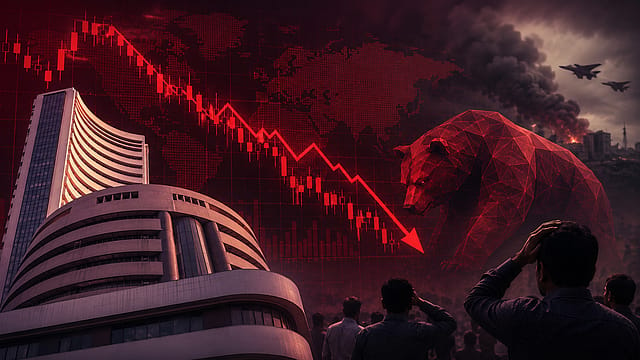
Indian equity markets saw a steep decline on Monday, with benchmark indices tumbling amid rising geopolitical tensions and macroeconomic concerns. The Nifty 50 closed at 23,815.85, down 360.30 points or 1.49 per cent, slipping below the crucial 24,000 mark. Meanwhile, the BSE Sensex ended at 76,015.28, falling 1,312.91 points or 1.70 per cent.
The sharp sell-off came as investor sentiment weakened due to renewed tensions in West Asia, particularly after Donald Trump reportedly rejected Iran’s peace proposal. The development heightened fears of prolonged instability in the Gulf region, which has direct implications for global oil prices.
How are crude oil prices influencing market sentiment?
Rising crude oil prices played a central role in Monday’s market downturn. Brent crude hovered around USD 103 per barrel, raising concerns for an oil-import-dependent economy like India.
Vinod Nair, Head of Research, Geojit Investments, told news agency ANI, “The benchmark index slipped below the 24,000 mark as renewed Gulf tensions, following Trump's rejection of Iran's peace proposal, weighed on investor sentiment.”
Higher crude prices tend to widen India’s current account deficit, weaken the rupee, and fuel inflation—all of which negatively impact equities.
What domestic signals added to investor caution?

Open Minds 2026
26 Jun 2026 - Vol 05 | Issue 26
The power of ideas and arguments in 50 portraits
Investor nervousness was compounded by remarks from Narendra Modi, who urged citizens to conserve energy and avoid non-essential foreign travel. The appeal was seen as a signal of potential economic strain if global conditions worsen.
Vinod Nair highlighted broader concerns, stating, “At present, India's strong fiscal position and healthy forex reserves are helping the government to absorb the impact of elevated crude prices. However, prolonged geopolitical tensions could increase macroeconomic stress.”
He further added, “rising bond yields and continued foreign institutional investor (FII) outflows are likely to keep markets range-bound in the near term.”
Which sectors were hit the hardest?
The sell-off was broad-based, with most sectors ending in the red. Consumer-facing and rate-sensitive sectors bore the brunt of the decline.
The Nifty Consumer Durables index emerged as the worst performer, falling over 3 per cent. Banking and media stocks also saw sharp declines, with Nifty PSU Bank down 2.52 per cent and Nifty Media slipping 2.49 per cent. Auto stocks dropped 1.86 per cent, while IT stocks ended marginally lower.
Only defensive sectors like FMCG and Pharma managed to stay in positive territory, reflecting a shift toward safer bets during uncertain times.
How did global markets react?
Despite the turbulence in India, most Asian markets ended on a positive note. Japan’s Nikkei 225 was the only major laggard, slipping 0.38 per cent. Meanwhile, Singapore’s Straits Times Index rose 0.42 per cent, Hong Kong’s Hang Seng Index edged up 0.06 per cent, and Taiwan’s Taiwan Weighted Index gained 0.45 per cent.
This divergence suggests that India-specific concerns—particularly its sensitivity to oil prices and capital flows—played a key role in the sharper decline.
What lies ahead for the markets?
The near-term outlook remains cautious as investors closely track geopolitical developments, crude oil trends, and foreign investment flows. While India’s macroeconomic fundamentals remain relatively strong, sustained global tensions could test market resilience.
(With inputs from ANI)