#Untold | 160 Rejections, No Revenue, and a Bet That Shouldn’t Have Worked: The Untold Story of Seekho
April 2021.
The call starts on time, like it always does.
Seven screens come alive almost together. Faces settle into place, but without the small rituals that used to precede these calls. There is no adjusting the camera, no checking how they look, and no quick smile before starting.
The frames hold, slightly uneven, but no one fixes them. Not all of them are founders. Everyone on the call already knows what the next few weeks might look like.
For a moment, no one speaks. It isn’t unusual anymore.
Keertay Agarwal looks at the screen, listening, nodding when something is said. There is a slight delay before he responds, as if his mind is somewhere else, trying to catch up. The last few days have been filled with calls, decisions, things that needed to be done quickly. There hasn’t been a moment to sit still.
This call asks for that.
Rohit Choudhary tries to stay with the conversation, but his attention keeps splitting. Every few seconds, his eyes move—just briefly—to his phone, then back to the screen. Not restless. Just the quiet habit of expecting something to change. Most of the updates he is waiting for don’t come with warning.
Yash Banwani joins a little late. There is a quick nod, and he slips into the same silence, picking up the thread without needing to ask what he missed.
Exclusive: To the Heavens and Back
19 Jun 2026 - Vol 04 | Issue 76
Shubhanshu Shukla relives the space odyssey that put India into orbit
There is nothing new to explain.
“Sab theek (all well)?”
The question comes out the same way it always has—light, almost automatic—but it doesn’t land the same way anymore.
No one answers immediately.
For a second, each of them has to decide what the question is actually asking. Health? Family? The situation outside? The company? Or something harder to articulate.
“Theek hai… (it’s okay)”
When Nothing Moves, Everything Tightens
The words arrive, but they don’t resolve anything. They’re acknowledged, and the call moves forward anyway.
What follows is familiar now. Numbers. Hospitals. Oxygen cylinders. Names of people who might help. Information that feels urgent in the moment and incomplete as soon as it’s said.
The conversation moves, but without direction, as if it is trying to keep pace with something already ahead of them.
No one brings up the company—Seekho, a short learning video subscription platform--immediately. When it does come up, it lands differently. Salaries are due. The line lingers. Everyone knows what sits behind it, and no one is ready to unpack that alongside everything else.
They do have money coming in. ₹1.8 crore has been committed. But it hasn’t reached their account yet, and in the middle of a lockdown, there is no clarity on when it will.
For now, it exists only as an expectation.
The conversation returns to logistics—calls to make, numbers to check, and things to follow up on.
Gradually, the urgency drains. There is nothing more to add. And then, almost without notice, the call slips into silence again. This is the part no one prepares for—the moment after, when there is nothing left to say and nothing left to do.
That is where the thought begins to take shape. If this doesn’t work, what does that say about us? No one says it out loud. “Stay safe. Kal baat karte hain.”
The screens go dark. The question doesn’t.
Outside, things are getting worse.
The second wave of Covid didn’t arrive gradually. It surged. What felt distant just days ago is now everywhere. Cases rising, hospitals filling up, and calls multiplying. Tier II and III cities, which had been relatively untouched before, are now in the middle of it.
Everything speeds up. Outcomes don’t.
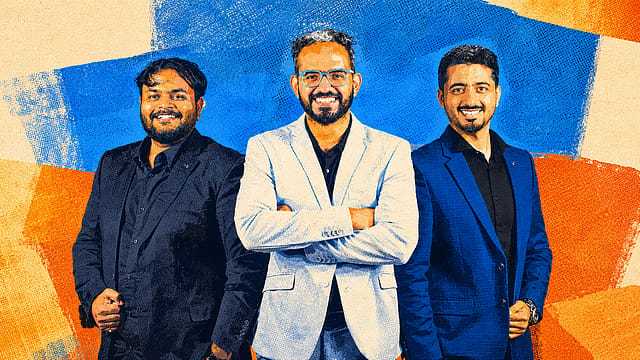
The three friends—and cofounders of Seekho—had gone home just days earlier.
The plan was simple. Spend time with family. Tell them they had quit their jobs and stepped into something uncertain. Reset. Come back to Mumbai and continue building.
That plan didn’t hold. Lockdowns are announced. Movement stops. Buses shut down. What was meant to be temporary turns indefinite almost overnight.
Around the same time, they tell their families they’ve quit their jobs, raised ₹1.8 crore, and are building something of their own. It sounds like progress to them. But to everyone else, it sounds like risk. The idea is still abstract and the conviction too early. There isn’t enough to show, and too much to explain.
But there is no going back now. And then, almost immediately, everything else starts to give way.
In the second week of April, Keertay’s father passes away. There isn’t time to sit with it. The phone keeps ringing. People keep arriving. Pandemic instructions have to be followed. One thing spills into the next without pause.
Somewhere in between, the fact lands for Keertay. The one person who had made this decision easier—the leap into entrepreneurship—is no longer there. He had been the one who said yes when this didn’t make sense yet. The one who didn’t ask for certainty before backing him.
When Everything Hits at Once
But there isn’t space for it to settle.
Before it can, something else takes over. There are hospital calls to track. Oxygen levels to monitor. Messages that need replies. Updates that can’t be missed. The outside world doesn’t pause for what has just happened inside his own.
Everything overlaps. Nothing completes. The rituals are done. The people leave. The calls slow down. But the moment that should follow—the one where it sinks in—doesn’t arrive. There isn’t space yet to understand what has actually changed.
For Rohit, the situation at home is no less fragile.
His mother’s oxygen levels drop. Updates come in fragments—numbers, readings, brief reassurances that don’t last long enough to settle anything. Every call carries the possibility of something turning.
Yash is dealing with the same uncertainty. His mother is in the hospital. Oxygen levels dipping. The situation shifts faster than it can be understood.
Across three homes, the same pattern repeats. Phones don’t stop ringing. Information moves constantly. Nothing feels stable.
And in the middle of all this, something else remains: Seekho. The ₹1.8 crore that was committed hasn’t reached their account yet. Everything that depends on it is stuck in the same uncertainty. There is no product in the market yet. No revenue. No buffer. As founders, they find themselves in a position they hadn’t imagined—business uncertainty, a pandemic that refuses to slow down, and families in distress. All at once. “At that time, we had to ensure two things survive,” Rohit recalls. “We as a team, and the company.”
So, they continue.
The 9 am calls don’t stop. If anything, they become more important. And then, just when it feels like the situation cannot layer itself any further, it does. Three days after Keertay’s father’s death, a relative arrives with a claim. There is a loan of ₹25 lakh, and a monthly interest of ₹50,000. But there isn’t time to verify it and no room to question it.
Now, the loss is no longer just emotional. It becomes financial. There is no income coming in. The company hasn’t started generating revenue. Everything is still in its earliest stage. And yet, the expectation is clear. The money has to be paid.
In the middle of this, Keertay’s mother steps in. She takes charge of her husband’s factory operations and handles what needs to be handled. “Tu apna dekh, (you take care of your startup)” she tells him.
There is strength in that. And responsibility that follows.
For the next few months, nothing stabilises. It just continues. Every day brings some version of the same uncertainty—health updates, financial pressure, and questions that don’t have immediate answers.
And still, every morning at 9, they show up. They don’t have clarity, but stepping away isn’t an option. By then, the choice has already been made.
Long before this, the path had looked very different.
The cofounders grew up in homes where the path ahead was predictable: study, get a stable job, and build a secure life. The kind of certainty that left little room for deviation. “I just knew I had to get out of Jodhpur,” recalls Rohit, describing what pushed him towards engineering. “That was the only thing that mattered.”
When Growth Became the Wrong Signal
At IIT Kanpur, the world expanded. So did the frame of reference. Until then, Rohit’s dream had stayed within his own limits—a white-collar job, and a good office in a city like Mumbai. Now, what had once felt enough no longer did. “Woh chhota lagne laga.”
But as ambition expanded, confidence didn’t always keep pace. Rohit carried doubt into his early years. At Toppr, watching a founder operate at a level he wasn’t sure he could match, the question surfaced quietly: Am I built for this? Can I start my own venture?
Keertay’s path wasn’t linear either. He cleared the prelims for UPSC, then stepped away. On paper, it didn’t make sense. But staying didn’t either.
The turning point came from exposure. At KukuFM, where all three of them were working across product and engineering roles, patterns began to show up. Users came in not just for entertainment, but for something more—learning, growth, improvement. But not in the way edtech companies were offering it. They weren’t signing up for long courses. They weren’t committing to structured learning. But they were consuming content.
That contradiction stayed. People wanted to learn, but they weren’t using the tools built for it. Around the same time, something else was shifting. Short-form content was exploding. Attention was already moving in that direction. Most of it was entertainment. Very little of it asked a different question: What if people didn’t want to scroll less, but to scroll better?
Seekho started as a side project—something they worked on alongside their jobs. Small experiments. Early iterations. Trying to understand what worked.
There was no category they were stepping into. No clear playbook. And yet, at some point, they decided to take the leap. They quit not because everything made sense, but because enough of it did. They raised ₹1.8 crore early on belief. What they were building was still hard to explain.
“Content se learning nahi hoti.” They heard it often. Investors had their own version of what this should look like—high-ticket courses, outcome-based learning, tighter niches, a different name, a model that didn’t compete with YouTube.
Some of it made sense in isolation. But together, it pulled in different directions.
Early on, the cofounders listened. They adjusted, reframed, and tried to fit into something easier to understand.
Around the same time, the focus began to narrow in a different way. DAU (daily active users) became the metric that mattered. “Everybody was playing the DAU game,” recounts Rohit. And that’s what the market seemed to reward. For a while, it felt like progress. But it took a while to realise it wasn’t.
Somewhere along the way, the original instinct started to blur. The question they had begun with—what if people wanted to learn differently—was slowly replaced by something else: What would make this easier to sell? They weren’t building blindly. But they weren’t building clearly either.
And yet, the momentum kept pushing forward. They had quit. They had raised money. Expectation had set in—external and internal. “We were trying to make sense of everything at once,” says Rohit. Result? “In that process, we were losing what we had started with,” he rues.
160 Rejections and a Shrinking Runway
The confusion didn’t collapse immediately. It rarely does. It builds in decisions that feel small at the time. Confusion builds in adjustments that seem reasonable, and in compromises that don’t look like compromises yet. By the time it becomes visible, it’s already deep. There is no luxury of stepping back to fix it. The bet had already been placed.
By January 2022, time was running out. They reached out again—to investors they had spoken to before, to new introductions, through cold emails—pushing on every door they could find.
The conversations happened, some promising, and most inconclusive. Over time, the responses began to sound the same: Too early. Unclear model. Come back later.
But later wasn’t something they had.
The rejections accumulated steadily. Ten conversations became twenty, then fifty, and by the time it approached 160, the outcome of each new call had started to feel predictable. “We kept hearing the same thing,” Rohit recalls.
Inside the company, the pressure took a different shape.
The team continued to show up, just as they had through everything else, but the reality around them tightened. Salaries were due. Expenses continued. There was still no meaningful revenue coming in to change the equation.
The cofounders began making cuts—first the obvious ones, then the ones that were harder to justify, and eventually the kind that forced them to rethink how long they could keep going. “We had to make some very hard calls,” says Rohit. And those hard calls were about costs, salaries, and how long they could keep going.
For the first time, shutting down began to feel like a possible outcome. No one said it outright, but it sat in the background of every conversation. And still, they kept going. They hadn’t reached the point where stopping became the only option.
But that point was getting closer. The shift didn’t arrive as a single moment. It emerged from something they had noticed earlier but hadn’t acted on. That signal had been coming from users. Even through the worst phases, some of them had been willing to pay—not in large numbers, and not enough to change the trajectory overnight, but consistently enough to register.
It had been there all along. But they had stayed away from it. Why? It felt too early to ask users to pay. The product was still evolving, the value still being shaped, and most of the advice they had received pushed them in other directions—towards scale, outcomes, and models that looked more familiar.
From Zero Revenue to ₹141 crore: The Monetisation Bet That Worked
By early 2022, that framing no longer held. Time had tightened. Options had narrowed. VCs had begun to pull back. There was barely a month of runway left, much of it sitting in a fixed deposit.
The question was no longer about building the most complete version of the product, but about finding something that could work now.
They decided to test the paid model, quietly, using what they already had. “We had seen the signals earlier,” says Rohit. People were willing to pay, but cofounders hadn’t leaned into it. “This time, we did,” he says.
The change was subtle, but it shifted their focus. Instead of shaping the product around what they thought it should become, they began to build around what users were already responding to—short-form learning that was accessible, relevant, and easy to return to.
Nothing moved in the first few days. But as they leaned into monetisation, users began to respond. What had once felt tentative started to hold. Over time, it translated into revenue.
The first meaningful amount came in—around ₹5 lakh. In isolation, it wasn’t a number that changed the business. But in context, it meant something else entirely. It meant they could pay salaries. “We weren’t celebrating,” recounts Rohit. “But it just felt like we could breathe a little.”
The pressure, though, didn’t disappear.
The runway was still tight. The model was still evolving. Questions around scale and sustainability hadn’t gone away. But the nature of the conversation began to shift. Earlier, every discussion had been about how long they could last. Now, there was space—however limited—to think about what could work.
The difference was small, but it showed up.
The calls felt less strained. The decisions, more deliberate. The urgency didn’t vanish, but it became more focused. For the first time in months, survival didn’t feel entirely dependent on something external arriving at the right moment.
They had, at least in part, created it.
Over the next few months, that signal strengthened. What had started as a small, tentative stream of revenue became more consistent, growing month after month as more users were willing to pay.
By FY25, that early signal had translated into scale. Seekho’s operating revenue grew over 12X to ₹141.5 crore, up from ₹11.5 crore the year before.
The momentum carried into September 2025, when the company raised $28 million at a $180 million valuation. Growth came at a cost—an aggressive marketing push of over ₹134 crore pushed losses up more than 8X to ₹39 crore—but the trajectory was clear.
Through it all, the product stayed true to its core: 3–5 minute, expert-led videos across career skills, business, technology, government exams, finance, and personal growth, delivered in Hinglish and regional languages.
Today, with over 100 million downloads and 5 million+ active subscribers, Seekho serves students, professionals, and everyday learners, backed by Bessemer Venture Partners, Elevation Capital, Lightspeed India, and Goodwater.
It didn’t happen in a straight line. But it held.
What followed wasn’t linear. There were still iterations, missteps, phases where things didn’t move as expected. But the direction they had chosen—grounded in how users were actually behaving—began to hold.
Seekho started to scale. Today, the platform reaches over 25 million users every month.
Most of them are not the audience traditional edtech products were built for. They are smartphone-first, vernacular-first users, spread across smaller towns and cities, navigating careers, business, and everyday decisions in ways that don’t always fit structured formats.
“There are 500 million Indians who are smartphone-first and vernacular-first,” says Anant Vidur Puri of Bessemer Venture Partners, one of the backers of Seekho. Almost nothing in the existing empowerment-tech stack was built for them. “Seekho is,” he reckons.
That insight had always been there. What changed was their willingness to follow it through.
The product evolved around that core idea—short-form, relevant, accessible learning that didn’t demand long commitments, but still delivered value. Something that fit into how people were already consuming content, rather than asking them to change their behaviour.
Over time, that began to shape how they thought about growth. AI has begun to play a role in that. “It changes the unit economics of reaching a user,” reckons Puri. It lowers acquisition cost by finding the right learner at the right moment, and improves retention by personalising the experience deeply enough to keep them coming back.
But that doesn’t remove the challenge. If anything, it sharpens it. “The challenge is scale without dilution,” Puri adds.
For the founders, that tension wasn’t theoretical.
Looking back, the arc is easier to trace—the chaos of 2021, the uncertainty of early 2022, the decisions that didn’t always make sense while they were being made.
“At that time, we had to ensure two things survive,” says Rohit. “We as a team, and the company.”
They did.