#UNTOLD | Silence, Shylock & Shawshank: Aloke Bajpai, Rajnish Kumar & the Untold Story of ixigo’s IPO Bell
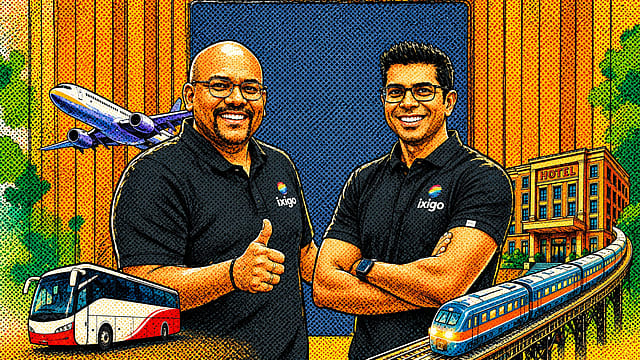
Aloke Bajpai was looking for his breath.
It was supposed to be somewhere beneath his nose, brushing against the small patch of skin above his upper lip. He had been instructed to observe it. Nothing more. No judgment. No reaction. Just notice the air entering his nostrils and leaving them.
In.
Out.
In.
The breath was there. Bajpai wasn’t.
His body sat cross-legged on the floor of a Vipassana centre in Gaya, Bihar. His phone had been taken away. Talking was forbidden. So was eye contact. For ten days, there would be no emails to answer, no meetings to enter, no employees to reassure and no investors whose hesitation could be converted into conviction.

Zeroing In on ECI
09 Oct 2026 - Vol 05 | Issue 41
Constitutional legitimacy versus political opportunism
For nearly nine hours every day, there would be only this: breath, silence and a mind that would not obey either.
His legs hurt. He shifted, then tried not to shift. Around him, other meditators sat with their private discomforts. Nobody looked at anybody. Nobody asked what he did for a living, how his company was performing or when its initial public offering would finally happen.
There was nowhere to go.
That was the problem. The phone had switched off immediately. The brain did not.
A door opened in Singapore. An investor walked out of a meeting. A war entered the room. A document approached its expiry date. An employee intercepted him on the way to the bathroom.
“Sir, IPO kab kar rahe hain?”
Bajpai returned to his breath.
In.
Out.
The question returned with it.
For years, people at ixigo had watched him remain steady while the ground moved. His co-founder, Rajnish Kumar, worried more visibly. Kumar saw creases before they became cracks. Bajpai could usually find the joke inside the emergency, the next move inside the setback.
But composure is not the absence of pressure. Sometimes it is merely pressure denied an audience.
By the first day, the silence had begun amplifying everything it was supposed to quieten.
The aborted IPO returned. So did family. Old injuries arrived without appointments. Memories he had stored away began opening themselves. Business, relatives and old wounds now had nowhere to hide from the silence.
He tried again.
In.
Out.
Pain travelled through his legs.
The teacher asked him to observe it without reacting. Sensation arose. Sensation passed. Nothing was permanent.
That was the lesson.
It was also difficult to believe.
An IPO could return. Money could return. A company could recover from a crisis. But time behaved differently. His children would not become younger because their father had finally found an empty calendar. The body would not forget every night that sleep had failed to repair it.
The hours accumulated. Then another day.
Bajpai had come to the retreat because he wanted his mind to stop running. Instead, the mind went backwards.
It went to a night when the world had stopped travelling. It went to a Slack dashboard covered in zeros. It went to another founder sitting motionless on a bed while his watch told him that his heart was racing at 120 beats per minute. It went to a potential buyer who believed desperation came with a discount. It went to the moment when fourteen years of work received a humiliating price.
The company had faced extinction once before. Bajpai had remained calm then. Or appeared to.
Now there was no dashboard before him, no buyer on the telephone and no employee asking for an answer.
There was only breath.
In.
Out.
Bajpai had surrendered his phone that morning. It would take three days to surrender his mind.
MARCH 2020 | GURUGRAM & JAIPUR
Kumar was sitting on his bed when his watch vibrated.
He looked at the screen.
120 BPM.
The alert did not disappear merely because Kumar stared at it.
He remained seated on the bed.
The watch had detected exertion. The body had detected danger. Only the room appeared unconvinced. Nothing moved except the numbers.
On another screen, the live dashboard that ordinarily recorded the restless movement of India—flights searched, trains booked, buses chosen, journeys begun—had fallen silent.
Zero bookings.
Zero revenue.
The two numbers looked almost clean. That was their cruelty. They contained no images of grounded aircraft, empty railway platforms or locked hotel rooms. They did not show employees sitting at home, wondering how long salaries could survive without sales. They did not calculate the years Bajpai and Kumar had already given ixigo or what would remain of those years if the company disappeared.
They simply said zero.
Kumar called Bajpai.
The two men had known difficult numbers before. They had spent years building a travel company in a country where customers once hesitated to book journeys online and investors repeatedly asked whether the business would ever make money. They had survived thin bank balances, abandoned deals and stretches during which salaries were something other people received.
But this was different. A weak business could be repaired. How did one repair movement itself?
Across the world, borders were closing. Aircraft were being parked. Trains were stopping. Hotels were emptying. Every product ixigo helped customers discover had become either unavailable, unsafe or illegal to use.
The company was not losing to a competitor. Its category had been switched off.
More than 200 employees depended on what the founders decided next. So did their families. The number expanded each time Kumar thought about it. Two hundred employees meant school fees, rent, medical bills, parents and children. A dashboard could reduce the company’s income to zero without reducing any of those obligations with it.
Then came the offer.
The buyer knew the moment.
ixigo’s valuation had become difficult to defend when nobody could travel. Cash was draining. The future could not be dated. A founder under ordinary circumstances could reject an insulting number and return to business. A founder in March 2020 first had to ask how many months of life remained in the bank.
The offer placed a humiliating price on fourteen years of work. It also came with urgency: Decide quickly.
The calculation was brutal because it was not entirely irrational. Sell cheaply and perhaps save something. Refuse and risk watching everything fall to zero—the value of the company, the founders’ holdings, employee stock options and the institution they had spent their adult lives building.
The offer did not ask only what ixigo was worth. It asked how frightened its founders were.
Kumar was frightened enough for his watch to notice. Bajpai sounded calmer.
That did not make the choice easier.
They began discussing escape routes. If travel had disappeared, could ixigo become something else? Gaming came up. Content came up. The company possessed engineers, a consumer brand and millions of users. Perhaps those ingredients could be rearranged into a business the pandemic had not paralysed.
The ideas were plausible. That made them dangerous.
A pivot could be described later as agility. In the moment, it felt closer to abandoning the reason ixigo existed. The founders had not spent fourteen years learning travel merely to flee it when travellers disappeared.
The world outside their windows had stopped. The buyer was waiting. The dashboard still read zero.
Bajpai and Kumar spoke until there was nothing left to do except postpone the answer.
Sleep on it.
They ended the call carrying the same questions into two separate homes.
Was refusing the offer courage or vanity?
Was remaining in travel conviction or denial?
Could they ask hundreds of employees to trust a category that governments across the world had shut down?
And if ixigo failed, how would they explain that they had once been offered an exit and had chosen the wreckage instead?
That night, Kumar’s mind travelled further backwards than the dashboard. To France. To Amadeus. To two IIT Kanpur batchmates and wingmates who had returned to India believing that travel could be made less punishing through technology. To the years when the company could not pay them properly.
Banks did not recognise entrepreneurial optimism as income. Credit histories did not improve because a founder claimed he was building something valuable. Bajpai and Kumar had gone so long without conventional salaries that obtaining an ordinary credit card became difficult. To receive one, money had to be deposited upfront.
They were building a company that helped strangers travel across India. The banking system was not convinced they could settle a card bill.
At home, time kept issuing invoices no investor could fund.
Both Bajpai and Kumar had families and children waiting at home. Yet work continued to consume their hours. They warned each other about what that relentless pace could cost. Your child will be one only once. Miss that year and it will not return. Then the child will be two only once.
The warning was affectionate. It was also useless.
A startup did not become less hungry because its founders understood childhood. There was always another release, another crisis, another investor conversation, another month when survival could not be delegated. They returned home after their families had gone to sleep and left again carrying the belief that the sacrifice would acquire meaning later.
Now “later” had arrived dressed as a pandemic.
Fourteen years after they had begun, the founders were again staring at the possibility that the company might leave them with almost nothing.
Except it was no longer only their nothing. More than 200 people had joined the wager.
Morning arrived without clarity.
Bajpai and Kumar called each other.
“What did you decide?”
“What did you decide?”
Neither wanted to influence the other. Neither wanted the company to survive because one founder had overruled the other. After everything ixigo had taken from them, the next decision had to belong equally to both.
They gave their answers: Continue.
They would not sell at the price placed before them. They would not turn ixigo into a gaming company because games could still be played from home. They would not run from the industry whose collapse had exposed them. If travel returned, ixigo would fight its way back with it.
If travel never returned, every travel company would be in trouble anyway.
In their retelling, the fatalism summoned two cinematic images. One came from 300: a small force facing an enemy too large to defeat, choosing the manner of resistance when it could no longer choose the odds.
The other came from the Titanic. As the ship went down, the musicians kept playing. The music could not repair the hull. It could not lower another lifeboat. It could not alter the destination of the ship. It could only insist that even catastrophe would not dictate every final act upon the deck.
Bajpai and Kumar had found their deck. If the travel industry sank, they would not leap into an unrelated business and pretend they had always wanted to be there.
They would keep playing.
Their next act of defiance was to give money away. Customers had booked flights, trains and buses through ixigo before the country shut down. Journeys were cancelled. Refund requests began flooding in precisely when the company needed to preserve every rupee it possessed.
Support traffic multiplied. Systems strained. Customers did not care which airline, bank, wallet or payment gateway had trapped the money. They had booked through ixigo. They wanted it back from ixigo.
The founders agreed. Refund them.
What began as a service response became a campaign inside the company: Refundathon.
Teams tried wallets, bank transfers, UPI and whatever method might carry money from a travel company with no travellers to customers trapped inside their homes. Each failed transfer returned as another problem. Each payment rail created a different obstruction. Then, one weekend, the payment gateway account ran out of funds. Employees pooled their own money to keep the refunds moving.
At some point, the frustration produced a question that sounded absurd only because the circumstances had already become absurd.
Should employees deliver cash to customers’ homes?
If that was what it took, the founders were prepared to consider it.
The ship was taking on water. They were returning the passengers’ money.
Meanwhile, the company had to reduce its own weight. Salary cuts became unavoidable, but the burden did not travel evenly downwards. Lower-paid employees were protected as far as possible. The cuts grew harsher as they climbed the hierarchy. Senior leaders surrendered roughly 70 to 80 per cent.
Bajpai and Kumar went back to zero. Again.
Nobody was fired. The salaries sacrificed during the crisis were subsequently converted into ESOPs designed to vest quickly. The founders could not promise when travel would return. They could at least ensure that employees who had financed the company’s survival through their own pay would possess a larger claim on whatever future remained.
There was no guarantee that the shares would one day become liquid. There was not yet a functioning business behind them. There was only belief converted into paper.
For months, ixigo operated against the logic visible outside. Airports remained ghostly. Trains ran under restrictions. Waves of infection kept rearranging every recovery. Each time movement appeared ready to return, another outbreak threatened to shut it down again.
Yet the numbers began moving. First faintly. Then faster.
Within approximately six months, ixigo regained profitability. Volumes approached twice their pre-Covid level. The company that had watched revenue collapse to zero had not merely remained alive. It had recovered while the pandemic was still rewriting travel.
For one brief moment, survival might have been enough.
It wasn’t.
Bajpai and Kumar looked at a wounded industry and decided this was the time to start buying pieces of it.
They approached investors for money.
The investors understood the request. A travel company had nearly been destroyed by a travel shutdown. Naturally, its founders wanted capital to strengthen the balance sheet.
Bajpai and Kumar corrected them. They did not want the money merely to survive. They wanted to acquire another company in the middle of a pandemic. They did not possess enough money to do it.
The band had stopped waiting for the ship to sink. It wanted to buy another ship.
The proposition did not improve when they explained it.
ixigo had only recently climbed out of a hole deep enough to bury it. Travel remained vulnerable. Covid had not left the world; it had merely loosened its grip between waves. Cash was still precious.
Yet Bajpai and Kumar were not asking investors to finance caution. They wanted ConfirmTkt. The railway-booking platform had built strength around train discovery and confirmation predictions, territory adjacent to ixigo’s own. Combining the two made strategic sense.
Timing made almost none.
Acquisition discussions took place through screens. The founders were attempting to judge people, culture, technology and intent over Zoom while a pandemic prevented the ordinary rituals through which companies inspect one another. There were no long rooms, no confident handshakes, no dinners during which guarded founders gradually revealed what the spreadsheets concealed.
There were rectangles on a screen.
There was also the minor inconvenience that ixigo did not possess all the money required to complete the deal.
Its investors had already travelled a difficult road with the company. Now the founders were asking them to believe that the business which had recently touched zero should use a crisis not merely to defend itself, but to expand.
The response was less enthusiasm than disbelief.
You cannot afford this.
Bajpai and Kumar already knew. They began looking for money elsewhere.
In The Merchant of Venice, Shylock lends Antonio 3,000 ducats. The security is not another asset or a larger interest payment. If Antonio defaults, Shylock may take a pound of his flesh.
Centuries later, finance had acquired cleaner vocabulary.
The founders were offered venture debt.
The phrase sounded respectable. The terms felt less so. Money would arrive quickly enough for ixigo to pursue the acquisition, but the lender wanted protection if the gamble failed.
Bajpai and Kumar signed personal guarantees. The limited liability surrounding the company thinned. If ixigo could not honour the debt, the risk would no longer stop neatly at its doors. The lender could pursue the men who had signed.
Their assets entered the agreement. Whatever assets they had.
The absurdity amused them later. These were founders who had gone without salaries for years, men whose income histories had once failed to qualify them for normal credit cards. Now their personal possessions were helping secure a loan large enough to buy a company.
The joke ended at the signature line.
If ConfirmTkt failed inside ixigo, the founders would own more than a bad decision. They would own a debt that knew their home addresses.
They signed anyway. The acquisition went through.
There ought to have been a pause after that—time to integrate systems, settle teams, rebuild reserves and allow one piece of audacity to prove itself before attempting another.
Instead, ixigo turned towards AbhiBus.
The bus-booking platform offered a different piece of India’s travel market. Trains could connect the country broadly, but buses entered routes and towns that other networks did not always serve. Acquiring AbhiBus could push ixigo beyond a product into a wider travel platform.
Once again, strategy ran ahead of money.
The founders put a term sheet on the table before possessing all the capital needed to complete the transaction.
This was no longer resilience in its polite, retrospective form. Resilience sounded admirable after the outcome was known. Inside the moment, it looked dangerously similar to compulsion.
ixigo had survived one impossible wager. Its founders immediately placed another.
The next several months folded into one another: ConfirmTkt, debt, guarantees, integration, the AbhiBus term sheet, fundraising and preparations for an initial public offering.
There was barely enough time to complete one transformation before another demanded attention.
The IPO was supposed to solve more than one problem. It could give ixigo access to capital, offer liquidity to employees and investors, and publicly validate a company that had spent years being told it was too early, too fragile or insufficiently funded.
For employees, the filing made the future visible.
ixigo marked the moment internally. There was a small celebration. After the terror of zero revenue and the salary sacrifices that followed, the public issue appeared to offer a destination large enough to justify the journey.
That was the danger. People began believing in the date. The founders did too.
By early 2022, they were in Singapore for the roadshow. Their task was familiar in structure: enter a room, explain ixigo, defend its numbers, answer doubts, leave enough conviction behind for an investor to commit money.
Only this time, the stakes were public. Every meeting mattered.
Then, on February 24, Russian forces entered Ukraine.
War did not knock on the conference-room door. It arrived through phones.
Screens lit up. News alerts interrupted presentations. Markets convulsed. Investors who had entered the room to study a potential Indian listing were suddenly responsible for portfolios exposed to a global crisis.
One of them left a meeting to assess what the invasion was doing to his investments.
Others cancelled.
The founders kept presenting.
They spoke about Indian travel, railway bookings, bus networks, technology and growth while television screens elsewhere showed tanks crossing a border. Each chart in the deck belonged to the world as it had existed hours earlier. Every investor in the room was trying to calculate the world that might exist by evening.
Nothing ixigo had done had caused the crisis. That offered no protection from it.
The war widened an unease already spreading through technology markets. Newly listed companies were trading below their offer prices. The great startup celebration had begun curdling into public anger. Founders were no longer being described only as visionaries who had created wealth. Some were being accused of bringing inflated companies to market and leaving ordinary investors to absorb the fall.
ixigo had spent years waiting to reach the public markets.
It had arrived when the public markets had become suspicious of companies like ixigo.
Though some investors did raise their hands, the roadshow eventually stalled. Meetings vanished from the calendar. The IPO did not formally die that morning. It entered a slower, more punishing condition: uncertainty. Wait. Watch the markets. Perhaps the window will reopen.
The founders returned without the outcome they had carried to Singapore in their heads.
Six months later, they tried again.
The external panic had eased enough to permit another approach. Potential anchor investors appeared. Interest existed. After the first interruption, the company allowed itself to believe that the process might revive.
The bankers examined the market.
Their advice remained the same in substance: Do not proceed.
A founder can fight a competitor. He can cut expenses, rebuild a product, persuade an employee or return to an investor with better numbers. He cannot argue a market into wanting an IPO.
Once again, ixigo withdrew.
Inside the office, the consequences became personal.
The employees had been told. They had seen the filing and attended the celebration. They knew what a listing could mean for stock options accumulated through years of work—including the ESOPs used to compensate for salaries surrendered during Covid.
They began asking when. Bajpai had no date to give them.
At first, the question arrived in conversations. Then it appeared in corridors.
Eventually, even a walk to the bathroom could become an ambush.
“Sir, IPO kab kar rahe hain?”
The employee asking was not necessarily accusing him. That made the question harder. Hope could sound casual to the person expressing it and unbearable to the person responsible for fulfilling it.
Bajpai could not say the IPO would happen soon. He could not say it would never happen. He could not explain why a profitable company with growing volumes and completed acquisitions remained stranded because a war had begun during its roadshow and the market had lost faith in technology listings.
So, he kept walking.
The draft red herring prospectus approached expiry.
This was not simply a document running out of time. It represented months of preparation, legal work, audits, explanations, promises and expectation. Once it expired, the first attempt would no longer be an IPO delayed by unfortunate timing.
It would be over.
In December 2022, the DRHP lapsed. The celebration had no reverse ceremony. No cake was uncut. No photograph was untaken.
The company continued. Bajpai began fraying.
Sleep became shallow. He could spend the required hours in bed and wake without feeling that his body had rested. The mind refused to respect the boundary between office and home. Questions followed him into the night; fatigue returned with him in the morning.
It baffled him.
He had remained composed when Covid erased the company’s revenue. He had helped reject a humiliating offer when ixigo possessed every reason to accept it. He had taken his own salary to zero, borrowed on brutal terms, signed personal guarantees and pursued two acquisitions without the comfort of having all the required money in hand.
He had endured a world without travel.
Now the failure of an IPO—an event the company could attempt again—was entering his health.
Perhaps the difference was expectation.
During Covid, the enemy had been visible. The dashboard said zero. The company might fail. Every decision belonged to survival.
The IPO had offered the opposite. It had allowed hundreds of people to imagine arrival.
Then it withdrew the destination without returning the hope invested in it.
At some point, Bajpai encountered an account of Jack Dorsey attending Vipassana.
The solution appeared almost comic: a technology founder reading about another technology founder switching off.
Bajpai searched for a course. Most had no immediate openings. One did. He registered before the practical objections could assemble themselves, then told his wife.
Ten days. No phone. No conversation. No eye contact. Nearly nine hours of meditation a day.
She understood that he was leaving for some kind of retreat. Perhaps there would be yoga. Bajpai did not fully know what he was going to find there.
He knew only what he needed to lose.
Noise.
Expectation.
The employee’s question.
The roadshow door opening.
The investor walking out.
The draft expiring.
At the Vipassana centre, he handed over his phone. The device went dark in his palm. His mind followed him into the room.
DAY THREE | VIPASSANA
The breath entered. The breath left. For perhaps the first time since he arrived, Bajpai remained long enough to notice both.
Something had altered.
Not the room. Not the schedule. Not the pain travelling through Bajpai’s legs.
The mind had merely stopped chasing every thought that crossed it.
For three days, he had tried to force silence upon a brain trained to anticipate the next problem. The harder he fought it, the more violently the mind supplied what he wished to escape: the failed roadshow, the expired document, the employees’ questions, family, old injuries, memories without invitations.
Now a thought appeared and moved on. Then another.
The breath entered. The breath left.
Bajpai observed both.
Vipassana did not delete the IPO. It did not reopen the market, repair his sleep or answer the employee waiting near the bathroom. It offered no strategy at all.
That may have been why it began working.
Bajpai had spent years intervening. If a product failed, fix it. If money ran short, raise it. If an acquisition appeared impossible, borrow against yourself. If the company reached zero, begin returning customers’ money.
Here, he had been instructed not to fix even an itch.
Notice it.
Do not react.
It will pass.
By the end of the ten days, the man who had entered carrying an entire company inside his head could sit with himself again.
He retrieved his phone. Messages returned. So did meetings, decisions and the unfinished IPO. But they no longer arrived with the same authority over his body.
When Bajpai reached home, he embraced his children. His wife watched the change with interest. For roughly 30 days, she would later tell him, he remained the calmest she had ever seen him.
Then ordinary life began restoring ordinary Bajpai.
Her verdict was immediate. Go again.
The joke mattered. It prevented the retreat from becoming a founder’s sermon about enlightenment. Bajpai had not levitated above anxiety. He had found temporary distance from it.
That distance would become useful. ixigo was going back.
2024 | THE SECOND ATTEMPT
In The Shawshank Redemption, Ellis “Red” Redding appears repeatedly before a parole board.
During the earlier hearings, he performs the language expected of a prisoner asking to be released. He speaks of rehabilitation and remorse. He offers hope in the approved vocabulary of the institution holding his fate.
The board rejects him.
Years pass.
When Red returns once more, something has changed. He no longer auditions for freedom. Repetition has exhausted the performance. The men across the table may approve his parole, reject it or stamp another form. He has stopped arranging his emotions around their decision. He only remembered Red’s line – “Go on and stamp your form, sonny, and stop wasting my time. Because to tell you the truth, I don't give a damn."
Bajpai remembered that scene when ixigo prepared for its second IPO attempt.
The first time, the company had behaved like a believer. It had told employees. It had celebrated the filing. The founders had carried expectation into the roadshow and returned with the burden of explaining why expectation had failed.
The second time, they protected the company from hope.
There was no filing celebration. No grand internal announcement. No promises. Employees were told little beyond the fact that another attempt was being made. The founders did not know whether the market would allow it, what valuation investors might offer or whether another event entirely beyond their control was waiting somewhere ahead.
Bajpai compared their state of mind to Red before the parole board.
Try again.
Let them decide.
Do not rehearse freedom.
The detachment could not remove jeopardy. It only stopped jeopardy from entering the room wearing celebration clothes.
For months, ixigo prepared quietly. Then the calendar supplied another ambush.
On June 4, 2024, India counted the votes in its general election. The outcome departed from the easy political certainty the markets had priced in. Television screens filled with unexpected leads, coalition arithmetic and speculation. Stocks plunged.
ixigo needed to file its red herring prospectus. That day.
The timing was not theatrical. It was procedural and therefore more dangerous. Delaying by a day or two could disturb the larger IPO timetable. Delay it further and the financial numbers used in the documents could become stale, forcing another cycle of work and uncertainty.
The bankers called.
Wait. Do not file into this market.
For Bajpai and Kumar, the warning carried an unpleasant familiarity. Once again, the company had arrived at the public-market door when history decided to pass through first.
In 2022, it had been a war. Now it was an election result.
The founders began calling the anchor investors whose commitments mattered to the issue. They wanted to know whether the day’s political shock had changed anything.
One investor reacted almost as though the question insulted the investment. Why were they asking? He was not entering ixigo for one day. He was coming for many years. The sentence cut through the market noise.
ixigo filed.
There was no party.
Red had appeared before the board. The form had been submitted. Whatever happened next would happen without the founders begging the future to behave.
Yet in another part of Bajpai's life, somebody had attached certainty to a date.
His father practised astrology. He had indicated that June 18 would matter. Bankers operated through timetables, regulations, demand and market windows. His father consulted an entirely different arrangement of forces. Both clocks pointed towards the same morning.
JUNE 18, 2024 | LISTING DAY
Kumar had not written his speech.
For a man who worried in advance, this was unusual. Or perhaps it proved how thoroughly the first attempt had trained him against anticipation.
His wife, Alicia, reminded him.
There was a listing ceremony ahead. A bell would be rung. Somebody might hand him a microphone. Seventeen years of building could not be summarised through improvisation alone.
Kumar wrote. Then he slept. Properly.
That too had become a discipline. Years of entrepreneurship had taught him that exhaustion did not make difficult decisions wiser. Whatever waited at the exchange in the morning, he would not improve it by arriving without sleep.
Bajpai woke with what he called divine energy.
The day existed.
After Covid, zero revenue, the buyer’s offer, Refundathon, salary sacrifices, personal guarantees, two acquisitions, one failed IPO, ten days of silence, a second filing and an election-day market crash, the listing morning had finally become physical.
Families prepared. Cars began leaving. People travelled towards the ceremony.
Then somebody noticed a minor logistical omission. The founders had no taxi.
In the machinery assembled to take ixigo public, the two men who had built ixigo had been forgotten.
Bajpai and Kumar waited for the last vehicle.
The clock continued. A listing ceremony could absorb years of delay. It could not indefinitely postpone the market opening because the founders were standing outside without a ride.
The taxi arrived. They got in. After spending their careers helping other Indians reach trains, buses and flights, Bajpai and Kumar were now racing to reach their own listing.
They entered with roughly two minutes remaining.
There was no time left for the founders to contemplate the symbolism. They were moved towards the ceremony, the bell and the culmination everybody else had been preparing to witness.
The moment came. They rang. Behind them, the screen waited to display the market’s verdict. Neither founder turned around.
They had spent too many years looking at numbers capable of altering a life. Zero bookings. Zero revenue. A 120 BPM warning. Acquisition prices. Interest rates. The valuation withheld by one market and granted by another.
Now, on the morning built around a number, they walked away from it.
Media interactions consumed the next three hours. Cameras, questions, conversations. The stock began trading elsewhere while the founders remained separated from the screen carrying its movement.
When they finally emerged, an employee found them.
The share had hit the upper circuit. The founders struggled to understand.
“IPO ke din circuit thodi na lagta hai.”
Apparently, it did.
The line belonged perfectly to them. After seventeen years of building an online travel company, preparing two IPO attempts and finally entering the public market, the founders did not know that a newly listed stock could hit its circuit.
For one morning, innocence had survived expertise.
The market supplied its applause.
But an upper circuit is a poor place to end a human story.
Markets can measure demand. They can produce valuations, returns and wealth. They cannot calculate what was exchanged long before the opening trade.
They cannot price the evenings when children went to sleep before their fathers returned. They cannot return the year in which a child was one, or the next in which the child was two. They cannot restore sleep retroactively. They cannot separate the heart that touched 120 BPM from the founder sitting motionless beneath it. They cannot give Aloke back the ten days he needed to learn how to sit with a mind he had spent years overloading.
When Bajpai had warned Kumar about his young child, he had identified the most merciless feature of time. Money could return. A salary could return. A credit score could return. Even an IPO could return. A childhood could not.
Asked what entrepreneurship had consumed, the founders eventually reduced the answer to two resources: time and health.
Everything else could, in some form, be recovered.
Years earlier, an uncle had examined ixigo’s profit-and-loss statement and disliked what he saw. The founders were keeping too little money in the bank. What would happen, he wanted to know, if a crisis arrived?
After the IPO, the uncle called again.
“Beta, maine galat bola tha.”
He had been wrong about the company. He had not been wrong about the cost of a crisis.
Bajpai and Kumar had kept finding something else to spend after the money appeared exhausted. First their salaries. Then their assets. Then their sleep. Then their health. Then years that belonged partly to their families.
The bell announced what they had finally built. It could not tell anyone what they had already given away.