Swiggy vs Eternal: Two Founders, Two Letters. Where’s the Proof?
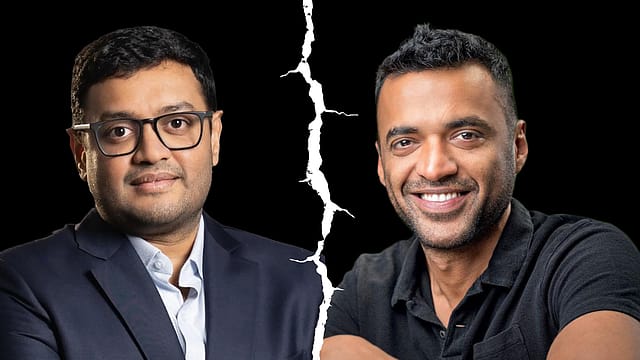
A chatbot with hurt feelings is an unusual guest at an earnings discussion.
Yet there it is in Eternal’s latest shareholder letter. Deepinder Goyal recounts an exchange in which Claude appeared to resent him for leaving conversations unfinished. He acknowledges that the response was probably confabulation: a machine producing something that sounded like a grievance.
Over at Swiggy, Sriharsha Majety has a different opening proposition: a long-term ambition to build towards ₹10,000 crore of adjusted EBITDA by FY31.
There is quite a distance between an annoyed chatbot and an earnings target. These letters cover it in a day.
Eternal published its Q2FY27 letter on October 21; Swiggy followed on October 22. Read them together and the comparison becomes more interesting than a contest over who has the better opening line. Each founder is making a case for how shareholders should think about the future—and why they should trust the company with the money required to get there.

Losing Memory
16 Oct 2026 - Vol 05 | Issue 42
The making of a medical and social emergency
FIRST, THE OPENING ACT
Majety gets down to business quickly. Growth, the earnings ambition, Instamart’s customer additions, spending and losses: the reader is soon among the moving parts.
The pitch is reasonably clear. Here is the destination. Here is what the businesses are doing. Judge whether they are getting closer.
Eternal displays headline financial results before its narrative discussion. The questions then begin with Dark.ai, its proposed private AI assistant, followed by an extended examination of what shopping agents could mean for its businesses. The review of quarterly business performance arrives at question three.
It is an expansive choice of opening. A shareholder arriving to check on meals and groceries also gets a discussion about the future of AI.
That can be useful. A founder should explain the forces that could change the business. The reader is entitled to keep a few practical questions handy: What will this cost? Who will run it? What would make the company stop?
An interesting opening earns attention. The pages that follow have to earn confidence.
THAT WORD: “ASPIRATION”
The word I would underline in Majety’s introduction is “aspiration”.
Swiggy’s ₹10,000-crore adjusted EBITDA ambition is a long-term aspiration. There is room for a great deal to happen between an aspiration and a reported result.
To Majety’s credit, the letter offers intermediate points to follow. Core food delivery has delivered record adjusted profitability. Instamart has accelerated growth while remaining substantially loss-making. Toing is being developed within Platform Innovations, separately from the core food-delivery segment.
The established business is expected to earn more. The growing business must improve its economics. The newer proposition has to prove that affordable meals can become an attractive business.
There are several bets on this particular table.
And progress travels at different speeds. A better food-delivery quarter cannot settle the question of Instamart’s profitability. Encouraging customer adoption at Toing cannot settle the question of what it costs to keep those customers.
Shareholders need to follow each argument through to its own evidence. Putting the businesses in the same letter does not make their economics converge.
WAIT. THERE’S ANOTHER FOUNDER
Before this turns into a two-man personality contest, Albinder Dhindsa deserves his place in the frame.
Goyal is Eternal’s founder and vice chairman. Dhindsa, Blinkit’s founder, became Eternal’s CEO in February. Goyal’s appointment as vice chairman took effect in March following shareholder approval.
Eternal’s letter gives Dhindsa and CFO Akshant Goyal substantial space. The speakers are identified, making it easier to see who is explaining which part of the business.
That matters more than it might appear. A founder can command attention long after operating responsibility has moved elsewhere. Shareholders should be able to identify who makes the argument, who allocates the capital and who must deliver the result.
Swiggy’s document also extends beyond Majety’s signed introduction into detailed management answers. There is considerably more to both letters than their opening performances.
The cast matters. So does knowing who has which job.
THE PROMISE YOU CAN COME BACK TO
Swiggy’s management discussion contains a statement worth saving for the next results day: it believes Instamart’s adjusted EBITDA losses peaked in Q2FY27.
Now there is something a shareholder can return to.
Management says pricing investments should begin reversing as customer groups mature. Future results can help establish whether those customers stay, order regularly and produce better economics as incentives recede.
There is a small but consequential detail to watch. A business can lose less on every rupee of orders and still lose more rupees overall as it grows. Improving margins and falling absolute losses need to be examined separately.
Goyal’s AI argument requires a different sort of patience. He sees fulfilment infrastructure protecting Zomato and Blinkit, acknowledges greater exposure in District and recognises that incumbents may overestimate their own resilience.
That last acknowledgement is useful. It gives the reader permission to examine the argument without having to accept the conclusion.
A delivery network may remain indispensable when an AI agent places the order. The unresolved commercial question is how much of the profit goes to the company doing the delivery and how much bargaining power belongs to whoever controls the customer’s request.
An essential role in a transaction still needs an attractive return.
BEZOS, WITHOUT THE HALO
This is a good point to bring in Jeff Bezos—and leave the mythology at the door.
In Amazon’s original 1997 shareholder letter, Bezos explained why the company would invest aggressively for long-term market leadership. He also committed to measuring investments analytically, abandoning those with unacceptable returns and putting more behind those that worked.
The second part deserves as much attention as the first.
Invoking the long term is easy. Explaining how you will recognise a bad investment is considerably more useful.
For shareholders reading Swiggy and Eternal today, that means looking for evidence such as retention after incentives, contribution after customer-acquisition costs, returns from mature operations and a commercial framework for new products.
A venture may need time. It also needs a way to establish whether that time is being well spent.
NEXT QUARTER, SAME QUESTION
The financial backdrop matters too.
Eternal reported consolidated adjusted EBITDA of ₹666 crore for the quarter; Swiggy reported a ₹760-crore adjusted EBITDA loss. These are company-defined operating measures, and their respective reconciliations need attention. They nevertheless provide materially different settings for the requests for patience.
Swiggy must show that its growth is bringing group profitability closer. Eternal must show that its wider ambitions remain subject to disciplined spending.
Majety’s operating milestones give shareholders relatively near-term checkpoints. Goyal’s broader argument asks them to consider how the business might remain valuable as technology changes. Both are legitimate subjects for a founder’s letter.
The useful reading habit is to mark the promises and keep the previous edition.
Enjoy the chatbot. Examine the earnings ambition. Then, when the next letter arrives, ask what happened to the claims in this one. The shareholder has paid for more than a good read.