Scent of Rebellion: How Rishi Chhabria Built Aerome by Selling the Invisible
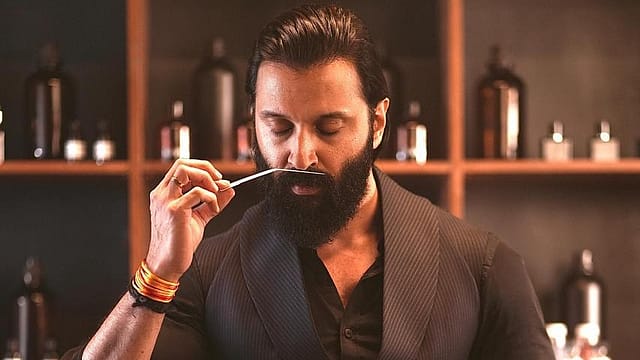
“First year, I managed just two clients. Just two.”
Rishi Chhabria still returns to that evening instantly.
It was a sodden Friday in June 2017. Mumbai’s monsoon had settled in for the season. The air outside carried that unmistakable city smell — wet concrete, diesel fumes softened by rain, and the faint metallic scent that rises when water hits overheated roads.
Inside the apartment, the air felt heavier. Chhabria sat across from his wife and finally said what had been circling in his head for weeks. “It seems like this is not working.”

The Vanguard
21 Aug 2026 - Vol 05 | Issue 34
BJP Rearmed for 2029
The words left him slowly. His shoulders sank a fraction after saying them. For a moment he held her gaze, eyes searching for something—reassurance, perhaps, or simply a signal that he hadn’t made the worst decision of his life.
Twelve months earlier, he had walked away from the family hotel business he had spent nearly a decade inside.

For almost 10 years, I was aimlessly trying my hands at different things and failing, and trying again and failing, he recalls his stint at the family business of hotels that he joined just two days after he graduated from college.
"I always had this feeling inside me that this is not my own," he says.
But when he finally decided to do something of his own, it was billed as ‘overtly outrageous.’ Chhabria borrowed close to ₹50 lakh, convinced himself that scent marketing—an idea he stumbled upon in 2013, and it was something that almost no one around him understood—would find its place in India and started Aerome in July 2016.
A year later, in 2017, he was quite close to believing that he had indeed done something overtly outrageous.
Two Clients and a Big Bet: The Early Days of Aerome
Building a business out of thin air was proving harder than he had imagined. Just two clients and a paltry revenue of roughly ₹15 lakh, Chhabria’s bid for an independent identity was beginning to dim. The shadow of family business seemed comforting.
“I thought the business would move faster,” he told his wife. “I researched this for years. I left everything for it. And today we have two clients.” His eyes drifted across her face, lingering there, almost pleading for a verdict. The room stayed quiet and the words never arrived. She simply watched him. No quick reassurance, alarm or attention. Nothing.
Chhabria’s eyes wandered again, as if the answer might be hiding somewhere in the room. There was none. And that silence lingered.
But this wasn’t the first time he had sat in front of his wife feeling the ground shift beneath him.
Months earlier, he had walked into the room carrying something heavier than doubt: Disbelief. “Three and a half years of my life has gone down the drain,” he blurted out.
The story went back to the beginning of the bet.
Before Aerome existed, Chhabria had spent more than two years studying scent marketing—how hotels, retail chains and public spaces abroad were using fragrance to shape experience and memory. The idea fascinated him. He believed the same model could work in India.
But instead of building everything from scratch, he initially tried the easier route: Distribution.
He began reaching out to established fragrance companies abroad, hoping to represent them in India. One of them seemed interested. Conversations started, emails moved back and forth and possibilities opened up. For eleven months, he worked under the assumption that the partnership would go through. “That’s when I pressed the exit button,” he says now. “I said okay, I’m done. I’m leaving the family business because I’m going to start this.”
In his mind, this was the shortcut—the fastest route into a global industry. A ready-made product, a tested model, and a head start in a market that had barely discovered scent branding.
The Rejection That Nearly Derailed Aerome
But there are rarely shortcuts in businesses built on belief. Sometimes, there are only short emails.
One morning, he did receive a short message. “Sorry. We cannot give you distributorship,” read the dreaded email. “That day I was devastated,” recalls Chhabria. “Completely broken.”
Three and a half years of research. Nearly a year spent waiting for the partnership to materialise and all were gone in a few sentences. “I had already left the family business,” he recalls. “I had nothing. I didn’t know what to do.”
He went home and said the words aloud. “Three and a half years of my life has gone down the drain.”
His wife listened. Her expression didn’t harden. It didn’t soften either. She just absorbed what he was saying. Across the table, Chhabria watched her closely, almost anxiously, waiting for a direction.
Advice? Encouragement? Even permission to stop? There was nothing. “She was just quiet,” Chhabria recounts.
In moments like that, silence can feel louder than words. His wife didn’t rush to comfort him. She didn’t push him either. She simply left the answer where it belonged—with him. “She knew I would figure it out,” Chhabria says now.
Eventually, he did.
How Aerome Built a Business in Ambient Scent Marketing
“I realised one thing,” he says. “I can’t give up now. All I can do is try.”
So, he did something simple. He took a pen and paper, wrote down a name, sketched a logo, and decided he would build the business himself.
Aerome—an ambient scenting company built around the idea that fragrance could shape how people experience a space—was born in July 2016.
To Chhabria, it felt like a leap of faith. To many around him, it looked like something else entirely: A fool’s gambit. He thought he was being brave. Others thought he was being reckless. Friends and family were convinced the experiment would run its course. The idea itself sounded strange enough—building a business around something invisible. For a while, most people were certain how the story would end: He would return.
But he hung on, precariously.
Then came 2020. “Covid was fair to everyone,” Chhabria says. “But for us it was cruel.”
By early that year, Aerome had finally begun to gain momentum. Hotels, malls and retail chains were slowly beginning to understand what scent could do for their spaces. And Chhabria did manage to build an impressive roster of clients across luxury hotels, premium retail stores, airport terminals and corporate headquarters. The company was on track to close the financial year with nearly ₹8 crore in revenue.
Then March arrived.
Aerome’s Pandemic Pivot: Surviving Covid
Within days, the spaces Aerome depended on went dark. Hotels shut their doors, malls locked their entrances and airports emptied. The hospitality ecosystem the company lived inside collapsed almost overnight.
Revenue vanished. “For us, it was zero,” Chhabria says.
At the time, Aerome had around thirty employees. Letting them go would have been the logical move. Many companies were doing exactly that.
Chhabria refused. “I am what I am because of my employees,” he says. “I couldn’t ask them to leave.”
Instead, the company improvised. Fragrance has always been its strength. Now Chhabria had to find new uses. Aerome began producing hand sanitizers—infused with signature scents for clients. They designed foot-operated dispensers for offices and stores. They built whatever small products they could simply to keep the company moving. “We just wanted to survive,” he says. “We just wanted to keep the ship from sinking.”
For nearly eighteen months, the business drifted through that uncertainty.
And through it all, a question hung in the air. When the world reopened, would fragrance even matter anymore?
Fast forward to March 2026.
From Luxury Hotels to Airports: Aerome’s Growing Client List
Six years after the onset of the pandemic, the arithmetic looks very different today. The company that once struggled to convince two clients in its first year now scents thousands of spaces across the country.
From the Taj and St Regis to Porsche showrooms, from Hamleys outlets to terminals at Bengaluru, Goa and Ahmedabad airports, Aéromé’s signature fragrances now drift quietly through places designed to leave an impression. Some of India’s grandest spectacles have carried that invisible signature too — Ambani family weddings, the inauguration of the Nita Mukesh Ambani Cultural Centre, and a growing list of Fortune 500 offices and luxury destinations.
The numbers tell their own story.
While Aerome closed FY17 with operating revenue of just ₹15 lakh, by FY19, it had climbed to ₹2.06 crore, and by FY22 it was ₹5.34 crore. Then something changed. Revenue leapfrogged to ₹26.2 crore and ₹34.6 crore in FY24 and FY25, respectively. It is now on track to cross ₹50 crore in FY26.
But the real story sits inside that curve. The inflection arrived after FY22.
When hotels, malls and airports reopened after Covid, something unexpected happened. Malls were among the first to call. Install the fragrance first, they said. Spaces that had spent months in anxiety and uncertainty wanted to feel calm again. Businesses wanted environments that reassured people the moment they walked in.
Suddenly, air mattered. And suddenly, the company that had spent years convincing people fragrance could shape an experience found itself at the top of reopening checklists.
Today, Chhabria is preparing for another bet.
Scentitude and the Next Bet: Entering India’s Perfume Market
After building a B2B scenting business, he has launched Scentitude, an artisanal perfume brand aimed directly at consumers. If Aerome was about scenting spaces, Scentitude is about scenting lives — taking the company’s fragrance expertise from hotels and airports into personal wardrobes.
The move drops him into one of India’s most crowded categories. And it’s a very different battlefield.
For one simple reason.
India’s perfume market is noisy, brand-heavy and brutally competitive. While global luxury houses dominate the premium tier, mass deodorant brands led by category leader Fogg have already expanded into perfumes. And then there is the brutal engine that powers the category: marketing budgets running into crores, an expensive shelf space and short attention spans. In comparison, Aerome grew quietly—one hotel lobby, one retail store, and one airport terminal at a time.
Scentitude, however, will not have that luxury.
The brand is entering a market where storytelling, packaging, distribution and celebrity endorsements often matter as much as the fragrance itself.
Which raises the obvious question: Can a B2B scent architect succeed in a B2C perfume war? Can Chhabria smell success again?
Marketing and branding experts say sniffing success will not be easy.
First, deodorant players—especially the likes of Fogg—already have a massive head start in nudging their existing users to upgrade from deo to perfume. Second, for a new consumer brand like Scentitude, brand awareness will be critical, and on this front, it still has ground to cover.
Third, unlike the B2B business Aerome built, the B2C fragrance market in India remains largely offline-driven, where distribution muscle and retailer push often matter more than brand pull.
Yet the opportunity is real. A new generation of Indian consumers is increasingly willing to explore well-crafted perfumes.
But that opportunity comes with a two-fold challenge. With limited awareness, the brand still lacks consumer pull. And to move products off shelves, it will have to incentivise retailers with attractive margins. “And this needs money, which is a premium for a bootstrapped brand,” she says. “You can’t play a consumer brand game without money.”
Chhabria, for his part, insists he is not competing with the existing players. India’s fast-growing perfume market may be crowded, but much of it still runs on a familiar formula—'inspired by’ scents, dupes and replica fragrances that mimic global bestsellers. “We want to challenge that playbook,” he says. Indian consumers, he believes, are ready for originality. “For years we have designed fragrances for spaces that shape how people feel,” he adds. Scentitude, says Chhabria, is about bringing that same craft to personal fragrance.
Yet every new bet carries its own uncertainty. What if nobody understands it? What if nobody notices it?
Chhabria smiles.
For years, people struggled to understand the idea of building a business around ambient scent. “I have spent most of my entrepreneurial life betting on things others could not smell yet,” he says.
The last time he did that, it ended up everywhere.