Realme’s ‘Real Wali Diwali’ Has a Real Shopkeeper Problem
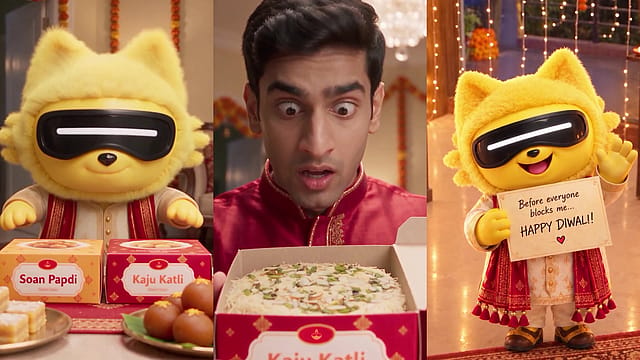
Realme’s yellow mascot has been tampering with the Diwali mithai. It swaps the labels on boxes of kaju katli and soan papdi, then retreats behind a door to enjoy the consequences. A young man opens his supposedly promising box. His expression suggests the joke will require explaining.
The mischief continues through the festive gathering. Eventually, the mascot appears with a handwritten appeal: “Before everyone blocks me… HAPPY DIWALI!”
Realme may want to keep that placard handy for its next meeting with retailers.
Its “Real Wali Diwali” campaign promises festive bargains. The All India Mobile Retailers Association, or AIMRA, alleges that online prices for the brand’s P4 range are undermining physical stores. It wants price parity, warns of stock getting stuck in distribution and has raised the possibility of discontinuing dialogue if the problems persist.

The Era of Forever Wars
30 Oct 2026 - Vol 05 | Issue 44
Coping with an explosive Middle East
For a brand already losing ground in India, Diwali is a particularly unfortunate time to have that conversation. The campaign is trying to bring customers closer to a purchase. The shopkeeper is asking what he should tell them when they arrive.
“During Diwali, brands are trying to convert a great deal of accumulated interest into purchases within a short window,” says Ashita Aggarwal, professor of marketing at SP Jain Institute of Management & Research.
A retailer occupied with defending a price has less time to sell the phone. That is an expensive additional assignment during the season when everyone is supposed to be reaching for their wallets.
The discount needs somebody to explain it
Realme’s promotional channel has advertised P-series discounts of up to ₹5,000 and financing benefits on Flipkart. An earlier announcement put the combined value of offers across its smartphone and connected-device portfolio at ₹500 crore.
The large number supplies the festive theatre. The smaller numbers attached to individual phones decide whether somebody buys one.
AIMRA claims some Realme phones are up to ₹6,000 cheaper online than at physical stores, leaving shopkeepers struggling to explain the difference to customers. But are buyers comparing the same model on the same day? Does the online price require a particular bank card or exchanging an old phone?
For the customer, the question is simpler: why does the same phone cost more at this shop?
The retailer lends the brand his own credibility when he recommends a handset. If the customer believes he has been quoted too much, the explanation lands at the counter, even when the price difference originates elsewhere. “Repeated uncertainty makes that recommendation harder to give,” says Aggarwal.
A person expected to explain the product is now required to explain the company. The camera demonstration was probably going rather better.
Realme was already slipping
IDC’s April–June 2026 figures put Realme’s India smartphone shipment share at 9.3%, against 9.7% a year earlier. Its unit shipments fell 14.2%, compared with an 11.1% decline for the market. Realme ranked fifth.
The share loss was 0.4 percentage points. That is modest erosion, although its shipments were contracting faster than the overall market.
Counterpoint’s quarterly share table points in the same direction. It puts Realme at 10% in Q2 2025 and 9% in Q2 2026. Its rounded figures also show 11% in Q1 2025, followed by 9% in each of the first two quarters of 2026.
The trackers use separate estimates, but both indicate a weaker position than a year earlier.
AIMRA separately alleges that Realme’s October sales fell more than 60% year-on-year. That claim should not be read as a verified nationwide sales figure. Its scope is unclear, including whether it concerns particular models or channels.
The earlier market-share decline also cannot be attributed to an October dispute. What the figures establish is that Realme entered the festive selling period with ground to recover.
Its retailer disagreement had already supplied a warning. In a July 6 letter to founder Sky Li, AIMRA reportedly sought clarity about Realme’s India strategy, leadership changes and support for offline retail. It also questioned pricing decisions that it said were weakening the brand’s value proposition.
The association argued that Realme’s C-series had previously given dealers a useful price advantage over comparable Oppo and Vivo devices. As that advantage narrowed, it questioned how the company expected physical stores to drive sales.
These were the retailers’ arguments, rather than an independent assessment of the competing phones. They nevertheless show that the latest complaint has a history.
Diwali has now put a deadline on the discussion. A customer can leave with another brand while everyone is still composing the next email.
The next counter is open
IDC’s channel figures make the friction more awkward.
Offline channels accounted for 58.1% of India’s smartphone shipments in Q2, up from 53.6% a year earlier. Their volumes fell 3.6%, while online shipments declined 19.8%.
Physical stores were hurting, but holding up better. Keeping them enthusiastic about selling your phones would seem a useful festive ambition.
Their role also extends beyond handing over a sealed box. Buyers can compare models, handle the device and work through financing options. A customer uncertain about the expense can ask another question before committing.
That reassurance has value for the brand receiving the recommendation. So does the retailer’s time. Demonstrating one handset means postponing the sales pitch for another.
“A competitor can exploit that opening by making its product easier to recommend and its commercial terms easier to explain,” says Aggarwal.
Samsung provides a useful comparison. Counterpoint says it reclaimed India’s top shipment position in Q3 2026 with a 17% share. The firm credits relatively measured price increases, management of memory costs and a balanced online–offline approach among the factors supporting its performance.
That does not mean Samsung has solved every dealer grievance. It does put channel management squarely in the competitive picture.
A rival could approach dissatisfied dealers with reliable stock, clearer offer conditions, financing support or more predictable selling terms. None of that would require an advertisement announcing that Realme had annoyed somebody.
The opportunity could emerge when a customer asks to compare two similarly priced phones. Which one gets demonstrated first? Which one receives the more enthusiastic explanation?
There is no evidence that this dispute has caused retailers to switch recommendations or delivered sales gains to competitors. Those are potential consequences, not established outcomes.
They are still uncomfortable possibilities for Realme. The national campaign can get a customer interested. It cannot accompany every buyer into the shop and supervise the conversation.
The customer deserves the saving
Retailers have a commercial interest in protecting their margins. Their dissatisfaction does not automatically make a discount unfair.
A customer saving ₹2,000 may consider that an excellent outcome. He is under no obligation to finance harmony between a manufacturer, a marketplace and a distributor.
Nor should a buyer have to study the funding arrangements behind every promotional benefit. If the offer is clear and he qualifies for it, the saving is his to enjoy.
Realme faces cost pressure, too. On October 12, it reportedly raised prices across seven variants by ₹1,000–₹5,000. A communication to retail partners attributed the revisions to higher memory, chipset and other ecosystem costs.
Those revisions concerned a different set of models from the P4 examples in the current complaint. They help explain the broader pressure on pricing.
Counterpoint reported a 20% year-on-year fall in India’s Q3 smartphone shipments. Shipments below ₹20,000 dropped 47%, with rising prices pushing models into higher bands as affordability weakened.
That is a difficult market in which to keep customers, dealers and the finance department equally cheerful. Buyers can postpone upgrades. Dealers need stock to move. Manufacturers must accommodate costs that a festive campaign cannot wish away.
Discounting is an understandable attempt to persuade hesitant customers. The problem arises when one advertised bargain makes another sales channel look unreasonably expensive.
Matching every price everywhere is not the only possible answer. Financing, exchange benefits, service and other clearly explained differences can give buyers reasons to choose between offers.
But the explanation has to survive an ordinary conversation. If the customer cannot understand the gap and the dealer cannot defend it, the campaign has created an objection alongside the incentive.
AIMRA’s warning about stranded inventory adds another practical concern. Phones sitting in distribution absorb money somebody expected to recover through sales. A shipment may have reached the channel; the buyer still has to take it home.
That distinction becomes especially important for a brand trying to regain momentum. Discounts need to move phones through the system without leaving the people selling them wondering whether they have been given the least attractive offer.
Realme has a worthwhile festive proposition if it can make an upgrade affordable. Its challenge is ensuring that the bargain remains persuasive after the customer starts comparing prices.
The mascot can swap the labels on two boxes of mithai and retreat behind a door. The shopkeeper has to stay at the counter and explain the price.
“Before everyone blocks me,” says the placard. Perhaps take that one to the retailer meeting.