Meta Unveils Brain2Qwerty v2 That Converts Thoughts Into Text Without Surgery
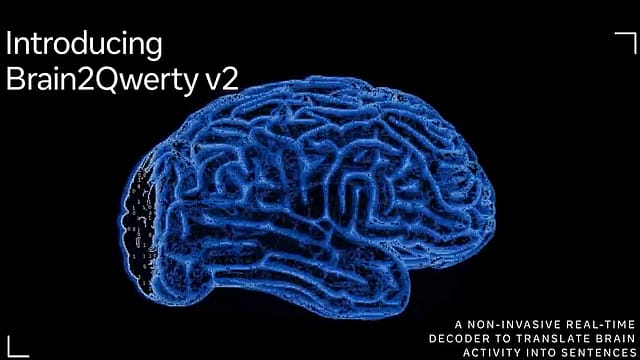
Meta has unveiled Brain2Qwerty v2, a new artificial intelligence (AI) system that can decode brain activity into text without requiring any surgical implant, marking a significant step forward in brain-computer interface research.
According to the company, Brain2Qwerty v2 is the highest-performing end-to-end pipeline capable of real-time sentence decoding from non-invasive brain recordings.
Meta said the technology is approaching levels of accuracy that were previously possible only through techniques involving brain surgery.

Rise of the Pivotal Power
18 Sep 2026 - Vol 05 | Issue 38
The BRICS declaration is a strategic victory for Modi
The company said the research could help millions of people suffering from brain lesions and other conditions that prevent them from communicating.
How does Meta’s Brain2Qwerty v2 decode text from non-invasive brain signals?
Unlike invasive methods such as stereotactic electroencephalography and electrocorticography, which require surgical implants to capture brain signals, Brain2Qwerty uses non-invasive recordings to decode intended text.
Meta said it trained Brain2Qwerty v2 using around 22,000 sentences collected from nine volunteer participants. Each participant spent about 10 hours wearing a magnetoencephalography (MEG) device while actively typing.
The company explained that the system uses end-to-end deep learning to decode language directly from raw brain signals instead of relying on manually designed pipelines to identify neural events.
According to Meta, large language models were fine-tuned on neural data, enabling the system to use semantic context to bridge the gap between noisy brain signals and coherent language.
The company also deployed AI agents to explore optimizations in the decoding process, with final training configurations selected by engineers.
Meta said the new system achieved a word accuracy rate of 61 per cent, a significant improvement over the 8 per cent word accuracy achieved by other non-invasive methods.
For the best-performing participant in the study, the system reached a word accuracy rate of 78 per cent, with more than half of all decoded sentences containing one word error or less.
The company also found that decoding accuracy improved as more training data became available, suggesting that the performance gap between non-invasive and surgical approaches could be reduced further through larger datasets.
To support further research, Meta announced that it is releasing the full training code for Brain2Qwerty v1 and v2. Its research partner, the Basque Center on Cognition, Brain and Language (BCBL), will also release the Brain2Qwerty v1 dataset.
(With inputs from ANI)