N Chandrasekaran: A Turn of the Tata Page
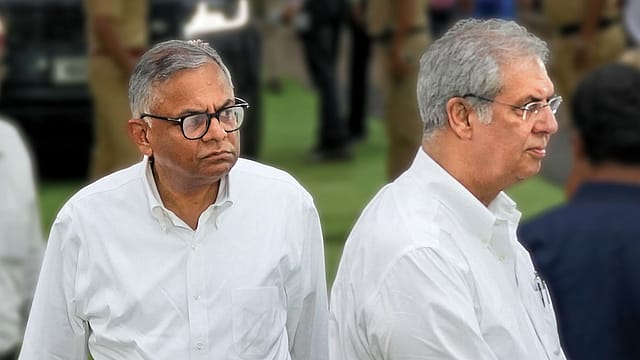
IN DECEMBER 2016, Ratan Tata told N Chandrasekaran he could be the frontrunner for the job of Tata Sons chairman, the person who leads the group. He went home and informed his wife. Her reply was, “You are currently very happy reading this page of the book. You would not know what is coming next unless you turn the page.” The anecdote comes from Thomas Mathew’s biography of Ratan Tata. A month later, Chandrasekaran was appointed chairman. In what has caught the markets by surprise, he has just announced that once his term ends on February 20, 2027, he won’t seek an extension. The group, he stated, had several strategic projects being executed, and whoever would lead needed stability. This was something he himself perhaps had found wanting lately. His announcement reveals that the two Tata Trusts, which hold a majority of Tata Sons, the holding company of the group, had unanimously recommended an extension to him. But at the Tata Sons board meeting this February, one member didn’t support it and Chandrasekaran decided to defer it. With no clarity even after six months, he decided that he was no longer happy reading the page.
Chandrasekaran was the first Tata chairman not related to the family. Or a Parsi. He was however connected to the Tatas his entire adult life. Coming from an agricultural family, he had been near the end of his Master of Computer Applications (MCA) course at REC, Trichy when a project led to an internship at Tata Consultancy Services (TCS). That led to a job offer there itself. Since then, he has been with the group where TCS had a unique position. The Tatas have an extensive presence in many sectors, but TCS has been the cash generator that allowed other companies access to capital during their growth phase. It was the financial bedrock from which the group made its other plans. And Chandrasekaran was responsible for one of the greatest phases of TCS’ growth. During his tenure as its CEO, revenues grew by more than $10 billion and the company was making nearly $4 billion in profits.
In the early 1990s, S Ramadorai, who would become TCS CEO, had spotted his potential. In an appendix to Ramadorai’s book, The TCS Story...and Beyond, Chandrasekaran writes about how he first came to Ramadorai’s notice after an assignment led to an award from a major US client. “Ram then assigned me to another complex project in the UK for a company that later became one of TCS’ largest clients. In September 1996, Ram had just taken over as CEO of TCS. I happened to be in Mumbai during a client visit. During a break in the meeting, Ram said in his typical soft-spoken manner, ‘I want you to work in my office.’” he wrote. When Ramadorai retired, Chandrasekaran, chief operating officer then, was the natural successor.
His journey to Tata Sons chairman, however, wasn’t as seamless and came under testing circumstances. Ratan Tata had modernised the group for a post-liberalisation world and then he had turned it global with acquisitions like Corus and Jaguar Land Rover. When he relinquished his position as the head of the Tatas, it was to Cyrus Mistry, who was not a Tata but the brother-in-law of one. He had led the Shapoorji Pallonji Group, which held a large shareholding of Tata Sons. Within a few years of Mistry’s taking over, Ratan Tata decided that a wrong decision had been made. Mistry was removed in a boardroom coup. A selection committee, guided by Ratan Tata, chose Chandrasekaran. He had a proven track record and could take it into a future being radically reshaped by technology.
Chandrasekaran has been able to do the steering. The chairman’s letter in this year’s annual report of Tata Sons says that revenue has doubled and profits multiplied five times since 2020. Besides the traditional drivers like TCS, Tata Steel, Titan, Tata Motors, etc, the group is now into cutting-edge sectors like AI infrastructure and semiconductor manufacturing. There are areas of challenge too. Air India, which was bought from the government under Chandrasekaran's charge, still has a bleeding bottom line and Tata Digital, which houses the ecommerce brands, makes huge losses too.
To steer a group as vast as the Tatas needs a unique set of characteristics that Chandrasekaran brought in—familiarity with the group, unquestioned loyalty to its ethos and business acumen. There is also personal flair. For example, in his mid-40s, after a health scare, he decided to take up running. Within eight months, he was finishing marathons.
Though Chandrasekaran does not name him, according to media reports, the person who did not agree to the extension is Noel Tata, the half-brother of Ratan Tata, someone who himself has a track record of building a very profitable business, Trent, within the group. But he is the chairman of the Tata Trusts and, for now at least, that is a bar on holding chairmanship of Tata Sons as per the articles of association. The uncertainty of who will lead is something the group will have to grapple with. Soon after Chandrasekaran’s announcement, the markets reacted with shares of Tata companies falling. Successions happen very infrequently in the group, but when they do, it can be a period of upheaval. Even Ratan Tata, as Mathew’s biography states, took years before he could exercise full control and execute his vision.
The biggest concern on the horizon is TCS itself. It brings in Rs 50,000 crore of profits every year, half of it going to the holding company as dividend, which is then routed into other group companies. But the business TCS is in, information technology, is almost certain to be upended by artificial intelligence. Negotiating it into that future will be critical for the Tatas and the person who may be equipped to do that is the one who has just put in his papers.