LPG Concerns Spark Electric Cooking Rush as Homes and Restaurants Scramble for Alternatives
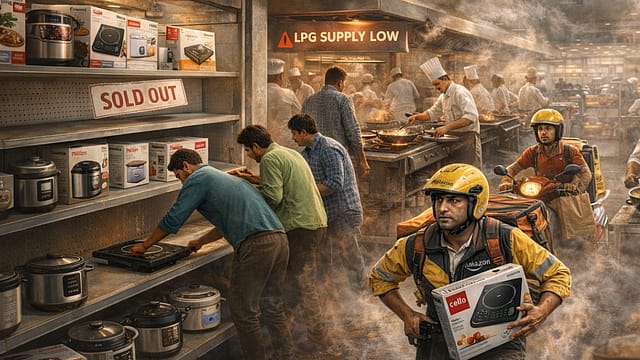
Concerns over LPG availability have triggered a sudden shift in India’s kitchens. Over the past few days, households across major cities have rushed to buy electric cooking appliances, sending sales of induction cooktops, rice cookers and electric pressure cookers soaring.
On several quick-commerce platforms across Delhi-NCR, induction cooktops are already running out of stock as consumers scramble to secure backup cooking options.
What was once seen as a convenience appliance is suddenly becoming a necessity.
A Sudden Spike in Electric Cooking
E-commerce platforms say the shift has been immediate and dramatic.
According to an Amazon India spokesperson, sales of induction cooktops have surged more than 30 times over the past two days, while rice cookers and electric pressure cookers have recorded a fourfold increase in demand. Other small kitchen appliances are also seeing strong traction.

Losing Memory
16 Oct 2026 - Vol 05 | Issue 42
The making of a medical and social emergency
“Over the last two days, sales of induction cooktops have increased over 30X, while rice cookers and electric pressure cookers are seeing a 4X increase. Air fryers and multi-use kettles are also seeing a 2X increase in sales over a regular day,” an Amazon India spokesperson said.
The speed of delivery is also shaping buying behaviour. Many consumers are opting for instant delivery through quick-commerce services.
“Customers are using Amazon Now to get similar products within minutes in parts of Delhi-NCR, Mumbai and Bengaluru,” the spokesperson added.
The rush suggests that households are not simply experimenting with electric appliances but actively preparing for disruptions in LPG availability, or we can say they don’t have any choice.
A Boom Across the Electric Kitchen Ecosystem
Appliance makers say the surge goes far beyond induction cooktops.
Ravi Saxena, CEO and Founder of Wonderchef, said the company has seen an unprecedented 10-fold surge in demand for induction cooktops and electric cooking appliances in recent days, significantly higher than the 15–20% increase typically seen during minor supply disruptions.
“We are witnessing an unprecedented 10X surge in demand for induction cooktops along with electric cooking appliances over the last few days,” Saxena said.
The demand spike is creating ripple effects across the broader kitchen appliance ecosystem.
According to Saxena, sales of electric kettles, rice cookers, air fryers, OTGs and electric pressure cookers have increased nearly fivefold, while demand for induction-compatible cookware has also surged as consumers prepare their kitchens for electric cooking.
The shift is most visible in India’s large metropolitan markets.
Cities such as Delhi, Mumbai, Chennai, Kolkata and Bengaluru are leading the demand due to higher e-commerce penetration and a large base of working professionals who rely heavily on LPG cylinders. However, the trend is not limited to metros.
Saxena said Tier-2 and Tier-3 towns are also seeing a sharp increase in demand, particularly in areas where LPG refill cycles have begun stretching.
“In regions where LPG refill cycles have stretched, we are seeing a significant shift,” he said, noting that the urgency is particularly high in urban areas that depend on cylinder deliveries rather than piped natural gas.
Restaurants Face a Much Tougher Challenge
While households are finding alternatives, the restaurant industry is facing a far more complex situation.
Commercial kitchens depend heavily on LPG because it allows high-volume cooking at consistent heat levels. Electric alternatives, while useful for households, are often impractical for large-scale cooking.
Industry bodies say restaurants across the country are already adjusting their operations.
“The situation on the ground is becoming increasingly challenging for restaurants across the country,” said Ankur Sharma, Management Committee Member at the National Restaurant Association of India (NRAI).
“Our industry is nearly 95% dependent on LPG for daily operations, and many restaurant partners are already streamlining menus and taking austerity measures just to keep their kitchens running,” Sharma said.
Some restaurants are reducing menu items that require prolonged cooking, while others are adjusting kitchen operations to conserve fuel.
The industry is also seeking greater clarity from authorities regarding supply.
“We understand that the government has identified priority sectors for LPG allocation, and currently the restaurant industry is not part of that list,” Sharma said.
However, he argued that restaurants remain essential for millions of consumers who rely on them for everyday meals.
“During the COVID pandemic as well, restaurants continued to operate and played a crucial role in serving communities across the country,” he added.
For operators, the bigger concern is uncertainty.
“At present, there is very little visibility on future supply, making it difficult for restaurants to plan operations ahead,” Sharma said.
Smaller Food Providers Already Feeling the Pressure
The impact is even more visible among small-scale food providers such as PG accommodations and shared kitchens.
Rahul Kumar, who operates a paying guest accommodation in Noida, said he has already started modifying meal services in response to rising fuel costs.
“We have cut down the quantity of meals served and have completely stopped making rotis,” Kumar said.
Bulk cooking requires large burners that cannot easily be replaced by electric appliances, he explained.
“While electric cooking is possible, it is not really feasible. It also increases the cost of preparing food nearly four times compared to LPG.”
For operators running on tight margins, such cost increases can quickly become unsustainable.
“For now, we are managing somehow, but there is uncertainty about how long this situation will continue,” he said.
Restaurants Trying to Avoid Price Hikes — For Now
Despite rising costs, many restaurant owners are still reluctant to increase menu prices immediately.
Instead, several establishments are absorbing the additional operational expenses in the short term in order to avoid losing customers.
But early signs of price adjustments are already beginning to appear.
Some restaurants that were already partly dependent on induction-based cooking have started introducing LPG-related surcharges or modest price hikes.
For example, an omelette sandwich that previously cost ₹80 is now being priced closer to ₹95–100 in some outlets.
Such incremental increases may become more common if supply constraints persist.
A Potential Turning Point for the Indian Kitchen
Industry leaders believe the current disruption could accelerate a longer-term change in how Indian households cook.
Electric appliances have been gradually gaining popularity over the past decade, but LPG has remained the primary cooking fuel for most households.
The current crisis may push consumers toward a more diversified kitchen setup.
“Crises often accelerate behaviour that was already trending,” Saxena said.
According to him, the hybrid kitchen model — where LPG and electric appliances coexist — is likely to become more common as households seek to reduce their dependence on a single fuel source.
“Once a household experiences the speed, safety and precision of induction cooking, they rarely go back to using it only as a backup,” he said.
For now, the rush toward electric cooking is largely reactive. But if the shift continues, India’s kitchens may emerge from the disruption looking very different — more flexible, more electrified and less dependent on a single cooking fuel.