Kundli Meets Code: InstaAstro’s $12-Million Bet on AI Reading the Customer
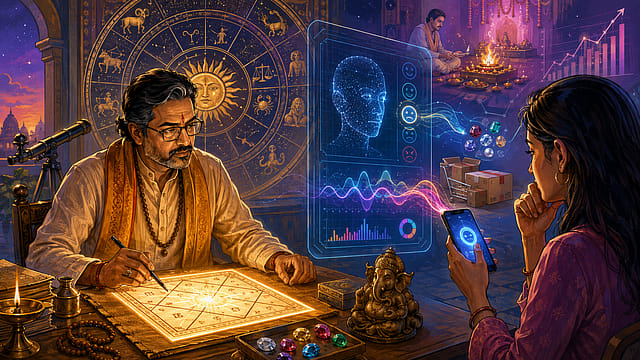
Artificial intelligence has been asked to write poetry, diagnose disease, drive cars and eliminate large portions of the white-collar workforce.
InstaAstro has found another assignment for it. Read the customer before the astrologer reads the stars.
The online astrology and spiritual-wellness company plans to deploy AI-powered sentiment analysis that can help its astrologers understand the emotional context in which a question is being asked. The technology will not decide whether Saturn is misbehaving or Mars is interfering with a marriage. Its job will be more immediate: detect the mood of the human being seeking an answer.
An algorithm may notice the anxiety. The astrologer can then explain the planets accordingly.
That intriguing marriage of ancient belief and modern behavioural technology sits inside InstaAstro’s new $12 million Series A funding round. The investment was led by Singularity AMC and Artha Venture Fund, with founder Nitin Verma and Artha managing partner Anirudh Damani also reportedly participating in their personal capacities.

Zeroing In on ECI
09 Oct 2026 - Vol 05 | Issue 41
Constitutional legitimacy versus political opportunism
The company plans to use the capital for AI-led products, multilingual services, expansion within India and overseas, online pujas and spiritual commerce.
The funding announcement is straightforward. The business being assembled underneath it is considerably more ambitious.
InstaAstro is attempting to turn astrology from an episodic consultation into a continuous commercial relationship. A customer can arrive with uncertainty, speak to an astrologer, receive a personalised recommendation, book a ritual and purchase the product prescribed as part of the remedy.
The horoscope is no longer merely an answer. It is the entrance to the store.
The Algorithm in the Kundli
InstaAstro began in 2021 as an on-demand astrology consultation platform. It now offers tarot, numerology, vastu, kundli readings, online pujas, courses and spiritual products.
The company says it has 12 million registered users, more than 5,000 verified experts and customers across 183 countries. Its expert network reportedly numbered around 1,500 when it raised its previous round.
Its financial growth has been equally rapid. Revenue more than doubled from ₹52 crore in FY25 to ₹111.26 crore in FY26. InstaAstro says its annualised revenue run-rate has since crossed ₹200 crore, although it has not disclosed its profit or loss for FY26.
Around 25 per cent of revenue reportedly comes from international markets, driven largely by the Indian diaspora. Tier I cities produce a larger share of domestic revenue, while Tier II and Tier III markets are growing faster.
AI can help it attack both opportunities.
Multilingual technology can make consultations easier to scale across Indian languages and overseas markets. Automated astrological calculations can reduce the time required to prepare charts and recommendations. Sentiment analysis can give the human expert another layer of information before responding.
The astrologer brings authority and empathy. The machine brings speed, consistency, translation and data.
Whether it brings greater astrological accuracy is another matter. Commercially, that may not even be the most important question.
For a platform, the essential task is to make a deeply personal service repeatable without making it feel mechanical. AI allows the business to standardise the machinery while preserving the impression of an intimate conversation.
InstaAstro is therefore not using AI to remove astrologers. It is using AI to help thousands of astrologers behave more like one scalable organisation.
Ancient Faith Gets an Operating System
AI is giving astrology a new lease of digital life. It can generate kundlis instantly, personalise forecasts at enormous scale, translate consultations across languages and remain available when the neighbourhood astrologer is asleep.
InstaAstro is not alone. Melooha describes itself as an AI-powered platform offering hyper-personalised guidance based on a user’s birth details. AstroSure.ai, which raised $6 million in 2025, offers real-time astrological insights through a virtual assistant called Agastyaa. The company has said the assistant draws upon Vedic texts and astrological rules instead of generic responses. Astrotalk now advertises AI-generated predictions alongside its marketplace of human astrologers, while Astroyogi is combining technology-assisted services with consultations, spiritual products and healing services. (Melooha, AstroSure.ai, Astrotalk, Astroyogi)
InstaAstro’s sentiment-analysis plan moves the combination into more intriguing territory. The machine will not merely calculate planetary positions. It could help the astrologer read the customer’s emotional weather.
Ancient faith is acquiring a modern operating system.
The Giant in InstaAstro’s Horoscope
The opportunity is large. So is the competitor standing directly in front of it.
Astrotalk posted operating revenue of ₹1,176 crore in FY25, up 81 per cent from ₹651 crore a year earlier. Its profit before tax reportedly climbed 125 per cent to ₹285 crore. It operates with more than 20,000 active astrologers on its platform. Available financial figures also indicate a 27 per cent rise in user engagement.
Astrotalk’s FY25 revenue was more than ten times InstaAstro’s reported FY26 revenue, although the figures belong to different financial years.
That scale explains why InstaAstro needs capital even while growing rapidly. It is entering the expensive phase in which attracting users is no longer enough. It must recruit and police expert supply, improve conversion, build trust, expand across languages and persuade customers to keep returning.
It must also compete beyond consultation.
Astrotalk reportedly generated more than ₹140 crore from ecommerce in 2025, within a year of entering the segment. It is expanding into gemstones, spiritual products and offline retail as it attempts to build a full-stack spirituality company.
InstaAstro’s expansion into Pooja Seva and spiritual commerce is therefore not a decorative addition. It is a response to the direction in which the market leader is moving.
The battle is shifting from who owns the astrologer to who owns the believer’s entire spiritual journey.
From Anxiety to Shopping Cart
Astrology is particularly suited to platform economics because the need it addresses rarely concludes permanently.
One question is answered. Life supplies another. A relationship changes. A job disappears. An examination approaches. A marriage stalls. A business struggles. A family worries. The customer returns with a fresh uncertainty and a new set of planetary suspects.
Digital platforms remove the traditional friction involved in seeking advice. There is no appointment, social hesitation or geographical limitation. A customer can connect instantly, privately and at almost any hour. Introductory prices reduce the barrier further.
AI adds another layer of scale. It can match customers with experts, recommend content, translate conversations, generate alerts and identify patterns that may improve retention. Sentiment analysis could allow the platform to respond differently to curiosity, distress, fear or urgency.
That power also carries a responsibility the funding celebrations rarely discuss.
Astrology platforms operate near the emotional fault lines of people’s lives. Personalisation can improve the customer experience, but it can also make commercial persuasion more powerful. A system capable of detecting vulnerability must be governed carefully when the same platform earns money from longer consultations, additional rituals or recommended products.
Trust, therefore, cannot be manufactured entirely by an algorithm. InstaAstro says it wants to build the world’s most trusted spiritual platform by prioritising quality over quantity. The difficult test will be whether quality controls can expand as quickly as users, experts and transactions.
Technology can organise belief. It cannot afford to exploit distress.
InstaAstro’s funding round is being described as a bet on faith-tech. More precisely, it is a bet that one of India’s oldest unorganised services can be transformed into an organised consumer platform.
The company wants to control consultation, personalisation, language, rituals, discovery and commerce. AI supplies the connective tissue. The astrologer becomes both expert and interface. The customer’s uncertainty begins a relationship that can travel from conversation to ceremony to commerce.
Investors are not being asked to believe that algorithms can predict the future. They are being asked to believe that algorithms can make the business of predicting it more scalable, personalised and profitable. That may be the least mysterious forecast in the entire astrology industry.
With inputs from agencies