India Needs National EV Export Strategy as Global Sales to Triple by 2030: FICCI-Yes Bank
India must move swiftly to craft a National Export Strategy for electric vehicles (EVs) as global demand surges and supply chains realign, according to a joint report by Federation of Indian Chambers of Commerce and Industry (FICCI) and Yes Bank.
Titled ‘EV Market – India’s Export Competitiveness’, the report was released at the 3rd FICCI National Conference on Electric Vehicles and argues that exports are no longer optional — they are central to scaling production, improving cost efficiency and securing India’s place in global value chains.
Global EV sales are projected to triple by 2030, making this a decisive decade for countries competing for manufacturing leadership.
"As India invests in ecosystem development to enhance capabilities and its EV market starts to gain significance, exports become a strategic opportunity to scale production, improve cost curves, develop high-quality products with technology learnings, apart from helping broaden market diversification, absorbing regulatory shifts, and develop a global positioning," the report said.

Losing Memory
16 Oct 2026 - Vol 05 | Issue 42
The making of a medical and social emergency
Why Does India Need an EV Export Strategy Now?
The report underscores that infrastructure expansion and alignment with international safety, sustainability and compliance standards are essential to unlock export opportunities across Europe, Latin America and Southeast Asia.
"Electric mobility continues to gain traction across vehicle segments and many countries are strengthening regulatory frameworks around safety, cybersecurity, battery traceability, and sustainability, which in turn are shaping market access conditions and often act as non-tariff barriers. The report highlights that these developments underscore the need for exporters to align with international trends, standards and compliance requirements," the report noted.
The global policy push toward clean mobility is intensifying. Governments increased purchase incentives by 5 per cent year-on-year to USD 19 billion in 2024. China led EV sales growth with strong incentives, while Europe’s expansion was driven by emissions compliance mandates.
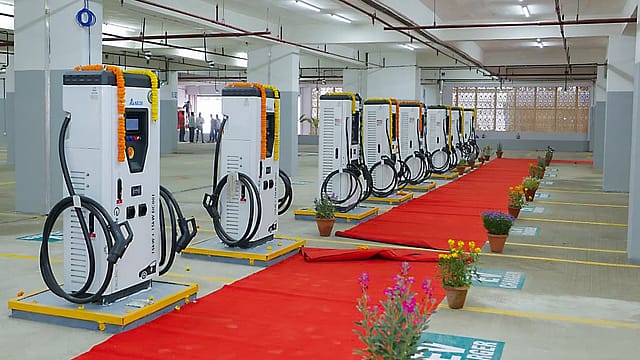
"Battery prices fell by 13% to USD 137/kWh in 2024; Advancements in cell chemistry, economies of scale from higher production, and improved supply chain efficiency. Charging also scaled up to meet demand, with 30% YoY increase in public chargers in 2024, driven by China and strong growth in Europe & the US," the report said.
These shifts signal both opportunity and urgency for India.
Can India Position Itself as a Global EV Manufacturing Hub?
Releasing the report, Heavy Industries and Steel Minister H. D. Kumaraswamy framed electric mobility as integral to India’s long-term economic strategy and its net-zero target by 2070.
"With clear policy direction and strong industry participation, India can firmly establish itself as a leading global center for electric mobility manufacturing and innovation. Electric mobility today is not merely a climate initiative, but it is an industrial strategy with strong manufacturing opportunity and supply-chain recalibration," Kumaraswamy said.
He encouraged industry to leverage India’s expanding Free Trade Agreements with the EU, UK and Australia to deepen export penetration.
"As our manufacturing depth strengthens, so does our export potential. Over the past decade, automotive component exports have nearly doubled, rising from about USD 8 billion to USD 16.9 billion, reflecting India's deepening integration into global value chains and its growing credibility as a manufacturing hub," he emphasised.
Highlighting policy backing, Kumaraswamy referenced the Rs 7,280 crore scheme for Sintered Rare Earth Permanent Magnets and stressed the centrality of EVs to the Make in India vision.
"As we advance towards the vision of Viksit Bharat 2047, electric mobility must remain central to the Make in India agenda," Kumaraswamy added.
Former G20 Sherpa Amitabh Kant described electric mobility as India’s next transformative leap.
"India must position itself as a trusted manufacturing hub for electric vehicles," Kant said, arguing that batteries, power electronics and charging infrastructure represent the new engines of value creation in a market projected to reach trillions of dollars.
Industry leaders echoed the optimism. Sulajja Firodia Motwani said, "With the first phase of e-mobility adoption, India made significant progress, and we are now entering a new and accelerated phase of the e-mobility transition."
Vikram Handa added, "From Green Mobility 1.0 to now 2.0, India has built an entire value chain. This spans from the processing of critical minerals to cell manufacturing, battery pack assembly, and the production of two-wheelers, three-wheelers, four-wheelers, buses, trucks, and even charging infrastructure."
Ganesh Mani emphasised the broader shift underway: "The shift to electric vehicles is not only about environmental benefits, but it is also about industrial and technological transformation. This transition will define the entire movement toward sustainable mobility for citizens across India."
Concluding the conference, Aanchal Jain stated that "electric mobility is no longer an emerging concept. It is now a strategic pillar of India's industrial transformation, climate action, and global trade ambitions."
As global EV demand accelerates and standards tighten, the report makes one message clear: India’s next leap in electric mobility will depend not only on domestic adoption but on its ability to compete — and win — in international markets.
(With inputs from ANI)