India’s Gold Jewellery Demand Slumps as Prices Surge, Middle-Class Buyers Pull Back
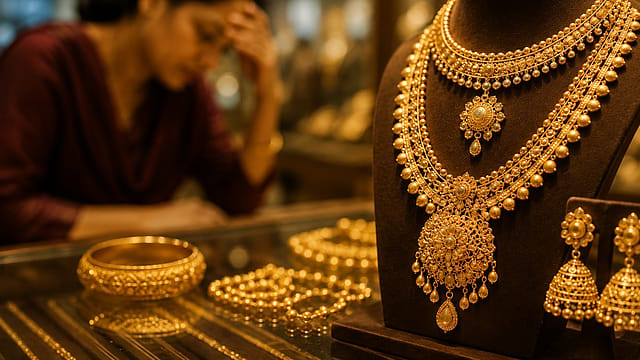
India’s organised gold jewellery retail sector was headed for one of its weakest volume years in a decade as soaring gold prices and higher import duties pushed consumers away from traditional jewellery buying.
According to a recent report by Crisil Ratings, organised gold jewellery sales volumes were expected to decline 13-15% this fiscal after already falling 8% last year. The report noted that the sector could see its lowest demand levels in a decade, excluding the pandemic-hit year.
The slowdown reflected a larger shift in how Indians were approaching gold purchases. What was once considered an essential household buy during weddings and festivals was increasingly becoming difficult for middle-class consumers to afford.
Crisil Ratings attributed the pressure largely to a sharp rise in domestic gold prices, which surged nearly 55% last fiscal due to geopolitical uncertainty, rising global gold rates and a weakening rupee. The impact deepened further after the government raised customs duty on gold to 15% from 6% to curb imports and reduce pressure on the trade deficit.
The shift was already visible on the ground. Jewellery retailers across cities reported consumers moving towards lightweight ornaments, lower-carat jewellery and studded pieces instead of heavy traditional designs. Crisil Ratings also observed growing demand for jewellery in the 16-22 carat range as buyers attempted to manage rising costs.

Open Minds 2026
26 Jun 2026 - Vol 05 | Issue 26
The power of ideas and arguments in 50 portraits
“People still come to buy because weddings cannot stop, but budgets have changed completely,” said a jewellery store executive in Lakhimpur Kheri. “Earlier families would buy full bridal sets. Now many are choosing lighter pieces or cutting quantities.”
Another retailer based in Delhi said many customers were spending more time calculating resale value and investment returns rather than purely shopping for jewellery. “Gold has emotionally always mattered in India, but now every customer first asks price per gram before even looking at designs,” the retailer said.
Crisil Ratings further highlighted that gold was increasingly being treated as an investment asset instead of a discretionary or ceremonial purchase. Over the past two fiscals, jewellery sales volumes had fallen nearly 25%, while demand for gold bars and coins surged more than 50%.
Despite weaker consumption, organised retailers were still expected to report strong revenue growth because higher gold prices significantly boosted realisations. Crisil Ratings estimated revenues for organised retailers could rise 20-25% this fiscal even as volumes declined sharply.
The report also noted that retailers could benefit from inventory gains as gold prices climbed further. However, a part of those gains might be offset through deeper discounts, promotional campaigns and the increasing share of lower-margin gold bars and coins.
At the same time, the high-price environment was increasing operational pressure on retailers. Crisil Ratings projected inventory holding periods to rise to 160-180 days this fiscal compared to around 150 days last year. Debt levels across organised retailers were also expected to increase as companies stocked more expensive inventory while continuing expansion plans.
Even amid the slowdown, organised jewellers continued expanding into Tier 2 and Tier 3 markets, largely through franchise-led models aimed at improving capital efficiency and widening reach.
The larger concern for the industry, however, appeared to be psychological. Gold in India had historically survived inflation, recessions and market volatility because of its emotional and cultural significance. But with prices remaining at record highs, affordability itself was emerging as the biggest challenge.
For many households, gold was no longer just expensive — it was slowly turning aspirational.