Neeraj Seth, Mr Frost, and the Founder Who Came Back to Compete With Himself
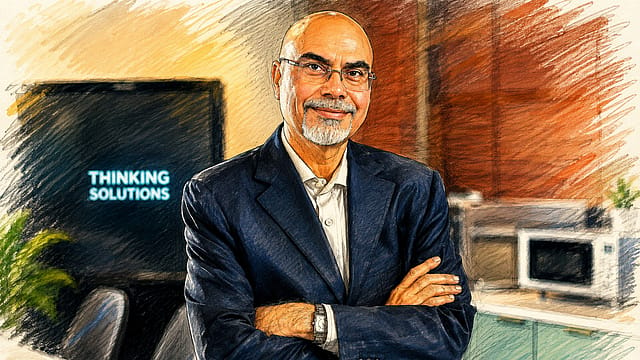
Everyone in India's foodservice industry has a nickname for Neeraj Seth. Mr Frost.
It is also a deeply misleading one. Because the most remarkable thing about Seth has nothing to do with refrigeration. It is that he competes every day against the company he once built.
Ask him about Celfrost, the company he founded in 2004 before selling it to an American multinational, and there is no trace of bitterness. Instead, he reaches for a metaphor.
"It's like my daughter," he says. "She has married into an American family."
He smiles. "I still want her to do well."
Then he pauses. "But my dharma is to build Trufrost."
Attachment on one side and duty on the other...few founders ever find themselves in that position. Fewer still choose to begin again at 58.

Greening the Future
23 Jul 2026 - Vol 05 | Issue 30
Securing a sustainable India
The nickname, it turns out, has survived longer than the company that gave birth to it.
Long before Trufrost & Butler crossed ₹200 crore in revenue, raised growth capital from Carpediem Capital and began preparing for its manufacturing journey, there was another company: Celfrost.
It was Seth's first entrepreneurial leap after a successful corporate career, scaled into one of India's best-known commercial refrigeration brands before being acquired by Chicago-headquartered Middleby Corporation in 2013.
For most founders, that would have been the culmination of a life's work.
Build. Exit. Move on.
Seth did move on. At least, he tried to.
The acquisition came with a five-year non-compete. He honoured it without exception. He travelled, made a few angel investments, spent time with family and discovered that retirement, even a temporary one, didn't quite suit him. "The semi-retirement mode," he says with a laugh, "did not keep me very motivated."
When the restriction finally ended, he wasn't interested in recreating Celfrost. That story had already been written. The question that occupied him was different. Had the foodservice industry really changed?
On the surface, almost everything had. Quick-service restaurants had spread beyond the metros. Coffee culture had exploded. Cloud kitchens had emerged. Food delivery had rewritten consumer habits.
Yet beneath that transformation, the same problems persisted. Restaurants still struggled with consistency. Imported equipment continued to falter in Indian conditions. After-sales service remained patchy. Operators were still choosing between expensive imported machines and cheaper products that often compromised reliability. The market had evolved. Its pain points had not.
Years later, that realisation would become Trufrost & Butler. Not an attempt to rebuild what he had once created. But an opportunity to build what he had missed the first time.
THE ACCIDENTAL ENTREPRENEUR
Seth doesn't romanticise entrepreneurship.
Ask him when he first dreamt of building a company and his answer is immediate.
"Never."
There was no family business waiting to be inherited. No childhood ambition to become a founder. For more than two decades, corporate India had given him exactly the career he wanted.
He worked at Nerolac Paints, Usha International and eventually Blue Star, where he headed its commercial refrigeration business. Promotions came steadily. Responsibilities grew. By 2004, he had reached what he calls the pinnacle of his corporate career.
Then, almost overnight, certainty disappeared. He had to leave.
At 44, finding another leadership role proved far more difficult than he had imagined. "The pyramid gets narrower at the top," he says. There simply weren't many opportunities.
The timing couldn't have been worse. He had recently bought a house. The home loan was substantial. His two daughters were still studying. For the first time in years, the future refused to follow the script. It is one of the few moments during our conversation when Seth slows down.
"You touched a very soft chord," he says quietly. He rarely speaks about those months.
Fortunately, someone else did. His wife. Instead of asking him to wait for the next corporate opportunity, she asked a different question.
"If you're not getting a good job... why don't you start something of your own?"
The suggestion wasn't born out of entrepreneurial romance. It was born out of necessity.
Looking back, Seth often describes himself as an accidental entrepreneur.
But accidents, too, need an opportunity. His arrived in the form of a phone call.
Blue Star had been distributing refrigeration products for Vestfrost, the Danish manufacturer. As the company shifted its priorities, Vestfrost began looking for a new distribution partner in India.
They called Seth. Would he take it on? He said yes.
There were no venture capital firms backing first-time founders. No startup ecosystem celebrating entrepreneurship. No playbook. Just experience, relationships and a willingness to begin again. That was enough.
Celfrost was born.
The transition, however, was anything but smooth.
Inside Blue Star, Seth had represented one of India's most respected companies. Outside it, he was simply another entrepreneur trying to persuade customers to trust a new name.
"The trade knew you because of Blue Star," he recalls. "Now you were a much smaller entrepreneur."
People welcomed him warmly. But familiarity did not automatically translate into business. Trust had to be earned all over again. Customer by customer. City by city.
The effort slowly began to pay off. Starting with commercial refrigeration, Celfrost expanded into ice machines, cold rooms, beverage refrigeration and specialised foodservice equipment. Over the next decade, it built a nationwide presence, supplied equipment to brands such as McDonald's, KFC and Pizza Hut, and grew into one of India's most respected names in the category.
The business was growing. So was Seth's understanding of the industry. Working with some of the world's largest restaurant chains gave him a ringside view of how hospitality itself was changing. Restaurants weren't simply buying refrigerators. They were buying consistency. Whether it was a burger in Delhi, a pizza in Bengaluru or a coffee in Guwahati, customers expected the same experience every single time.
Behind that promise sat something most diners never thought about. Equipment. Processes. Service. Technology. The better Seth understood those invisible systems, the more convinced he became that the future of foodservice would belong to companies that solved operational problems—not merely those that sold equipment.
He didn't know it then. But one meeting in 2008 would completely reshape that conviction.
THE CONVERSATION THAT CHANGED THE MENU
By 2008, Celfrost had found its footing.
The business was growing. New customers were coming on board. Global restaurant chains were beginning to reshape India's foodservice landscape, and Seth was spending more time understanding how kitchens functioned than simply selling refrigeration equipment.
Then came a meeting that almost didn't matter.
Seth had gone to meet Sandeep Sharma, who headed the supply chain at Barista Coffee Company.
The agenda was straightforward: Introduce Celfrost's refrigeration solutions. He had barely settled into his presentation when Sharma interrupted him.
"Put the laptop away."
For a fleeting moment, Seth thought the meeting was over. Instead, Sharma asked a question he hadn't anticipated. "I know refrigeration is your strength. But what about coffee machines?"
Seth smiled.
"The only 'C' I know is Cooling," he replied. "Not Coffee."
Sharma wasn't interested in what Seth already knew. He was interested in whether Seth could learn.
Barista had been struggling with after-sales service for its coffee machines. Sharma believed Seth understood service well enough to solve the problem.
Most people would have politely declined. Seth didn't.
"Why not?"
Ten days later, he was in Milan, sitting across the leadership team of La Cimbali, one of Italy's most respected commercial coffee machine manufacturers. He returned to India with an exclusive distribution agreement.
Looking back, Seth often describes the episode as a fortunate turn of events. It was much more than that. It quietly changed the way he thought about the business. Until then, Celfrost had largely been selling equipment. Coffee forced him to think about ecosystems. A café didn't simply need refrigeration. It needed coffee machines. A bakery needed ovens. A restaurant needed refrigeration, cooking equipment, preparation stations and service working together seamlessly. Customers weren't looking for products. They were trying to build businesses. That insight would stay with him long after Celfrost itself had changed hands.
Years later, when he returned to entrepreneurship after his non-compete, it would become one of the foundational ideas behind Trufrost & Butler. The company wasn't conceived as another refrigeration business. It was imagined as a complete foodservice solutions company. Sometimes strategy emerges from market research. Sometimes it begins with an unexpected question in the middle of a sales presentation. For Seth, it began with someone asking him to close his laptop.
THE COMPANY HE HAD TO LEAVE BEHIND
By the early 2010s, Celfrost had become one of India's most respected names in commercial refrigeration. Its footprint stretched across the country. Global hospitality brands trusted it. International manufacturers increasingly saw India as a market worth investing in.
One of them was Middleby Corporation. The Chicago-headquartered foodservice equipment giant had been watching Celfrost's growth for some time. Conversations that had begun around partnerships gradually evolved into something bigger: An acquisition.
For most entrepreneurs, selling the company they built is the ultimate validation. It certainly was for Seth. Middleby wasn't merely buying a business. It was buying the credibility, relationships and reputation that Celfrost had painstakingly built over nearly a decade.
The transaction was completed in 2013. Seth stayed on to help with the transition. It didn't take long to realise that the next chapter would be different. "The Americans wanted to have their own way," he says without any trace of disappointment.
There is no criticism in his voice. Only acceptance. Businesses evolve. Ownership changes. People move on. He did too.
The agreement required him to stay away from the industry for five years. He honoured every day of it.
There were opportunities to remain connected. Customers still called. Friends in the industry continued to seek advice. Hospitality, after all, had become part of his identity. Yet he kept his distance. Some agreements are legal. Others are personal. For Seth, honouring the non-compete was both.
He travelled. He made a handful of angel investments. He spent more time with family. He immersed himself in interests that had long remained on the margins of a demanding career—design, travel, literature and the occasional evening of Urdu poetry.
For a while, it was enough. Then the restlessness returned. Not because he missed running a company. Because he missed solving problems.
The more he reflected on his years at Celfrost, the clearer one realisation became. His first company had helped restaurants buy equipment. His second could help them build businesses. That distinction would change everything.
When Seth and his longtime colleague Satish Dudeja began discussing a return in 2018, they weren't interested in recreating Celfrost.
The market itself had moved on. Coffee culture had matured. Cloud kitchens had emerged. Restaurant chains were expanding into smaller cities. Customers expected consistency, not just good food. Operators needed partners who understood kitchens end to end. The opportunity was no longer refrigeration. It was foodservice.
Trufrost & Butler was conceived around that idea. Commercial refrigeration would remain central. But it would sit alongside cooking equipment, beverage solutions, kitchen planning, workflow optimisation and culinary support. The ambition was no longer to supply machines. It was to become part of the operating system behind India's hospitality industry.
The learning from Celfrost shaped almost every decision. Even the company's name.
During his first venture, Seth had experimented with introducing hot-side kitchen equipment under the Celfrost brand. Customers were puzzled.
"Anything with Frost couldn't possibly be hot," he says, laughing. This time, he separated the identities. Trufrost for refrigeration. Butler for the kitchen. A small decision but a lesson earned over fourteen years.
Then something happened that neither Seth nor Dudeja had anticipated. The market heard they were back. The phone started ringing. Former employees wanted to return. Dealers reached out. Customers called. The people who had helped build the first company wanted to help build the second.
Years later, Seth would borrow a line from Majrooh Sultanpuri to describe the experience. "मैं अकेला ही चला था जानिब-ए-मंज़िल मगर, लोग साथ आते गए और कारवाँ बनता गया (I had started walking towards my destination alone. People kept joining me, until it became a caravan.)"
That, perhaps, is the truest measure of an entrepreneur. Not how many people join a successful company. But how many choose to follow the founder into an uncertain one.
THE SECOND INNINGS
If Celfrost taught Seth how to build a company, Trufrost & Butler reflects what he learnt from building one.
The distinction is subtle but important. The first business grew by supplying equipment. The second is growing by solving operational problems.
Talk to Seth for an hour and one pattern becomes impossible to miss. He rarely begins with products. He begins with questions. Why should an entrepreneur spend lakhs on a commercial coffee machine without ever seeing it work? Why should equipment designed for European kitchens struggle in Indian temperatures, humidity and voltage conditions? Why should a restaurant operator have to coordinate multiple vendors when one integrated solution could simplify the entire kitchen?
Those questions shaped Trufrost & Butler far more than any business plan.
The company today spans commercial refrigeration, beverage systems, cooking equipment, kitchen design and culinary consultancy. Its Culinary Labs and Experience Centres allow restaurateurs, chefs and café owners to test equipment in real working kitchens before making investment decisions. The objective isn't simply to sell machines. It is to reduce uncertainty.
Ashita Aggarwal believes that mindset explains much of the company's momentum.
"India's foodservice ecosystem has evolved rapidly, but the supporting infrastructure hasn't always kept pace," reckons Aggarwal, professor of marketing at SP Jain Institute of Management & Research. Operators today aren't looking for vendors. They're looking for partners who understand their business end to end. “That's where Trufrost & Butler has differentiated itself," she adds.
Aggarwal points to another factor. The company has consistently invested ahead of demand—in service infrastructure, culinary support, experience centres and, more recently, manufacturing. Those decisions may not always produce the quickest returns. They tend to produce longer ones.
That philosophy found its strongest validation in September 2025, when Carpediem Capital invested ₹62 crore ($7 million) in Trufrost & Butler—its first institutional round. The capital is being deployed to strengthen manufacturing, deepen after-sales service, expand localisation and support the company's international ambitions.
For Seth, however, the investment represents something beyond growth capital. It is another beginning. For most of his career, he thought of himself as a marketer, a brand builder and a distributor.
Today, he is helping build a manufacturing business. The company's new facility in Bhiwandi marks another reinvention in a career that has been defined by them.
Recently, reflecting on the decision to invest before every uncertainty had disappeared, Seth recently wrote in one of his Linkedin posts: "Waiting rarely builds anything meaningful."
It reads like a business decision. It also reads like a biography. He didn't wait for another corporate job. He didn't wait for the perfect entrepreneurial blueprint. He didn't wait for the discomfort of starting over to disappear. And he didn't wait for the market to tell him it was ready. Every meaningful chapter of his career began before certainty arrived.
Today, everyone still calls him Mr Frost. The nickname survived a corporate career, an entrepreneurial leap, an acquisition, a five-year absence and a second company.
He has never seemed particularly interested in changing it. Perhaps because he understands something that many founders discover only much later. A company can give you a name. Only character gives that name meaning. Celfrost made Neeraj Seth Mr Frost. Trufrost & Butler is quietly redefining what that name stands for.
And somewhere between the two lies the story of an accidental entrepreneur who discovered that every time life asked him to begin again, he simply said yes.