Gujarat’s Japan investment push: What it means for Indian jobs, technology and exports
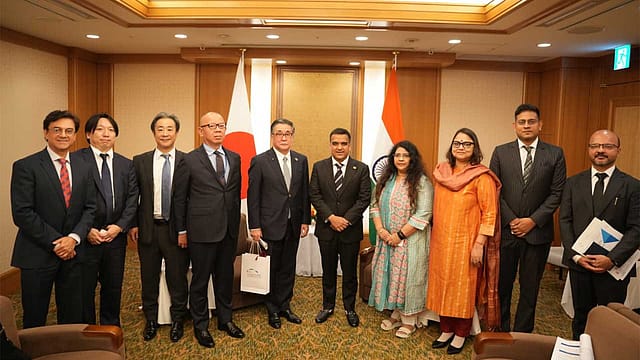
What if a Japanese technology partnership helped an Indian factory become more efficient, gave a local supplier a new customer or created skilled jobs closer to home? That is the potential behind Gujarat Deputy Chief Minister Harsh Sanghavi’s investment outreach in Japan. But the important distinction is between companies exploring opportunities and investments that actually materialise.
Sanghavi’s visit is part of Gujarat’s effort to attract fresh capital and technology ahead of the Vibrant Gujarat Global Summit, scheduled for January 10–12, 2027, in Gandhinagar. According to reports on the visit, the delegation has engaged Japanese companies across chemicals, textiles, life sciences, automotive components, green energy and digital technology.

Losing Memory
16 Oct 2026 - Vol 05 | Issue 42
The making of a medical and social emergency
What happened during Harsh Sanghavi’s Japan visit?
The latest development came on October 19, when Sanghavi held an “Invest in Gujarat” roundtable with Japanese industrialists and investors in Osaka. Earlier engagements included discussions with Ultrafabrics on synthetic leather, Kaneka Corporation on chemicals and life sciences, and Itochu Corporation on trade and green innovation.
The wider programme also identified opportunities involving Fujifilm in electronic materials, Yazaki India in automotive components, and Green Carbon in carbon-credit projects. Discussions with Hireso covered cloud computing and Global Capability Centres (GCCs), which multinational companies use for functions such as technology, research and business operations.
Sanghavi also met members of the Indian and Gujarati diaspora in Kobe, pitching stronger, sustained business links rather than relying solely on periodic investor summits. These engagements are intended to generate interest; they do not, by themselves, confirm that any company has approved a new investment.
How could Japanese investment create jobs for Indians?
The most direct potential benefit is employment. If companies establish or expand manufacturing facilities, research centres or digital operations in Gujarat, they could create jobs for engineers, technicians, software professionals and factory workers.
Local businesses may benefit, too. Indian small and medium enterprises could become suppliers of components, materials, logistics or professional services to Japanese firms. However, the scale of these benefits will depend on which proposals progress, how much companies invest and how many jobs they create.
For workers, the quality of employment matters as much as the number of jobs. Training, technology transfer and opportunities to move into higher-skilled roles would determine whether these partnerships produce lasting benefits.
Why do textiles, electronics and green energy matter?
Each sector offers a different route to growth. Japanese expertise in advanced materials and chemicals could support Indian manufacturing. Collaboration in electronic materials could strengthen supply chains serving the electronics and semiconductor industries. Automotive-component partnerships could benefit vehicle manufacturers and their suppliers.
In textiles, Gujarat is using its existing industrial base to attract Japanese investors and promote exports. New investment could help businesses upgrade production and reach overseas markets, provided demand and commercial conditions support expansion.
Green-energy and carbon-credit initiatives could open opportunities in lower-emission industrial processes and carbon-management projects. Their real environmental and economic value, however, would depend on implementation and credible measurement of results.
How does Gujarat’s push fit into India-Japan relations?
The outreach builds on a wider national partnership. Reuters reported that India and Japan’s July 2026 summit produced agreements covering artificial intelligence, energy, metals and economic security. The two countries have also been pursuing closer technology and manufacturing cooperation.
For India, stronger Japanese investment could diversify supply chains, support industrial development and deepen access to advanced technologies. Gujarat is competing to secure a share of those opportunities by offering investors an established manufacturing ecosystem.
Will Indians see immediate benefits?
Not necessarily. No confirmed investment totals, project timelines or job figures have been announced in the material available about this outreach. The next test will be whether meetings lead to signed agreements, factory expansions, research partnerships or operational projects.
For Indian workers and businesses, the promise is tangible. But the outcome will depend on what follows the photo opportunities and roundtables. The real measure of Gujarat’s Japan push will be how much investment arrives, what skills it brings and how widely the resulting economic gains are shared.
(With inputs from ANI)