From Jack Ma to Robot Ma: Masayoshi Son’s Next Mammoth Bet is Humanoid
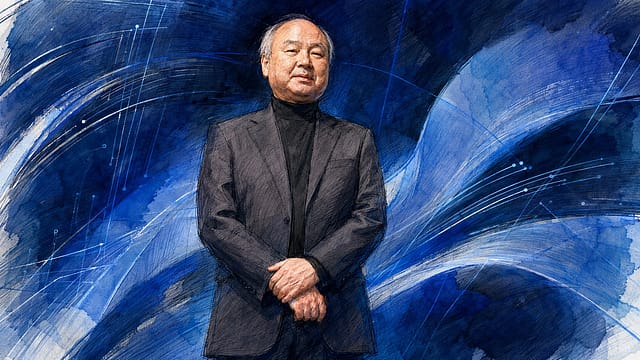
Jack Ma had a scrap of paper. No proven business model. Little revenue. No urgent request for money.
He had secured a few minutes with Masayoshi Son during the Japanese investor’s search for promising Chinese internet companies in 2000. Founder after founder had arrived armed with financial projections and funding pitches.
Ma spoke about something larger. He wanted the internet to give small Chinese businesses a road to the world.
Five minutes into the conversation, Son had heard enough.
'Take my money.'
Ma initially declined. He had come to meet Son, not raise capital. Son first offered $50 million. Ma considered it excessive. They eventually settled on roughly $20 million for about a third of Alibaba.
Zeroing In on ECI
09 Oct 2026 - Vol 05 | Issue 41
Constitutional legitimacy versus political opportunism
The conversation did not revolve around revenue.
“We just talked about a shared vision,” Ma later recalled in one of his interviews. He had not even worn a suit. “After five or six minutes, he began to like me and I began to like him. People around him have said that we are soulmates.”
Asked years later what he had spotted, Son did not cite market forecasts or unit economics.
“It was the look in his eye,” he told reporters in 2014, according to Reuters. “It was an ‘animal smell’.”
The nose proved spectacularly accurate. Son’s $20 million became one of the greatest investments in technology history, eventually generating tens of billions of dollars for SoftBank.
Twenty-six years later, the investor who built his legend reading humans may be preparing to spend billions on a company trying to build them.
SoftBank is reportedly in talks to acquire a majority stake in humanoid robot developer 1X Technologies at a valuation of about $6 billion. The discussions remain fluid. Neither company has confirmed them. But the possibility fits too neatly into Son’s latest ambition to be dismissed as another portfolio punt.
Arm can supply computing architecture. OpenAI can supply intelligence. SoftBank’s data centres can supply computing power. ABB can bring industrial muscle. And 1X could place a soft-bodied humanoid inside homes and workplaces.
Jack Ma made Son’s fortune. Robot Ma may determine whether his instinct still possesses its magic.
The Boy Who Put Weights in His Shoes
Masayoshi Son was born in 1957 into a family of Korean descent in Kyushu, Japan. His family used the Japanese surname Yasumoto in a country where Koreans faced entrenched discrimination.
Son later described a childhood shaped by both hardship and shame. His grandmother collected food scraps to feed the family’s animals. His father scrambled through a succession of businesses, including livestock, illicit sake and eventually pachinko parlours.
The boy learned early that reinvention could feed a family. He also learned what it meant to carry an identity that the surrounding society treated as inferior. Son was taunted for his Korean heritage. According to a 1999 TIME profile, he placed weights inside his shoes to strengthen his legs for football.
The future billionaire was training himself to move while carrying an invisible burden. At 16, Son left Japan for the United States. He studied economics at the University of California, Berkeley, but behaved less like a conventional student than a man racing a private clock. He reportedly decided to devote a few minutes each day to producing new ideas. One became an electronic multilingual translator. Son enlisted technical help to develop it and sold the design to Sharp, earning his first million dollars while still young. He also imported used Space Invaders machines from Japan and installed them in American campuses and restaurants.
The ventures mattered beyond the money. They taught Son that technology could cross borders even when human beings struggled to do so. He returned to Japan and founded SoftBank in 1981 as a software distributor. According to TIME, he climbed onto a crate and told his first two employees that the tiny company would eventually dominate its industry. They reportedly quit. Son’s audience disappeared. His forecast did not.
Meet 'Mr Ten Times'
At 19, Son drew up a 50-year plan.
He would establish himself in his twenties, build a financial war chest in his thirties, make major moves in his forties, achieve his defining vision in his fifties and hand the company to a successor in his sixties.
At 68, he has rewritten the final act. “I have more to give,” Son wrote in SoftBank’s 2026 annual report, extending his deadline by another 10 or 15 years. His new assignment is artificial superintelligence, or ASI, which he believes could become 10,000 times smarter than an individual human.
Son does not think in quarters. He sometimes struggles to think in centuries shorter than three. SoftBank has published a 300-year vision. Son imagines the group as a constellation of leading businesses that will survive long after its founder vanishes. He does not merely want to participate in technological change. He wants to assemble the companies that control it.
This appetite earned him a nickname inside Alibaba. David Wei, a former chief executive of Alibaba.com, called him “Mr Ten Times”. Whenever Wei presented a business plan, Son would reportedly ask whether it could become ten times larger. If Wei found an answer, Son asked whether it could grow tenfold again.
Vijay Shekhar Sharma encountered the same appetite after SoftBank backed Paytm. “One of the things that Masa always brings to the table is aspirations which are global, aspirations which are larger than life,” Sharma reportedly said, adding that Son carried enormous expectations into the companies he funded.
This is the product Son supplies beyond capital. He expands what founders believe they are permitted to attempt. The effect can be electrifying. It can also become dangerous.
Masayoshi Son does not merely invest in founders. He changes their sense of scale. Sometimes he gives ambition the capital it deserves. Sometimes he gives delusion more money than it can safely spend.
One Enormous Winner
At the height of the dotcom boom, SoftBank’s holdings briefly made Son one of the richest people on earth.
Then the market collapsed. SoftBank’s share price plunged. Son reportedly lost tens of billions of dollars in paper wealth. Companies that had appeared capable of remaking commerce disappeared. The grand internet constellation threatened to become debris. “Somehow, I survived,” Son later told interviewer David Rubenstein.
Survival did not teach him to bet smaller. It taught him that one enormous winner could redeem a cemetery of mistakes. Alibaba supplied the proof. Son did not back Ma after studying a mature company. He backed the man and allowed the company to arrive later.
That distinction became central to his investment method. Son has said he does not begin by looking for companies. He looks for founders. He studies the eyes, ambition and ability to recruit believers.
In Jack Ma, he found a “fighter’s spirit”. In South Korean e-commerce founder Bom Kim, Son found an entrepreneur who had absorbed the Masa mythology before receiving his money. Kim reportedly used to end emails with a Son quotation: “All I had was a dream and confidence for which I had no basis.”
SoftBank invested $1 billion in Coupang in 2015 and another $2 billion in 2018. Kim called SoftBank a long-term partner and described Son as one of the world’s greatest technology investors. Coupang subsequently reached the public markets and became one of the Vision Fund’s most important successes.
The disciple had become an investee. The quotation about baseless confidence could have described them both.
Twelve Minutes With Adam Neumann
Then Adam Neumann walked into Son’s life.
Neumann had built WeWork into a charismatic office-sharing company that spoke the language of community, consciousness and global transformation. He did not sell desks. He sold belonging. He did not describe tenants. He described members of a movement.
When SoftBank expressed interest, Neumann insisted that Son visit WeWork’s headquarters. “It wasn’t because we were trying to be cheeky,” Neumann told WIRED. “It was because part of what we do is energy, and I can’t put energy on a piece of paper.”
A meeting expected to last two hours began shrinking as Son ran late. Ninety minutes became 30. When Son arrived, Neumann recalled, he announced: “I only have 12 minutes. Go.”
Neumann raced him through WeWork’s research-and-development area and one office floor. He did not even reach the room where the formal presentation awaited. Son invited him into his car. The two began sketching a deal on an iPad. Neumann said he would ordinarily have delayed, negotiated and squeezed the offer. That morning, however, a spiritual teacher had advised him that people sometimes needed to act against their nature. “I took the pen, I said, ‘Today I’m not a negotiator,’” Neumann told WIRED. “I signed my name, his name, and that piece of paper ended up being the deal to a T.”
The deal committed $4.4 billion.
Son reportedly told Neumann that his problem was insufficient ambition. He needed to become crazier and build WeWork ten times larger. The man called Mr Ten Times had found a founder who understood scale as theatre.
SoftBank’s money pushed WeWork to expand at ferocious speed. Its valuation reached $47 billion. Neumann talked about elevating global consciousness while the company accumulated leases, losses and governance problems.
Then WeWork tried to go public. Its filing exposed a company consuming cash, pursuing questionable transactions and orbiting a founder whose power had escaped ordinary restraints. Public investors revolted. The IPO collapsed. Neumann departed. WeWork’s valuation disintegrated and the company eventually filed for bankruptcy.
The saga cost SoftBank an estimated $11.5 billion in equity losses, with billions more tied to debt, Bloomberg reported. Son admitted that he had overestimated Neumann’s strengths and turned away from his weaknesses. “My own investment judgement was really bad,” he reportedly said after SoftBank recorded a historic quarterly loss.
The failure exposed the danger inside his emotional intelligence. The quality Son prized in exceptional founders could also blind him.
Jack Ma’s eyes had carried disciplined hunger. Neumann’s charisma amplified Son’s own appetite until conviction became intoxication. Son had read another human being. This time, he misread him by billions.
Masa Arrives in India
India’s startup founders encountered both sides of the Son method: the investor who supplied astonishing firepower and the shareholder whose embrace could threaten control.
SoftBank backed Paytm, OYO, Ola, Flipkart, Delhivery, Swiggy, Lenskart, Meesho, FirstCry and several other Indian companies. For a generation of founders, Son’s interest acted as global certification.
Sharma later thanked him publicly for the “belief and support” extended to India’s startups. Ritesh Agarwal reportedly described Son’s inputs to OYO as transformational, arguing that SoftBank brought more than money to the table. Son became an important mentor as OYO chased rapid international expansion.
The relationship moved beyond boardroom formality. When Son attended Agarwal’s wedding reception in Delhi in 2023, Agarwal and his wife, Geetansha Sood, bent to touch his feet. It was a startling image of investor, mentor and patriarch.
But OYO also demonstrated how Son’s capital could turbocharge expansion before the underlying machine had stabilised. The hotel network raced across markets, fought with property owners, cut jobs and struggled towards a public listing. SoftBank also supported a financing structure that helped Agarwal increase his ownership.
Bhavish Aggarwal supplied a different counterpoint. The Ola founder has described conversations with Son as “energising” and said the two would help build the future in India. But Aggarwal also reportedly resisted a proposed $1.1 billion SoftBank investment that could have increased its Ola stake beyond 40 per cent. He sought protections over control, and the deal fell apart.
The founder wanted the vision. He did not want the visionary taking the steering wheel. Son’s capital could give an entrepreneur the road, the fuel and permission to accelerate. It could also appear in the rear-view mirror, closing fast.
The $150-Billion Fish That Escaped
Son’s record contains failures, but it also contains something possibly more painful: winners he recognised and failed to keep.
In 2017, SoftBank acquired a 4.9 per cent stake in Nvidia for roughly $700 million. It sold the holding in 2019 for about $3.3 billion, a handsome return at the time. Then generative AI detonated demand for Nvidia’s chips.
By 2024, Son calculated that the stake could have been worth approximately $160 billion. SoftBank had surrendered more than $150 billion in potential gains. “The fish that got away was big,” Son told shareholders, according to The Wall Street Journal.
There was another twist. Son revealed that he had once explored buying Nvidia itself. He reportedly sat with chief executive Jensen Huang for four hours in the garden of his California home and discussed taking the chipmaker private.
The transaction never happened. SoftBank later tried to sell Arm to Nvidia. Regulators stopped that deal too. Arm subsequently returned to the public markets and emerged as the most valuable asset in Son’s empire.
Then Son sold Nvidia again. In October 2025, SoftBank disposed of its rebuilt holding for about $5.8 billion to help finance its OpenAI commitments and other AI investments. “I don’t want to sell a single share,” Son later said. He claimed he had been “crying” while selling, but needed the capital for OpenAI and other opportunities.
The pattern captures him perfectly. A missed fortune does not send Son towards safety. It sends him hunting for the next fortune with greater urgency. Regret becomes fuel.
Pepper Had a Heart. Market Wanted Hands
Robots have haunted Son’s imagination for years.
In 2014, SoftBank unveiled Pepper, a waist-high humanoid promoted as capable of recognising human emotions. With round eyes, gesticulating arms and a tablet on its chest, Pepper charmed conference audiences and appeared in shops, banks and SoftBank outlets.
The robot looked like the future had learnt customer service. Then customers asked what it could actually do. Pepper’s functions remained narrow. Reliability proved troublesome. Businesses struggled to find jobs valuable enough to justify the machine. SoftBank placed units in its own stores, but global demand failed to match the spectacle. Production stopped after approximately 27,000 units were made, Reuters reported in 2021. SoftBank cut jobs across its robotics operation.
Son later stood before an image of Pepper hanging its head. The robot had been marketed as having a heart. What it lacked was a sufficiently capable brain and enough useful hands. SoftBank also acquired Boston Dynamics from Alphabet in 2017, gaining ownership of robots that could run, jump and dance with unnerving agility. Four years later, it sold control to Hyundai.
On paper, Son had been beaten twice by robotics. In his mind, the necessary technology had arrived in the wrong order. Pepper’s body had preceded generative AI. Its conversations relied on programmed interactions and narrow systems. Today’s multimodal models can process speech, images and surroundings with far greater flexibility. The possibility now tempting Son is that AI can leave the screen and operate in the physical world.
He is returning to the robot ring with a different brain in his corner.
Building the Organism
SoftBank’s investments can appear bewilderingly scattered until they are arranged as parts of one organism.
Arm supplies architecture used across smartphones and increasingly in servers, vehicles and AI systems. OpenAI supplies advanced models and a road towards the artificial superintelligence Son regards as his remaining mission.
Son first met Sam Altman years before ChatGPT turned OpenAI into a global phenomenon. “When I met you when you were younger, you said that you’re going to go for AGI,” Son told Altman during a public conversation reported by the Financial Times. “I immediately said, ‘I believe you. I want to invest.’”
Once again, Son had found a human carrying an enormous future in his head. Microsoft captured the early investment opportunity. Son returned later with far more money.
SoftBank has since committed tens of billions of dollars to OpenAI. It is working with the company and Oracle on Stargate, a plan to build vast AI infrastructure in the United States. SoftBank and OpenAI have also created a venture to sell enterprise AI products in Japan. In October 2025, SoftBank agreed to acquire ABB’s robotics business for $5.375 billion. ABB supplies industrial robots, controllers, automation systems and decades of factory experience. The business employs about 7,000 people and produced $2.3 billion in revenue in 2024, according to SoftBank.
Son called physical AI the company’s next frontier. 1X could fill a different space.
Its NEO humanoid has been designed for homes and other environments made for human bodies. The machine walks on two legs, understands spoken requests and attempts chores such as fetching objects, tidying rooms and putting away dishes. Its padded body and fabric covering aim to make it safer around people than a heavy industrial machine.
It is also unfinished. NEO possesses basic autonomy, but unfamiliar jobs may require an employee of 1X to guide it remotely through “Expert Mode”. The operator can see through the robot’s cameras, raising obvious privacy questions inside a home.
Yet the human assistance produces what the industry desperately needs: physical training data. A language model can consume trillions of words. A robot must learn how a drawer resists, how a glass slips, how a towel folds and how a cluttered room changes between morning and evening. Each deployment creates demonstrations, errors and corrections that can train the next version.
Son may see NEO less as a finished housekeeper than as a walking data engine. More bodies generate more experience. Experience improves the intelligence. Improved intelligence makes each body more useful. If the cycle works, the company controlling the robots could build an enormous lead. If it fails, SoftBank may own another charming machine searching for a job.
The Founder in the Mirror
Humanoid robotics currently contains industrial ambition, scientific progress and a generous dose of theatre.
A Reuters investigation found that many machines remain slow, expensive and unreliable when a task moves beyond a programmed routine. Embodied AI lacks the oceans of training material available to language models. Commercial demand remains uncertain. Chinese manufacturers could crush hardware prices before Western developers establish viable businesses.
SoftBank’s financial commitment is already formidable. The company has poured tens of billions into OpenAI, chips, infrastructure and robotics. Reuters reported that SoftBank may consider selling between $10 billion and $20 billion in bonds to refinance borrowing associated with its OpenAI investment. The 1X transaction, should it happen, would add another expensive promise to a balance sheet already carrying Son’s vision of the future.
At 65, after Vision Fund losses and years spent away from the public stage, Son told shareholders that he had cried for days. He wondered how many years remained. He felt empty. Had his life’s work reached its limit?
Then AI pulled him back. “I wanted to become an architect to build the future of humankind,” he said in 2023. “The time has come to shift to offence mode.”
Three years later, he dismisses talk of an AI bubble as “blasphemy against AI”. He predicts that trillions of dollars will flow annually into computing infrastructure. He has extended the deadline on his 50-year plan and intends to pursue ASI into his seventies.
At his most persuasive, Son resembles the rare investor willing to cross a bridge before anybody else can see it. At his most dangerous, he starts spending before confirming that a bridge exists. The founders he has backed describe the same force from different angles. Jack Ma found a soulmate. Adam Neumann found a man who asked him to become crazier. Vijay Shekhar Sharma found someone who enlarged aspiration. Ritesh Agarwal found a mentor. Bhavish Aggarwal found an investor whose money required a line around control. Bom Kim found the hero whose words he had quoted before the cheque arrived.
Son saw something of himself in these men. The outsider. The missionary. The salesman. The fighter. The founder capable of describing a future large enough to swallow the present.
That may explain both his great wins and his great wounds.
Masayoshi Son does not merely bet on founders. He bets on reflections. In 2000, he looked into Jack Ma’s eyes and found the future. In 2026, the figure looking back at him may have cameras instead. Jack Ma made his legend. Robot Ma may decide whether the legend can still see.