EXPLAINED | Binance Was Hacked. Why Is Bitcoin Falling?
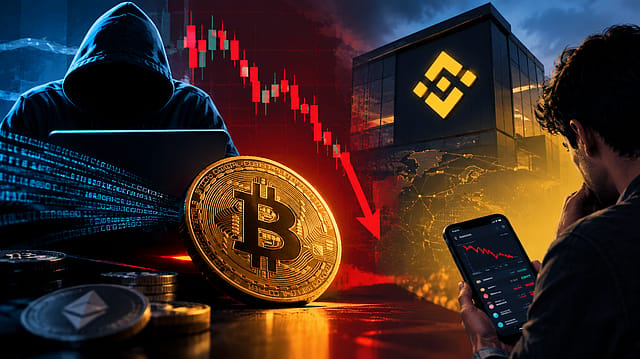
Bitcoin fell below $78,000 on October 30 after a reported hack at Binance, the world’s largest cryptocurrency exchange, rattled traders. Reuters reported a six-week low during the early sell-off.
Binance estimates that about $6.3 billion in crypto assets was affected. It says roughly $3 billion has been frozen and promises to cover the losses.
That promise addresses the breach. It offers no protection against a falling Bitcoin price. Someone holding Bitcoin elsewhere can lose money as the market drops, even if their coins remain exactly where they left them.
Why would a Binance hack push Bitcoin’s price down?
Because an attack on a major place to trade and hold cryptocurrency can shake confidence across the market.

Look Who's Talking Regime Change
23 Oct 2026 - Vol 05 | Issue 43
People may sell because they fear further losses or want less exposure while the facts emerge. Disrupted withdrawals can also prevent trading firms from moving funds between platforms. With fewer buyers willing or able to trade at the old price, sellers may have to accept less.
Analysts interviewed by Reuters pointed to confidence, disrupted fund movements and the possibility of forced selling. The precise contribution of each remains uncertain.
Does this mean Bitcoin itself was hacked?
The published preliminary findings concern Binance’s systems for approving withdrawals.
Binance says a compromised employee laptop may have allowed an attacker to submit unauthorised withdrawals. Its investigation is continuing. That concerns access to assets held by the exchange. It does not establish that attackers broke the Bitcoin network’s rules or rewrote its transaction record. A service that handles Bitcoin and the network recording Bitcoin transactions have different jobs.
So what exactly is Bitcoin?
Bitcoin is a digital asset that people can send to one another over a computer network. It began operating in 2009, following a proposal published under the name Satoshi Nakamoto. No central bank issues it.
The network keeps a shared public record of transactions, called the blockchain. Computers check transactions against its rules. Specialised operators called miners compete to add groups of transactions to the record, earning rewards and transaction fees for doing so.
There is no physical coin you need to collect. You can buy a fraction of a bitcoin. Each bitcoin can be divided into 100 million units, called satoshis. Bitcoin is one cryptocurrency. Ether and Binance’s BNB token are others, with different systems and uses. Their prices need not move together.
Who decides what a bitcoin is worth?
Buyers and sellers do, through trading. There is no official price that a central bank promises to maintain.
Supporters value Bitcoin’s limited supply and the ability to transfer it without a bank processing the payment. Its existing rules cap supply at approximately 21 million bitcoins. But limited supply cannot guarantee a rising price: demand can weaken.
For a simple illustration, suppose you buy ₹10,000 worth of Bitcoin. If its price falls 20%, the holding is worth approximately ₹8,000 before fees. You still own the same fraction of a bitcoin. What someone will pay for it has changed.
What am I holding when I buy through an app?
On an exchange that holds assets for customers, your account displays a balance while the company manages access to the underlying cryptocurrency.
The crucial tool is a private key, a secret digital code used to approve spending. A crypto wallet manages those keys. The coins’ ownership record is on the network.
An app password lets you access your account with the company. It does not necessarily give you control of the private keys. If the company pauses withdrawals, your ability to move the assets depends on it restoring that service.
What are the risks beyond a hack?
Price falls are one. Platform failure, fraud and losing access to your wallet are others. They can overlap. A person might face a falling balance and suspended withdrawals at the same time.
Trading with leverage adds another danger. This means taking a position larger than the money you put down.
In a simplified example, ₹1,000 supports a ₹10,000 position. A 5% move against that position produces a ₹500 loss before fees, wiping out half the initial ₹1,000. The platform may close the position as losses approach its limits. Actual requirements differ by product, and losses can exceed the initial payment. The US Commodity Futures Trading Commission warns that leverage amplifies losses.
Would keeping Bitcoin myself solve the problem?
It changes which risks you carry.
With self-custody, you manage the keys rather than leaving that responsibility to an exchange. You must protect them and the recovery information used to restore access. Losing both can mean permanently losing the ability to spend your coins.
An offline hardware wallet can reduce exposure to internet attacks. It still requires careful setup, backups and checking of transactions. Someone tricked into approving a transfer can lose funds. A confirmed Bitcoin payment generally has no central help desk that can reverse it. Self-custody also leaves the price risk intact.
What does Binance’s promise mean for customers now?
Binance has promised to cover incident-related losses using its emergency reserve and company money. In its October 30 service update, it said deposits were operating normally while withdrawals remained paused. It expected withdrawals to begin resuming within 48 hours. That is a target, rather than confirmation that access has returned.
Covering stolen assets, restoring withdrawals and recovering a market loss are separate matters. Binance has not promised to restore everyone’s holdings to their value before Bitcoin fell.
What should Indian users understand?
The same global market movements can affect holdings bought through an Indian app. A familiar interface does not remove the need to understand who holds the assets and what happens if withdrawals stop.
India requires relevant crypto service providers to register with the Financial Intelligence Unit and meet anti-money-laundering obligations. That registration does not guarantee their investments or security. In a September 9 statement, the Finance Ministry warned that crypto products can be highly risky and that losses may have no regulatory recourse.
There are tax obligations too. Income from transferring virtual digital assets attracts a 30% tax rate, plus applicable additional levies. Paying tax does not provide protection from theft or price falls.
What happens next?
For Binance customers, the immediate questions are when withdrawals return, what its investigation establishes and how it fulfils its promise to cover losses.
Bitcoin’s price will continue to reflect buying and selling across the market. Restoring confidence could help, but neither a reimbursement promise nor a fixed supply tells us where the price goes next.
Before this incident, a customer might have looked at an app and asked how much their Bitcoin was worth. The breach adds an equally practical question: can they actually move it?