Bullion Meltdown Continues: Gold Sees Worst Fall in 40 Years, Silver Slumps Sharply
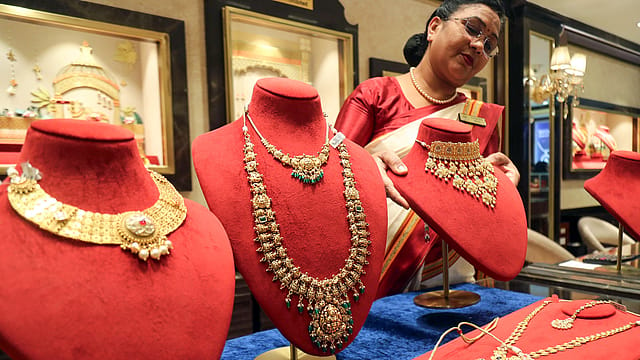
Gold and silver prices in India witnessed a sharp decline on Monday, tracking sustained losses in international bullion markets, which have now extended into a fourth consecutive week.
In early trade on Monday, spot gold fell by 3 to 4 per cent to slip below $4,400 per ounce, while spot silver also dropped by a similar margin to hover around $65 per ounce.
The weakness was mirrored on the domestic front, where MCX gold plunged nearly 6 per cent, breaching the Rs 1.37 lakh mark.

What Rahul Gandhi Wants
28 Aug 2026 - Vol 05 | Issue 35
He is desperately courting the angry youth. That won't be enough to credibly challenge Modi
MCX silver touched an intraday low of Rs 2,11,729 per kilogram on March 23 before recovering slightly to Rs 2,13,045 per kilogram, still down by Rs 13,727 or 6.05 per cent.
Silver has now declined by more than half from its peak of Rs 4,39,337 per kilogram recorded in late January 2026.
Why Have Gold and Silver Prices in India Fallen 12–17% in March?
Overall, gold and silver prices in India have declined between 12 per cent and 17 per cent so far in March.
The fall comes amid heightened inflation concerns triggered by escalating tensions between the United States, Israel and Iran, along with liquidity challenges faced by major economies and a firm US dollar hovering around the 100 mark.
Gold has recorded its worst weekly fall in 40 years, dropping from around $5,200 per ounce on March 13 to $4,354 per ounce by March 23.
The metal had earlier scaled an all-time high of $5,595.51 before coming under sustained pressure due to shifting global market dynamics.
Geopolitical tensions remain elevated, with US President Donald Trump threatening strikes on Iranian power plants if the Strait of Hormuz is not reopened.
Why Is Gold Failing as a Safe-Haven Despite Rising Geopolitical Tensions?
Tehran has responded with warnings of targeting key US and Israeli assets across the region if its energy infrastructure is attacked.
Despite these developments, gold has failed to retain its safe-haven appeal.
Last week alone, prices fell over 10 per cent as rising oil prices intensified inflation concerns, prompting markets to factor in a prolonged pause or possible rate hikes by major central banks, according to Trading Economics.
Market experts observed that gold’s inability to rally despite geopolitical stress reflects the dominance of other macroeconomic factors.
A report by The Wall Street Journal noted that the recent correction could create opportunities for long-term investors.
Phillip Nova's senior market analyst, Priyanka Sachdeva, told WSJ that gold's ongoing correction could provide "staggered" long-term accumulation opportunities at lower levels.
How Are Liquidity Pressures and Global Selling Impacting Gold Prices?
The report added that the fall below $4,400 per ounce has "opened the door" to the 200-day moving average of $4,154 per ounce, which is emerging as a potential downside target before prices stabilise.
Data from ICE showed that spot gold was 2.0 per cent lower at $4,400.44 per ounce after earlier touching $4,320.08 per ounce, the lowest intraday level since early January.
The report also highlighted that gold prices edged lower amid prospects of liquidity-driven selling in global markets during the ongoing Middle East conflict.
Saxo Bank's Head of Commodity Strategy, Ole Hansen, told WSJ that speculation is emerging that some economies may need to raise liquidity, potentially including gold sales.
"While not a confirmed driver, it adds to the more cautious tone," Hansen said.
"Gold's failure to rally despite geopolitical stress highlights the current dominance of higher real yields, a firmer dollar and position adjustment over its traditional safe-haven role," he added.
(With inputs from ANI)