Why India’s Coffee Industry Is Still Brewing a ‘Fifth Wave’
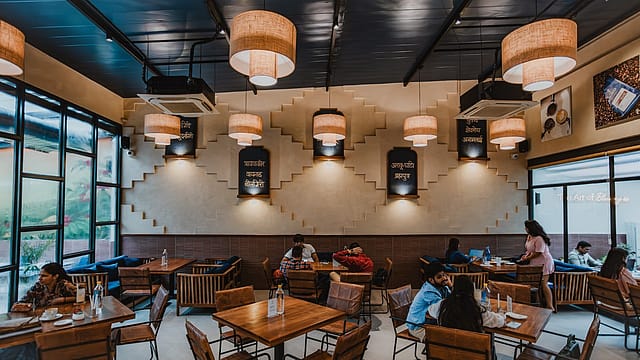
India wants to call this the fifth wave.
On a weekday afternoon in South Delhi, a barista weighs 18 grams of freshly ground coffee, locks in the portafilter, watches extraction time tick past 27 seconds, then discards the shot and recalibrates. A customer at the counter asks whether the current pour-over is a natural or washed process. Someone else swaps dairy for oat milk without being prompted. The bill touches ₹420 for a single cup.
Scenes like this now unfold across Delhi, Mumbai, Bengaluru, Hyderabad and a growing list of smaller cities, too. Specialty cafés are fuller, menus more experimental, customers more curious. India’s urban coffee culture feels transformed from what it was a decade ago.
This is not an anomaly. It is increasingly ordinary.
Zeroing In on ECI
09 Oct 2026 - Vol 05 | Issue 41
Constitutional legitimacy versus political opportunism
But enthusiasm alone doesn’t make a wave. Whether it spreads beyond select pockets is the real question.
“Fifth wave is how you commercialise very good specialty coffee at scale,” says Vikram Khurana, founder & CEO of Kaapi Solutions, who operates at the infrastructure end of the coffee ecosystem, supplying imported espresso machines, grinders, and roasting equipment to cafés, hospitality chains, and specialty operators across the country. “If it’s confined to 0.15% of the population, it’s still not the fifth wave,” he adds.
That tension between visible momentum and limited penetration sits at the centre of India’s specialty coffee moment.

The Café as Social Infrastructure
To understand why the ‘fifth wave’ label has gained traction, it helps to begin with the cultural shift. For years, youth culture in Indian metros revolved around malls, multiplexes and nightlife. Today, the café has emerged as a primary social anchor. The music is lower, the lighting is softer and conversations stretch across hours. For many young urban consumers, especially Gen Z, the café is not just a stop between plans. It is the plan.
The shift is partly aesthetic and partly behavioral. Interiors are designed to be photographed. Seating accommodates laptops and lingering. Plant-based milk options are default rather than special requests. Matcha and cold brews share space with classic espresso drinks. Even high-energy formats such as daytime ‘Coffee Raves’, which are alcohol-free dance gatherings powered by caffeine, reflect a change in how younger consumers socialise.
Today’s café culture is being shaped heavily by a health-conscious Gen Z. This is a generation that reads labels, counts steps, swaps dairy for oat milk, and thinks twice before ordering something too sugary. For them, what they drink is not just about taste, it reflects lifestyle choices. Coffee, positioned as cleaner stimulation compared to alcohol, fits into that recalibration. The café becomes a site of participation rather than excess.
But ambience alone is no longer enough. “Coffee has evolved into a lifestyle product,” says Dushyant Singh, Jaipur-based founder and CEO of Coffee Sutra that supplies beans to hotel partners including Fairmont and Novotel while serving over 60 businesses across India. “More than a beverage, it has become a reason for people to meet,” he adds.
That evolution changed expectations at the counter. As cafés became more design-driven, aesthetics alone weren’t enough; the coffee had to justify the setting.
When Coffee Became the Hero of the Table
India’s organised café culture dates back nearly 25 years to brands like Café Coffee Day and Barista, which first positioned the café as a standalone destination. At the time, beverages often played a supporting role to food and ambience; the hero on most tables was the meal, not the cup.
The arrival of Starbucks, followed by international players like The Coffee Bean & Tea Leaf and other specialty brands, began to change that equation. Coffee began to be positioned as a premium offering. Menus diversified, and seasonal offerings and alternative brewing methods gained visibility.
Alongside this came a deeper curiosity.
“At the end of the day, we like to be involved where there is engagement,” Dushyant says. “Today, a customer can walk up to the barista and say, use soy milk instead of regular milk, make it a double shot, or choose a darker roast. The pleasure is not always just in drinking coffee. The pleasure is that I am involved in making this coffee,” he says.
The café counter has become participatory. That engagement, Singh believes, is part of what makes specialty coffee sticky. But it requires something most café menus don’t communicate clearly: what “specialty” means.
“There’s something called Q grading. Like you have wine connoisseurs, coffee has Q Graders,” he says. Certified Q-Graders, often referred to as the industry’s equivalent of sommeliers, perform rigorous cupping to assess aroma, flavour, acidity, body and balance. Under the Specialty Coffee Association’s (SCA) certification system, beans are scored on a 100-point scale. Coffees that score above 80 are designated as specialty-grade.
“Most people think they’re going to a specialty café,” Singh says, “but they don’t really know what specialty coffee means.”
Most Indian consumers may not know the scoring mechanics. But they are increasingly able to detect differences. They ask questions and try new things.
The Multi-Roaster Experiment
For some operators, that curiosity has opened space for new formats.
Rishabh Bhambri, founder of Daily Drama, a multi-roaster café in Delhi’s Defence Colony, that realization came first as a customer, not an operator. Unlike many café founders rooted in hospitality, Bhambri came from an IT background and had spent time working in New York. As a customer, he recalls frequenting well-designed cafés where service and ambience were strong but the cup disappointed. “I had one or two cafés in Khan Market that were my go-to places. The place was good, the name was good,” he says. “But the coffee was average.”
Daily Drama began as a way to close that gap. Instead of tying the café to a single roaster, Bhambri built it as a curated multi-roaster platform. Beans from Karnataka’s Chikmagalur region, including estates such as Baarbara and Ratnagiri, sit alongside international origins from Costa Rica and Tanzania.
Customers are encouraged to explore flavour profiles rather than navigate technical jargon. But operationally, it is heavy. “As soon as I started understanding the industry, I realised one coffee bean often means one grinder,” Rishabh says. Each additional origin complicates calibration, storage and workflow, increasing equipment costs and making staff training more demanding. Inventory cycles tighten as well. In this model, specialty coffee is not just about taste but also about infrastructure.
Beyond the beans, Bhambri is looking toward collaborative, “embedded” spaces intersecting with apparel stores, salons, and retail environments. This hybrid model, seen in spaces like Subko or Gully Labs, allows specialty coffee to tap into existing communities that already linger in lifestyle spaces.
“Some people have such nice, beautiful apparel stores. Where you can't use the seating. It's a small coffee shop, It helps both,” he says of such collaborations.
The idea is mutual reinforcement, partnering with apparel stores, salons and other retail spaces to weave coffee into everyday routines, beyond just expanding footprint. But expansion carries risk. The more complex the offering, the heavier the system required to support it.
The Invisible Architecture
The romance of specialty coffee often lives in flavour notes and farm stories. But delivering that cup repeatedly, across locations, across staff shifts requires more than passion. Behind the aesthetics of specialty cafés lies a layer most customers rarely see: ‘The Machinery’.
Grind-by-weight systems reduce dosage error. Programmable espresso machines control temperature stability and pressure profiling. Auto-foaming milk systems aim to standardise texture. Automation, once viewed as a compromise, is increasingly positioned as a stabiliser.
“We don’t want to be over-relying on the barista’s moods and manpower,” says Vikram Khurana from Kaapi Solutions. “If you go to Starbucks in Delhi, Coimbatore or Kolkata, you get the same coffee. Because it’s tech,” he added.
Consistency becomes critical as soon as a brand opens its second, third or fifth outlet. India’s hospitality sector faces high staff churn and uneven training pathways. Structured barista schools remain limited compared to mature coffee markets. Precision often depends as much on systems as on skill.
For Vikram, the scale question extends beyond machinery, it begins with consumption habits.
“India was never a coffee or tea drinking nation,” he says. “It has always been a milk drinking nation.”
That starting point matters. India’s relationship with coffee has historically been milk-heavy, sweetened and comfort-led. While urban consumers are experimenting with black coffee, pour-overs and single origins, the base habit remains rooted in milk-based beverages. From that lens, he remains cautious about calling this moment a fifth wave. His scepticism around the ‘fifth wave’ label stems from this structural lens.
“I think we are still continuing with the third wave,” he says. “The third and fourth wave are very similar. Fifth wave is when you scale up very good specialty coffee in a big way.”
Scale, in his definition, is commercial penetration.
Beyond the Urban Bubble: Hype vs Scale
India is among the world’s largest coffee producers, exporting a significant share of its output. Domestic consumption, however, has historically lagged behind tea. Industry estimates suggest per capita coffee consumption in India remains far lower than in Europe or even parts of East Asia. Instant coffee continues to dominate retail volumes.
Organized café chains have expanded rapidly in metros and tier-one cities, and specialty operators have multiplied over the past decade. Yet relative to a population exceeding 1.4 billion, specialty coffee drinkers represent a narrow urban slice.
Average ticket sizes at specialty coffee cafés often range between ₹300 and ₹500 per cup in major cities which is accessible to upper-middle-class consumers, less so in price-sensitive markets. In tier-two and tier-three cities, footfalls may spike initially, driven by novelty and ambience, but repeated behaviour depends on sustained product acceptance.
“Instant coffee is always going to be huge. Aspirational home brewers are experimenting, and those who start with entry-level machines tend to scale up,” Khurana says. But mass adoption is a different story.
The metaphor he reaches for is automotive. India sells far more Marutis and Hyundais than it does Rolls-Royces. Specialty, by definition, sits at the premium end. The question is how wide that premium band can stretch.
Between Craft and Commercialisation
There is no denying the progress of the past eight to nine years. Processing techniques have evolved. Indian estates experiment with fermentation methods and drying protocols that enhance flavour complexity. Roasters are more sophisticated. Consumer awareness is deeper than before.
But friction appears when ambition meets economics.
When the conversation turns to sustainability and long-term growth, Khurana is quite direct. “In India, we are not able to scale up our businesses and coffee the way it’s happening in other countries,” he says.
He points to markets like China, where single brands have expanded into tens of thousands of outlets. In India, growth has been slower and more uneven. Average cuppage per café remains modest. Loyalty, particularly in tier-two and tier-three cities, is fragile and experience-led rather than product-led.
Sustainability adds another layer to that challenge. For an industry still building its consumption base, sustainability remains aspirational — acknowledged but unevenly implemented.
“Sustainability has always been a very good point to be discussed on big forums. “When you see the applicability, it’s very slow,” Khurana says. While progressive growers invest in water stewardship and responsible farming, consumer willingness to absorb higher prices remains inconsistent.
“Everyone wants to talk about sustainability. But when it’s about paying money… people are not willing to pay the premium,” he adds.
However, For Dushyant from Coffee sutra, the answer lies in patience rather than pace. Coffee Sutra positions itself around community gatherings and cultural events rather than trend-driven formats.
“If my product is right, people will come back. I believe in building something long-term and sustainable,” he says. The emphasis, ultimately, returns to repeatability.
The Distance Specialty Must Travel
India’s specialty coffee scene has clearly moved beyond introduction. The cup now carries narrative: Origin stories, roast profiles and processing notes. Cafés double as workspaces and social venues, baristas speak the language of extraction ratios and customers listen.
What remains unsettled is distance. And it hurts on three fronts. First, distance between flagship outlets in metropolitan enclaves and smaller-city expansions. Second, distance between aspiration and affordability. Third, distance between education at the counter and everyday habit.
For what many describe as a fifth wave to take hold, coffee must move beyond being a fashionable experience and become a daily ritual at scale including a stronger breakfast culture, and a broader base of repeat consumption. That means travelling across geography and repetition without losing quality. Outlet five must taste like outlet one, a barista in Indore must be able to deliver what a trained specialist does in Bengaluru and consumers must choose specialty routinely.
Until then, the shift remains incomplete. The infrastructure is improving, operators are refining their models, and consumers are becoming more discerning. Momentum is visible but habit at scale is still forming.
But for now, India's specialty coffee story remains precisely what it has always been.
Still brewing.