Who Is Abdul Majeed? Inside Hamdard Laboratories and the Living 'Kahani' of Unani Practice
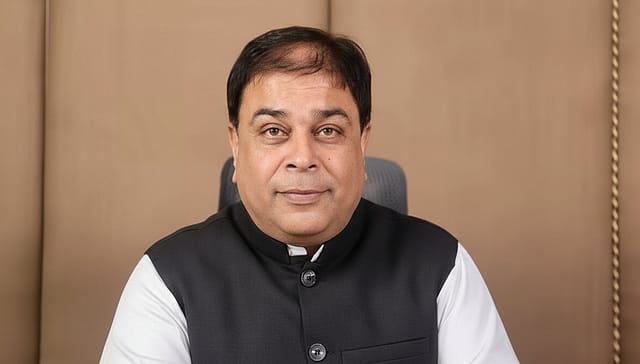
The room where Abdul Majeed sits today once belonged to his grandfather. It is no longer an office in the conventional sense — it functions as a wellness centre now — but the rhythms remain familiar. Patients arrive, consultations begin, medicines are discussed, and practitioners move through their routines.
Majeed witnessed it unfold as a child.
“He would come exactly at nine,” he says of his grandfather. “Very disciplined. Very focused. He spoke little. But everything about him showed commitment.”
That memory surfaces early in the conversation, less as nostalgia than as explanation. It’s a way of contextualising how he sees his role today as Chairman and Trustee of Hamdard Laboratories.
The Modi Years
02 Oct 2026 - Vol 05 | Issue 40
A Nation Rebuilt
For more than a century, Hamdard has occupied an unusual space in India’s healthcare landscape, part pharmaceutical manufacturer, part institutional patron of Unani medicine, and structurally a charitable trust. Its trajectory cannot be separated from the evolution of Unani practice in India, nor from the layered family stewardship that has shaped it across generations.
Understanding Abdul Majeed’s leadership requires stepping beyond boardroom narratives and into that continuum, where inheritance intersects with strategy, and institutional purpose meets contemporary market realities.
Legacy, Responsibility & Business
Hamdard’s beginnings predate modern branding frameworks. Founded in the early twentieth century by Hakeem Hafiz Abdul Majeed, the enterprise was conceived within a tradition where healing and community service were intertwined.
When the founder died in 1922, his wife Rabea Begum and their sons formalised that ethos through the creation of the Hamdard Trust. The governing principle, committing 85 percent of profits toward charitable initiatives, distinguished the organisation structurally from conventional commercial enterprises.
Leadership passed to Hakeem Abdul Hameed, who assumed administrative responsibility at a young age and expanded educational and healthcare initiatives tied to the institution.
For Abdul Majeed, that history is not abstract narrative.
“I grew up in an environment where healthcare was seen as responsibility,” he says. “It was never explained as business alone.”
Today, the Hamdard name spans multiple entities, including consumer foods, but his stewardship is confined to Hamdard Laboratories, the medicinal arm. The division itself emerged through structural separation following family succession disputes decades later, eventually resolved through legal settlement.
“I chose to stay with the medicine side,” he says. “That is where I felt I could contribute meaningfully.”
His entry into the organisation in the mid-1990s followed formal business training and exposure to operations that began at ground level — time spent in factories observing production, preparing formulations, and reporting observations upward.
“When you understand processes from the grassroots,” he says, “decision-making becomes more grounded.”
That grounding continues to influence how he frames authority, less as ownership, more as custodianship.
“We are trustees, not proprietors. There are no dividends. Funds are reinvested or directed toward welfare initiatives.”
Such positioning is not unique in institutional philanthropy but remains rare in scale within healthcare manufacturing contexts.
Tradition in a Contemporary Healthcare Landscape
Unani medicine occupies a complex—and often misunderstood—position within India’s pluralistic healthcare system. Derived historically from Greek medical philosophy and refined through Arab and Persian scholarship, the system centres on temperament-based diagnosis and holistic balance.
“Two patients may present identical symptoms,” explains Zubair Ahmed, who oversees traditional medicine sales. “But prescriptions may differ entirely depending on temperament.”
India has emerged as a principal centre for Unani education and practice, supported by government policy through the Ministry of AYUSH. Increased institutional emphasis, including budgetary allocation toward research and infrastructure, reflects broader public health interest in preventive and complementary care frameworks.
Majeed views this policy direction pragmatically.
“Chronic disease burden is increasing,” he says. “Preventive approaches and long-term management become relevant in that context.”
Hamdard’s institutional involvement extends beyond manufacturing. Several of its formulations appear within national reference frameworks, and the organisation participates in academic and practitioner training initiatives across medical colleges and professional forums.
More than 400 products span prescription and over-the-counter categories, positioning the company among larger players within the AYUSH-linked OTC segment.
Yet the space itself is not without tension. Aggressive marketing narratives across traditional medicine sectors, including controversial claims by competitors, have intensified scrutiny around scientific validation and regulatory clarity.
Majeed addresses the environment cautiously.
“Trust, once compromised, is difficult to rebuild,” he says. “We prefer to move carefully rather than aggressively.”
The comment reflects positioning as much as philosophy — balancing credibility with competitiveness in a crowded wellness marketplace.
Strategy, Scale & Adaptation
Financially, Hamdard Laboratories’ medicine division reported revenues approaching ₹400 crore in recent years, with profits reinvested across institutional and operational channels.
Strategic interventions — including distribution restructuring and digital integration — followed consultancy-led reforms designed to modernise operational frameworks without altering governance structure.
Manufacturing upgrades and backward integration initiatives now include cultivation of medicinal herbs across hundreds of acres, reducing supply dependency while enabling traceability.
Digitisation has extended into sales channels as well. Entry into e-commerce accelerated during pandemic disruptions, and distribution now spans retail, institutional supply networks, and government tenders.
Growth ambitions target expansion toward ₹1,000 crore revenues over a five-year horizon, supported by increasing wellness centre presence nationwide.
Product innovation reflects shifting health concerns. Lifestyle disorder formulations addressing metabolic and cardiovascular conditions have expanded portfolio scope, alongside research into alternative dosage forms that reduce reliance on traditional sugar-based carriers.
“Consumer expectations evolve,” Majeed says. “Adaptation becomes necessary.”
Marketing adaptation has also taken narrative form. Digital engagement initiatives and documentary storytelling projects attempt to introduce Unani concepts to younger demographics through cultural framing rather than clinical persuasion.
“You have to communicate in the language audiences understand,” he says.
Yet speed remains measured, a reflection of institutional caution shaped by governance philosophy. “As a charitable entity, experimentation carries responsibility.”
This balance between preservation and adaptation defines much of Hamdard’s present strategic posture.
Stewardship in an Era of Change
Discussion eventually returns to personal perspective, not as biographical diversion but as interpretive lens.
Majeed speaks often of three principles learned from his grandfather: clarity, commitment, and courage.
“Clarity comes from the mind. Commitment from the heart. Courage follows from both.”
The triad appears repeatedly in conversation, guiding business decisions, institutional positioning, and even emotionally complex moments involving structural transitions within the broader Hamdard ecosystem.
“There is satisfaction in contributing,” he says. His leadership style reflects continuity more than reinvention, prioritising incremental evolution over disruption.
Within India’s rapidly transforming healthcare and wellness sectors, such an approach may appear understated. Yet its durability underscores a different metric of success – longevity shaped through institutional stability rather than visibility alone.
Hamdard’s trajectory, intertwined with philanthropy, education, medicine, and identity, continues to evolve within that framework.
And Abdul Majeed’s role within it remains defined less by personal imprint than by stewardship, maintaining direction rather than redirecting it.
In a business environment often characterised by acceleration, his approach reflects something quieter: the discipline of continuity