What 10,000 People Lining Up for LEGO Says About the Future of Retail
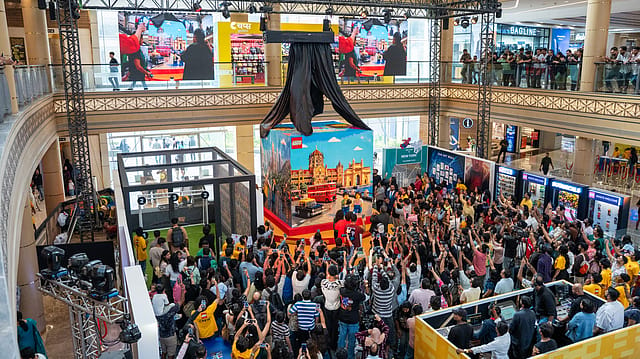
What if opening a store was no longer really about opening a store? That is the question increasingly shaping physical retail as brands try to give consumers a reason to leave the convenience of their phones and step into a physical space.
LEGO India offered a recent example with the launch of its first LEGO Certified Store in Mumbai, where its "Build Your Masterpiece" campaign turned the retail opening into a larger play-led experience across the city, drawing 10,000 visitors over the launch weekend, according to the company. The bigger story, however, isn't LEGO — it is what the launch says about the changing job of a physical store.
The store has a new job
India's retail market is hardly retreating offline; the sector reached an estimated $1.06 trillion in 2025 and is projected to reach $1.93 trillion by 2030, according to a Deloitte-FICCI report, while online retail is expected to grow from $75 billion in 2024 to $260 billion by 2030. So the question isn't online versus offline anymore, but rather what offline can do that online can't, and the answer increasingly appears to be experience.
The Modi Years
02 Oct 2026 - Vol 05 | Issue 40
A Nation Rebuilt
CBRE reported that India's retail market recorded a record 8.9 million sq ft of absorption in 2025, with leasing momentum driven in part by experiential flagship stores and Gen Z-focused formats, which it said were helping drive customer visits, dwell time and brand engagement. In other words, retailers aren't just buying square feet — they are buying attention.
"Opening new stores, especially for big brands, is leading to what we call experiential marketing. Physical retail allows customers to engage with a brand through all five senses, creating deeper engagement and, ultimately, stronger brand loyalty. In LEGO's case, it is also about the legacy and nostalgia associated with the brand,” said Ashita Aggarwal, Professor of Marketing, S.P. Jain Institute of Management & Research (SPJIMR).
Because consumers can already buy the product
The biggest problem with a conventional store launch is that there is very little novelty in saying we have opened a store, since consumers already know how to shop and can compare prices, read reviews and order products without leaving the sofa. And yet, physical retail remains important: PwC's India consumer survey found that 62% of consumers expected to visit physical stores for shopping, while 53% said they purchase from physical stores compared with 47% online.
The physical store, then, isn't dead — it simply has to earn the trip, and that changes the marketing brief. A launch is no longer just about announcing a location; it can become the first demonstration of what makes the store worth visiting. For LEGO, that naturally meant play, while for a beauty brand it could mean makeovers or consultations, for a sports brand a community workout, for an electronics brand product demos, and for food and beverage a limited-time experience or an event built around the outlet. The product gets people interested, while the experience gives them a reason to come. “Most people have probably grown up playing with LEGO, so the store offers an opportunity to relive that nostalgia and experience the brand beyond simply buying a product. While brands such as Apple build a sense of community around their stores, LEGO allows consumers to reconnect with the experience and memories the brand has created over the years," Aggarwal added.
Welcome to the experience economy
This isn't merely a marketing buzzword. CBRE and Invest India found in a 2024-25 survey that more than 70% of consumers across age groups preferred active retail experiences, and nearly 90% of respondents were also open to spending up to ₹4,000 a month on experiences. That helps explain why malls, high streets and standalone stores are increasingly being designed as places to do things, not just places to buy things, and brands are taking note, with CBRE describing the evolution as a shift from shops to destinations, with physical spaces increasingly blending shopping, entertainment and community engagement.
The store is becoming media. A well-designed experience can generate footfall in the physical world and content in the digital one, since a customer who builds something, attends an event, gets a personalised consultation or encounters an unusual installation is also more likely to have something to photograph, share or talk about, giving the physical store a second life on social media.
But there is a catch
The danger is that brands start confusing crowds with success. Ten thousand visitors make for an attractive campaign statistic, but the harder and increasingly important questions are what happened next — how many bought something, how many returned, how many joined a loyalty programme, how much earned media the activation generated, and whether the experience improved brand consideration.
Experiential marketing can be expensive, and if the entire investment produces one crowded weekend and a few Instagram posts, the store launch becomes an event rather than a strategy. The smartest brands therefore need to connect the experience to the retail funnel: attention, experience, purchase, repeat visit — and miss the last two steps, and you may have created a great event, not great retail.
The local twist
There is another interesting piece to this evolution: localisation. For global brands entering Indian markets, the physical store can become a way of making the brand feel local, since instead of simply replicating an international store format, brands can build experiences around the city, its consumers and its cultural context. That is part of what made the Mumbai LEGO launch interesting, as the campaign did not position the store as an isolated retail address but attempted to make the opening a larger city moment.
And that may be the real future of retail launches — not "come see our new store," but "come experience why our store exists." As India's retail market expands and consumers become increasingly comfortable moving between online discovery and offline shopping, the physical store will have to do more than hold inventory; it will need to hold attention. And perhaps that is the new retail launch playbook: don't just open the doors, but give people a reason to walk through them.