The Making of a Maker: Ganesh Pareek, Ad Break & Life Beyond 30 seconds
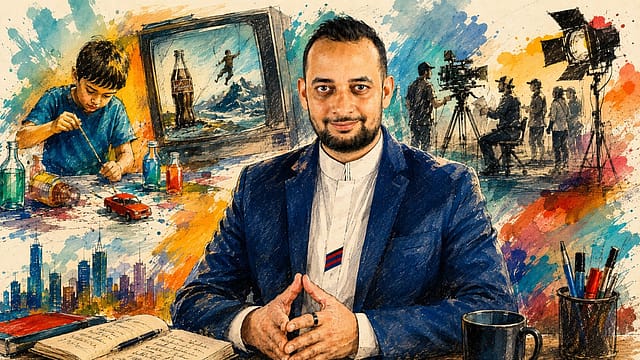
There is powder on the floor. A bowl of water. A bar of soap going soft in his palm. A toy car with kite string knotted around its axle, dragged again and again off the edge of a step to see how it falls. Torn pages from a school notebook are scattered around him, each one a pencil sketch of the same man mid-air, arms out, rope invisible.
His aunt walks through the room and nearly goes down on the talcum powder he forgot to clean up. He gets scolded. He does it again the next day anyway.
He is nine, maybe ten, and he is trying to reverse-engineer a Thums Up advertisement — a man jumping off a cliff, landing clean, picking up a bottle like the fall cost him nothing. He doesn't have a word yet for what he's doing. He just knows that somewhere between the water and the string and the soap, there's a way to make the thing in his head look like the thing on the television.
Rise of the Pivotal Power
18 Sep 2026 - Vol 05 | Issue 38
The BRICS declaration is a strategic victory for Modi
"I didn't know anything about filmmaking at the time," Ganesh Pareek says now, thirty-odd years and a Cannes Gold Lion later. "But I remember thinking — I want to do something like that."
There was a second image lodged in him around the same time: a song on television, colour-saturated, all sunset. He couldn't tell you its name today. What he remembers is standing at the seam between the two — the adrenaline of the falling man and the softness of that sunset — and wanting, badly, to know what it would look like if you fused them. He didn't have the vocabulary. He just kept drawing it, on paper meant for homework, until the wanting became a habit, and the habit became a life.
A boy who learned to perform being good
Long before Pareek learned to direct anything, he learned to direct how he was seen.
He noticed, as a child, that the household ran on a quiet exchange: children who looked studious were trusted with freedom. So he started acting studious — sitting straighter, finishing homework early, saying the right things at the right time. "Eventually," he says, almost surprised at his own younger self, "I actually became good at academics." The performance folded into the person. He couldn't have told you, by the end of it, where the acting stopped.
What he was buying with those grades was specific and precious to him: music lessons, dance class, permission to disappear into a corner and make something. He was asthmatic, so sport was closed to him. He grew up in a flat, in a city, where a building's walls decide how far a boy's imagination is allowed to run before it hits concrete. So the running happened inward instead — carefully, nervously, always half-watching his own report card like it was a life-support monitor for his freedom.
There's an ache underneath this, even if Pareek doesn't dramatise it himself: a child bartering obedience for permission to feel like himself. He got the permission. He also, quietly, learned that love in his house came with conditions attached — and that he was capable of meeting them.
Money worked the same way, filtered through a different gatekeeper. His elder sister, eight or ten years his senior, controlled the family finances with a tightness he now describes, fondly, as almost miserly. She decided what he could spend. He didn't get a vote. It was his first lesson in building something ambitious inside a budget somebody else had already drawn — a skill no one in advertising ever gets to retire.
And there was a guru, inherited from his father, tracing back to a lineage in Banaras — the city where Pareek had his mundan as a small child. Once a year the guru would visit and leave behind instructions: wake early, read, sit still, control the breath, hold your attention to a single point. At the time, Pareek understood none of it as anything more than an exam trick. It would be years before he recognised it for what it actually was — the same discipline he'd one day need to sit inside a crowded set, ignore the noise, and see only the one shot he was chasing.
The staircase, the street, and the people who came anyway
By ten, maybe fifteen, he was staging his own street theatre — not joining someone else's, building his own from nothing. He'd gather whoever would come, teach them whatever fragment of acting he'd figured out himself, and put on a show. "It seemed easy to get people on board," he says, and there's something almost tender in how simply he says it, like he still doesn't fully understand why people trusted a teenager with so little to offer them yet.
Here's the detail that stays with you: most of the people who showed up weren't there for the craft. "They enjoyed the showmanship," he admits. "But they were willing to participate." He didn't wait for a room of believers. He built with whoever was standing in front of him, and let the work itself do the converting.
He was picked for his first dance competition with no formal training and nowhere to rehearse but a friend's staircase — and made the cut anyway. He directed his own play as a teenager. His mother told him, half-joking, that he carried Goddess Durga's blessing, and to go use it. Each of these, told separately, is a small anecdote. Told together, they're a portrait of a boy who kept discovering, over and over, that if he simply began, people would follow him into the beginning.
Bengaluru, and the film that wasn't really the point
Officially, Pareek went to Bengaluru to study mass communication and, later, journalism. Unofficially, from the first week, he was studying something else entirely.
"I felt I was interested in a small part of what the college was teaching — filmmaking," he says. He walked into the dean's office and said so, plainly, almost apologetically: he didn't think he'd be good at everything on the syllabus, only at this one part of it. The dean backed him anyway. So did his classmates, who helped him make a student film and screen it.
Into the audition for that film walked a young man named Atul Kattukaran. Pareek remembers the meeting less as an introduction and more as a comparison he lost, gladly. Atul had made his own film — not a small one. He wasn't even from Bengaluru, and yet he'd taken over Brigade Road and pulled together a hundred people for what was, on paper, just a student assignment. Pareek watched it and thought one plain thought: what an execution.
Neither of them knew, in that room, that they were watching the opening frame of a partnership that would one day put an Indian film on Adweek's list of the world's best commercials, or that their names would sit beside each other on trophies from Cannes to D&AD for the next two decades.
Bombay, held up by other people's kindness
Bombay began as a favour, not a plan. A school friend mentioned that his own brother had a flat in the city and happened to be leaving for Singapore — Pareek could stay there while he was gone. That's the whole story of how he got a roof. No struggle montage. Just one friend, trusting him to another friend.
An internship on Indian Idol put him inside a high-visibility set early. Someone who noticed his work there recommended him for a National Geographic documentary on the Indian Army; he stayed almost a year and a half. Someone from that crew passed him on again, this time to a BBC production.
It would be easy to call this luck. Pareek doesn't. He believes, plainly and without embarrassment, that the good things he did for people kept finding their way back to him — mentors who chose him for no obvious reason, friends' families who fed and housed him, a chain of strangers-turned-allies that he never takes for granted. He calls it a luxury, not an entitlement. It bought him the one thing every twenty-something needs and almost never gets: time to figure out his own life before the industry could hand him someone else's version of it.
The fear that had nothing to do with failing
Ask Pareek what actually frightened him in those early years, and the answer isn't the one you expect. Not money. Not rejection. Not the work being bad.
It was this: could he make people understand what he was trying to do?
He describes himself, honestly, as someone who could see the whole staircase in his head but forgot, again and again, to build it in front of the people walking with him. "I didn't always simplify things for the people around me," he says. He'd arrive at a conclusion and just hand it over, without the working — and the people who'd trusted him with their time sometimes read his certainty as something colder than it was. "They may even interpret your confidence as arrogance," he says, without any self-pity, just the flat honesty of a mistake he made often enough to finally learn from.
The fix wasn't more confidence. It was narration — going back and showing his working, every time. I saw this, I studied that, and this is how I got here. Not because anyone needed hand-holding, but because, as he puts it, people can't see the patterns you see unless you show them the seams.
The mountain, again
Somewhere in all of it, the boy on the floor with the powder and the kite string is still visible, if you know where to look.
He is also, by any external measure, past the point of needing to prove any of this. As Partner, Executive Producer and Creative Director at First December Films, Pareek has helped build a studio carrying 150+ national and international awards across Cannes Lions, D&AD, Clio, and The One Show. His short film Manu recently won the Jury Award at the 15th Dada Saheb Phalke Film Festival 2025 — a directing credit that sits, tellingly, outside the ad work entirely. And the studio's current slate — JioStar's T20 World Cup 2026 campaign, Zee Entertainment's FIFA World Cup 2026 campaign, among other projects underway — has it staking out sports storytelling as its next real estate.
None of that is the point he'd make about himself, though. He doesn't put it this way himself, but the throughline is hard to miss: the child who bartered good grades for a shot at making something, who built a theatre troupe out of people who just liked the showmanship, who once thought certainty was enough and learned, the hard way, that it isn't — that same person now insists, in his own telling of what good creative work requires, that clarity is not a soft skill bolted onto the real craft. It is the craft. It's the seam he spent thirty years learning to show.
The fall off the mountain was never the hard part. Landing so it looks like nothing was. And explaining, afterward, exactly how you did it — so someone else could try it too — turned out to be the hardest part of all.