Sprite Missed the Summer Rush. Then It Caught a Train
The timing is unusual for a beverage brand.
It is August. The monsoon is underway, temperatures have eased in much of the country, and the season when soft drinks typically get their biggest marketing push is already behind them. Yet Sprite is putting one of its most visible brand bets on a train.
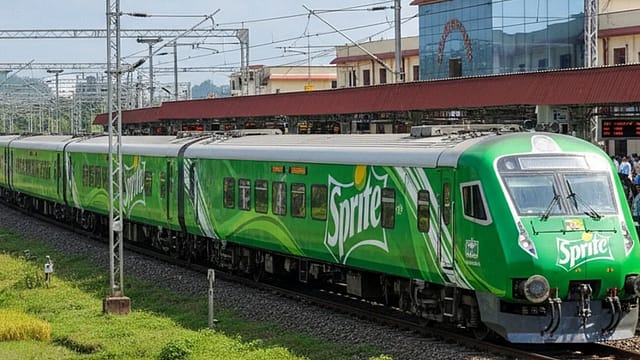
From August 20, the Lucknow-Delhi-Lucknow Tejas Express will run as the ‘Sprite’ Tejas Express, with the train wrapped in the brand’s distinctive green identity. The branding arrangement, involving IRCTC, is expected to run for at least six months.
On the surface, it is an outdoor advertising deal.
But a closer look suggests that Sprite is buying something more valuable than advertising space.
The Modi Years
02 Oct 2026 - Vol 05 | Issue 40
A Nation Rebuilt
The brand is not simply appearing on the train. It is becoming part of how the train is identified.
That changes the nature of the medium.
A billboard is a billboard. An advertisement on the side of a train is still an advertisement. But when the entire train carries one brand, travels between two major cities and is repeatedly seen by passengers, people at stations and commuters along the route, the asset begins to function less like an ad surface and more like a moving brand property.
And that may be the real reason the monsoon timing matters less than it initially appears to.
“If the objective is to drive immediate consumption, summer would obviously be the stronger season. But if the objective is recall and visibility, this can work beyond the seasonality of the category,” says Ashita Aggarwal, Professor-Marketing, SPJIMR.
Aggarwal sees the move as particularly effective because of the additional publicity it can generate around the branding itself.
“I think it’s a great idea as it builds PR and recall. Branding a train brings greater shelf life to the campaign. It will generate both short-term scale and long-term brand recall,” she says.
That shelf life is an important distinction.
For beverage brands, advertising has traditionally followed consumption. Summer means higher relevance, which means larger campaigns, stronger media spends and more attempts to occupy the consumer’s attention at the point when thirst and consumption are naturally higher.
Sprite’s Tejas play flips that logic to some extent.
The campaign does not need every passenger to immediately buy a bottle or can of Sprite. The train itself becomes the media vehicle. Every journey gives the branding another opportunity to be seen. Every station creates another point of exposure. And every photograph or social media post of the unusually branded train extends the campaign beyond the railway track.
The train, in effect, carries the advertising with it.
That is an old idea in a new format.
“Mobile advertising always was brands’ favourite but lost sheen only with digital becoming big,” says Aggarwal.
Digital advertising changed the economics of attention. It offered brands targeting, measurement and the ability to follow consumers across platforms. Transit advertising, meanwhile, remained largely rooted in physical formats: billboards, station panels, train wraps and platform branding.
But the Sprite activation points towards a more ambitious version of transit media.
The question is no longer simply how many people saw the advertisement.
It is: how much of the asset can the brand own?
That shift has already been visible in other forms.
In March 2025, Fevicol acquired naming rights for Mumbai’s Marol Naka Metro Station, turning it into ‘Fevicol Marol Naka’. The brand did not stop at putting its name on the station. One of the station’s vestibules was converted into a walk-through gallery featuring Fevicol’s advertising history, while digital screens carried its campaigns.
The difference between the two executions is significant, but the underlying thinking is similar.
Both turn a piece of public infrastructure into a brand environment.
For Sprite, the environment happens to move.
That mobility could make the proposition particularly attractive to marketers. Unlike a static outdoor property, a branded train can travel across geographies while retaining the same visual identity. It can reach consumers at multiple touchpoints without requiring the brand to buy multiple individual locations.
But there is another advantage: distinctiveness.
Consumers are exposed to an enormous volume of advertising every day. The challenge for brands is increasingly not visibility but memorability. A green train covered in Sprite branding is harder to process as just another advertisement. It is an interruption to the normal visual landscape of a railway station.
That makes the execution potentially more useful as a brand-building exercise than as a straightforward sales campaign.
It also explains why the format could attract other categories.
Aggarwal believes brands can make greater use of transit advertising, but only if they move beyond simply putting logos on vehicles.
“I think brands can really use it but have to be creative like this or what Fevicol did with Mumbai trains,” she says.
That qualification may be the most important part of the opportunity.
If every train becomes a giant billboard, the novelty will disappear quickly. The value of the format lies in making the asset itself part of the idea.
For Sprite, the visual fit is obvious. The green-and-white train is instantly recognisable from a distance. The branding lends itself to photography. And because the Tejas Express is an inter-city service, the activation has a natural association with movement, travel and visibility across a route rather than within a single urban neighbourhood.
The commercial question will ultimately be whether that visibility translates into meaningful brand metrics.
But that may not necessarily mean looking for a direct spike in Sprite sales during the six-month branding period.
The bigger payoff could be mental availability: making Sprite easier to recall, generating conversations around the brand and creating a physical property that consumers remember seeing.
That is increasingly what makes large-format outdoor advertising relevant in a digital-first media environment.
Digital can tell a brand exactly who saw an advertisement. Transit can sometimes make people remember where they saw the brand.
And that distinction matters.
The Sprite Tejas Express is therefore less interesting as another train wrap and more interesting as a sign of where out-of-home advertising could be going.
Brands are no longer satisfied with occupying the surface of public infrastructure. They are increasingly looking to occupy the identity of the space itself, even if temporarily.
A station. A metro line. A train.
The next evolution of transit advertising may not be about putting more advertisements on these assets. It could be about making the asset itself synonymous with the brand for as long as the partnership lasts.
For Sprite, the experiment begins in the monsoon.
The real test, however, will be whether the train is remembered not merely as a heavily branded piece of media, but as the Sprite train.
If it is, the brand may have bought something that a conventional summer campaign cannot easily deliver: not just visibility during a consumption season, but a piece of everyday infrastructure that keeps travelling long after the advertising message would normally have disappeared.