Print Is Dead? Tell That to the Newspaper That Just Became a Fridge
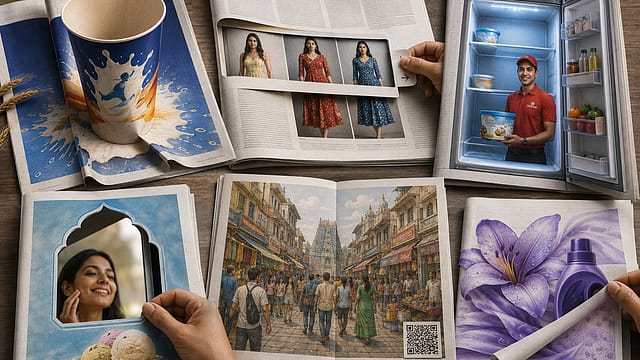
The strange thing about print advertising today is that the medium has become less powerful while some of the best print ads have become more powerful. It sounds contradictory, but the numbers explain it. Print is no longer the default destination for advertising money. Digital is. Yet when brands choose print, some of the most inventive work is happening on paper. Newspapers are being folded into cups, turned into refrigerators, fitted with sliders and even given a “Skip Ad” button. The medium may be losing share, but it is gaining a reason to be noticed.
India’s print advertising market grew 3% in 2025 to ₹20,866 crore from ₹20,272 crore in 2024, according to the Pitch Madison Advertising Report 2026. But print’s share of total AdEx fell from 19% to 18%. Print volumes were almost flat, rising roughly 1%, suggesting that the growth came more from pricing and premium inventory than a significant increase in advertising space. Digital, meanwhile, continued to take the larger share of incremental advertising growth. The FICCI-EY Media & Entertainment Report 2026 said print remained resilient, with advertising revenue growing 2%, particularly in premium formats. So the argument that print is “dead” is too simplistic. The more accurate argument is that print is becoming a more selective medium. It no longer wins because it is everywhere. It has to win because it can do something distinctive.
Rise of the Pivotal Power
18 Sep 2026 - Vol 05 | Issue 38
The BRICS declaration is a strategic victory for Modi
That is beginning to show up in the advertising itself. Horlicks recently used a four-page newspaper pull-out that could be transformed into a three-dimensional, stretchable cup. Instead of simply showing the product, the execution made the reader construct the very object associated with it. The cup was not merely an illustration in the ad; the newspaper itself became the cup. It is a small but important distinction. The reader was no longer only looking at an advertisement. The reader was doing something with it. And that is exactly where print has an advantage over the screen: it can be touched, folded, pulled and physically manipulated.
ZILO took a similar approach with Bombay Times, but used the newspaper’s architecture differently. The masthead was changed to “Bombay Tries”, while an envelope-style physical slider allowed readers to move through different outfits. The idea was built around ZILO’s proposition of trying different styles before buying. The execution worked because the innovation was not sitting on top of the message; it was communicating the message. Pull the slider and you understood the proposition. That is a useful test for innovative advertising: if you remove most of the copy, does the idea still communicate what the brand does? In ZILO’s case, largely yes. That is harder to achieve than simply making an ad look unusual.
Instamart and Go Zero went further by making the newspaper behave like something it was not. Their print execution in Hindustan Times used an embedded LED to recreate the inside of a refrigerator. When the page was opened, the light switched on, revealing an Instamart delivery partner holding a tub of Go Zero ice cream. The technology is interesting, but it is not the real idea. The real idea is the behaviour: you open the refrigerator when you want something to eat. The advertisement recreated that moment inside the newspaper. The page was no longer simply carrying the message. It had become a miniature physical environment. The best print ads are beginning to use the page, rather than merely occupy it.
Then came one of the more amusing examples of print borrowing from the medium that supposedly killed it. The Jagran Film Festival used a literal “Skip Ad” button in its newspaper campaign, connecting the physical execution to a digital experience around the festival. The irony was obvious: digital advertising spent years training consumers to skip ads; print put the button on paper. But there was a larger point underneath the joke. Print did not have to compete with digital. It could borrow digital behaviour and use it to create a different physical interaction. The newspaper becomes the starting point, the phone becomes the next step. That is perhaps where print’s relationship with digital is heading: not print versus digital, but print doing the things a screen cannot and then handing the consumer over to the screen when that makes sense.
There is evidence that this is more than a collection of clever agency stunts. The FICCI-EY report says print remained resilient in 2025, with advertisers increasingly favouring higher-impact formats such as larger units, jackets and contextual placements. That shift is important because it changes what advertisers are buying. A standard page is inventory. A jacket, masthead integration or unusual physical format can become an event. And when the medium itself becomes part of the idea, the advertising is harder to ignore. Print may not offer digital’s targeting or optimisation, but it can offer something increasingly scarce in advertising: physical interruption.
But there is a danger in reading too much into the resurgence of unusual formats. Innovative print remains a small part of the overall market. TAM AdEx data shows that print advertising space in 2025 was 21% higher than in 2021, but only 2% higher than the previous year. More than 72,000 advertisers and 95,000 brands advertised exclusively in print during 2025. Auto remained the largest sector, accounting for 16% of print ad space, followed by Services at 15% and Education at 14%. The ordinary print ad remains far more common than the elaborate one. That matters because the future of print will not be determined by how many brands can afford an LED or a custom slider. It will be determined by whether advertisers can find ideas that exploit the medium without turning every execution into a production stunt.
That is ultimately the paradox. Print is losing its old advantage, but that may be forcing it to rediscover another one. Digital can deliver scale, targeting, optimisation, measurement and immediate action. Print cannot beat it on those terms. But paper has physicality. It can fold. A masthead can change. A page can contain a light. An insert can become an object. A newspaper can become a cup, a refrigerator or a fitting room. Those are not advantages that make print more efficient. They make it different. And as print becomes a smaller part of the advertising pie, being different may matter more than being ubiquitous.
For decades, the standard question for a print advertiser was: how do we make people notice the ad? The better question now is: what can we make people do with it? The shift from “look and remember” to “look, interact and act” is already visible in the way brands are using the medium. The irony is that print’s decline may actually be making its best advertising more interesting. When newspapers could rely on habitual attention, the creative did not always have to work very hard. Today, it has to earn the second look. Horlicks asks readers to build a cup. ZILO asks them to try. Instamart recreates the fridge. Other brands are using QR codes, contextual placements and high-impact formats to turn a page into a starting point for action. Print advertising is not dead. It has simply lost its right to be boring.