Naraaz Fufa, Sunil Babu & Sirji: Why Politics and Advertising Talk Like Family
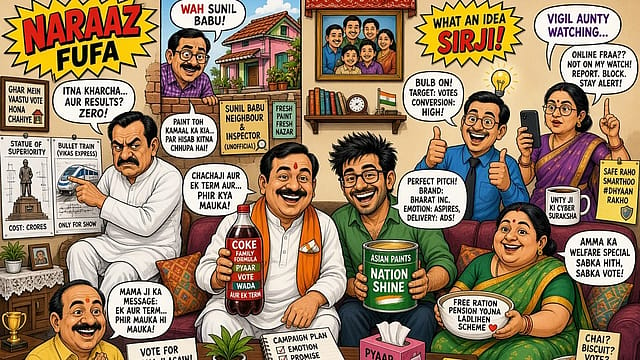
The fufa has arrived. He is unhappy.
The advertising people recognise the type immediately. They have been dealing with Sunil Babu’s neighbour for years.
Prime Minister Narendra Modi’s “naraaz fufa” questions the need for development projects. Asian Paints’ neighbour keeps inspecting somebody else’s good fortune. Both have observations to make. Neither appears to require an invitation.
Elsewhere, Mama wants another term. Sirji has an idea. Vigil Aunty is watching for fraud.
India’s public life has a crowded family drawing room. Somewhere between asking for a vote and selling a tin of paint, everybody has become somebody’s relative.
At the centenary celebrations of Delhi’s Shri Ram College of Commerce on September 5, 2026, PM Modi gave habitual critics of his government’s development projects a familiar designation: “naraaz fufa”. In his telling, these characters questioned the need for initiatives ranging from the world’s tallest statue to bullet trains and the new Parliament.

Losing Memory
16 Oct 2026 - Vol 05 | Issue 42
The making of a medical and social emergency
The choice of relative did much of the work. Fufa specifically means the husband of one’s paternal aunt. Add naraaz and the description summons a recognisable comic character: the perpetually displeased relative who can locate an inadequacy in any celebration.
A criticism of public expenditure becomes the complaint of someone who was probably going to complain anyway.
Advertising understands the usefulness of such characters. A familiar person brings an entire social world into a few seconds of screen time.
“Wah, Sunil babu! Badhiya hai.”
The Asian Paints commercial made a neighbour’s commentary the vehicle for a product demonstration. Time moved on. Sunil Babu’s circumstances changed. The house continued to look good.
In a retrospective account of the campaign, director Prasoon Pandey traced the neighbour’s character to a woman from his childhood neighbourhood in Jaipur. He resisted describing such people simply as nosy: they felt close enough to comment freely on your life.
There is our first connection. Before a speech or a commercial can persuade an audience, it helps to introduce someone the audience already knows.
The political fufa and the advertising neighbour are different characters performing different tasks. But neither needs much explanation. We can almost hear them before they speak.
“Babu”, in Sunil Babu’s case, is a familiar honorific rather than a family relationship. That distinction widens the story. Indian persuasion draws on relatives, respectful addresses and the conversational flourishes that place people in relation to one another.
Consider “Sirji”.
Idea’s “What an Idea, Sirji” attached the respectful ji to the English sir, producing a phrase with an unmistakably Indian conversational rhythm. In an interview, the company’s then marketing chief described the line as having entered everyday vocabulary.
The expression could admire, flatter or gently tease. It was compact enough to travel beyond the commercial and useful enough to apply to somebody else’s bright suggestion.
A brand name had found a place in an ordinary exchange.
The power of these addresses also explains why tone matters so much. In Bengal, “Didi”—elder sister—was already embedded in Mamata Banerjee’s public identity. During the 2021 Assembly campaign, Modi repeatedly used “Didi, o Didi” as a taunt. TMC leaders objected to the delivery as demeaning.
The word retained its dictionary meaning. The microphone altered the relationship.
That is the risk of building a public identity around a familiar address. Once the audience knows it, an opponent can change the emphasis.
Shivraj Singh Chouhan’s “Mama” persona offered an especially clear example.
Campaigning in Madhya Pradesh in October 2023, Chouhan asked a gathering in Dindori whether Mama should become chief minister again. He also explicitly described his relationship with the state’s people as familial.
A chief minister seeking another term must defend a record. Mama can additionally appeal to a bond.
Priyanka Gandhi supplied a different family reference. At Chitrakoot on November 9, 2023, she reminded voters that Kansa, Krishna’s tyrannical maternal uncle, was also a mama. Relationships, she argued, should be judged by actions.
Chouhan could keep the title. Priyanka had changed the uncle.
Advertising’s relatives generally enjoy a more controlled environment. The brand gets to cast them, script them and decide when the film ends.
HDFC Bank’s Vigil Aunty is a case in point. The bank presents her as a fraud-prevention influencer, using a familiar social figure to communicate the dangers of scams. The name itself plays on “vigilante”.
An aunty is someone who may feel perfectly entitled to intervene before you do something foolish. That makes her a useful character for a message about suspicious links and fraudulent calls.
A banking warning has acquired a person who can deliver it.
The protective relationship has an older political counterpart in Tamil Nadu. At an election rally in 2016, the late Tamil Nadu chief minister J Jayalalithaa invoked motherhood to explain her welfare policies: “Because a mother knows what is required for her children.”
Amma supplied an argument for authority. A mother understands needs, anticipates difficulties and knows when to act.
Karunanidhi invoked another Tamil bond. His recurring address to cadres, udanpirappe, conveyed siblinghood or brethren. In speeches and writing, it invited supporters to understand their political association as a shared family relationship.
The vocabulary changes across languages. The invitation to belong remains powerful.
Sometimes, that invitation arrives on a bottle.
When Coca-Cola brought its Share a Coke campaign to India in 2018, it put relationships on the packaging. Labels featured 20 relationships, including Mom, Dad, Bro and Daughter, and were created in 12 languages, including Tamil, Telugu, Kannada, Bengali, Malayalam and Marathi.
The company’s launch communication described how it had tested five possible themes with young consumers: names, designations, relationships, film dialogues and film names. Relationships emerged as the most popular choice.
The family had made it through consumer research.
A bottle could now function as a small message to the person receiving it. The relationship helped give an everyday purchase an occasion.
Coca-Cola had previously found another route into familiar speech with “Thanda Matlab Coca-Cola”. There, the opportunity lay in connecting a colloquial request for something cold with a particular brand. Aamir Khan’s characters carried the expression into memorable advertising.
From thanda to relationship labels, the brand drew on language consumers already had a use for.
Bikaji’s “Kya Baat Hai Ji!” campaign, featuring Pankaj Tripathi and aimed at Uttar Pradesh, works with a similarly familiar expression of appreciation. The brand’s own description places it among everyday pleasures, conversations and family moments. Brand campaign post
The ji is small. It helps set the temperature of the exchange.
But the most interesting use of family language may be the one that asks whether we mean it.
Cadbury Dairy Milk’s 2023 Sit Together campaign explicitly invoked the “watchman kaka”, “cook didi” and “guard bhaiyya”. It asked people to extend their shared enthusiasm for cricket into watching the game together.
Here, familiar addresses revealed an awkward distance.
We may call someone uncle, sister or brother while maintaining a firm boundary around where they sit and what they share with us. The campaign asked the affectionate word to produce an affectionate action.
That gives this entire family drama a sharper question: what is the relationship worth after it has secured our attention?
In politics, a claimed bond can soften a request. At an official event in Adilabad in March 2024, Congress’s Revanth Reddy called Modi an “elder brother” while seeking support for Telangana’s development.
It can also sharpen an attack. Jagan Mohan Reddy and YSRCP leaders called Pawan Kalyan Chandrababu Naidu’s datta putrudu, or adopted son. In April 2022, Pawan returned the insult by calling Jagan the CBI’s adopted son, invoking the cases against him. These were political barbs, rather than factual descriptions of either relationship.
Even adoption had become an argument.
Across these examples, familiar language provides a head start. It gives an audience a character, a tone and a set of expectations before the speaker reaches the actual proposition.
Mama will care. Amma will understand. Aunty will intervene. Sirji will appreciate the idea. The neighbour will have something to say.
That familiarity can make communication warm, funny and memorable. It can also make a promise feel more personal than the evidence supporting it.
Cadbury’s invitation to sit together offers a useful test: does the behaviour honour the address?
For a brand, the answer lies partly in whether the product delivers what the familiar voice promises. For a politician, it lies in whether the claimed relationship survives a citizen asking difficult questions.
Sunil Babu’s neighbour, after all, had a house he could inspect. The voter is entitled to inspect the work too. Even at the risk of becoming the naraaz fufa.