Mirzapur Bullet Ice Cream: When Movie Marketing Makes Violence Edible
An entirely imaginary scene. Obviously.
Kaleen Bhaiya opened the freezer. Guddu Pandit reached for his gun.
“Shaant ho jaiye, Guddu,” Kaleen Bhaiya said. “Thanda maamla hai.”
He removed a chocolate-coated bullet and placed it on the table. Guddu stared at it.
“Yeh nayi bandook ka maal hai?”
“Bandook ka zamaana gaya,” Kaleen Bhaiya replied. “Ab bullet quick commerce se aati hai.”
“Isse aadmi marega?”
“Chocolate hai. Zyada khaoge toh doctor daantega.”
Guddu picked it up cautiously.
“Naam?”
“Bullet Ice Cream.”
Guddu took a bite. For once in Mirzapur, a bullet entered someone’s mouth and nobody died. Somewhere, a freezer door closed. Somewhere else, a marketing department opened the champagne.
The Modi Years
02 Oct 2026 - Vol 05 | Issue 40
A Nation Rebuilt
From Gunfire to Brain Freeze
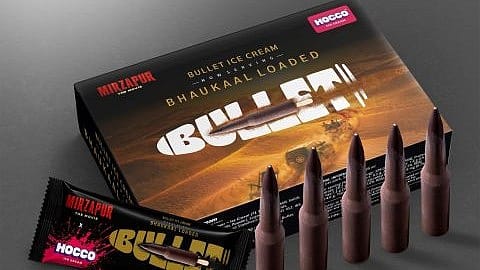
Ice cream brand Hocco has collaborated with Mirzapur: The Movie to launch a limited-edition Bullet Ice Cream ahead of the film’s theatrical release on September 4.
The product takes one of the crime franchise’s most recognisable visual cues and turns it into something people can unwrap, photograph, lick and order through quick-commerce platforms. The line completes the transformation: “Ilaaka apna, rules apne, aur bullet bhi apni.”
Mirzapur spent years putting people in front of bullets. Its latest piece of marketing puts the bullet in front of people.
Film collaborations traditionally followed a predictable recipe. Hire the star. Place the product in the star’s hand. Add the film’s logo. Offer premiere tickets. Pray that fandom rubs off.
Hocco has done something more interesting. It has borrowed the world of Mirzapur and frozen that world into the product. Remove the wrapper and the idea can still be understood. The ice cream itself carries the visual code.
“The strongest entertainment collaborations do not merely borrow a celebrity or paste two logos together. They borrow the fictional world,” says Ashita Agarwal, professor of marketing at SPJIMR. Hocco has converted a recognisable piece of Mirzapur’s identity into the product itself. That gives the collaboration a much better chance of being remembered.
There is a delicious clash at its centre. Mirzapur is hot-headed. Ice cream is cold. The franchise traffics in guns, blood and revenge. The product promises chocolate and pleasure. The bullet represents danger. The ice cream belongs to indulgence. The contradiction writes the campaign before the copywriter enters the room. See Bullet. Tap Screen. Eat Evidence.
The product is almost custom-built for social media. It can become a reel, gag, selfie and meme before it becomes dessert. Quick commerce then collapses the distance between discovering the joke and consuming it.
Someone sees the Bullet Ice Cream online, understands the reference and orders it before the cultural moment melts. Film merchandise once demanded intention. One visited a store, bought an expensive T-shirt or waited for a collectible. Quick commerce has turned fandom into an impulse purchase.
Food also travels farther than conventional merchandise. It is relatively inexpensive, widely distributed and carries little commitment. One need not be devoted enough to Mirzapur to buy a ₹1,500 jacket. Curiosity and a functioning sweet tooth may be enough to order an ice cream. “Limited editions allow brands to monetise fandom while controlling long-term risk,” says Agarwal. The product does not need to become a permanent bestseller. It needs to generate curiosity, conversation and trial while the film occupies culture.
The collaboration gives both partners something they lack. Hocco receives the instant fame, attitude and bhaukaal of an established entertainment property. Mirzapur enters freezers, delivery apps, ice cream outlets and homes that may otherwise never encounter a conventional film promotion. The Bullet Ice Cream becomes media that can be eaten.
Would You Like Murder With Fries?
Mirzapur is hardly the first entertainment property to discover that audiences want to consume more than the story.
For the final season of Game of Thrones, Oreo embossed biscuits with the emblems of House Stark, House Lannister, House Targaryen and the Night King. It then reconstructed the show’s famous opening sequence using more than 2,750 Oreos.
Westeros had served incest, war, dragons, betrayal and mass death.
Oreo served it with crème filling. According to the team behind the campaign, reportedly 4.3 million limited-edition packs were distributed. During the first week, they reportedly outsold every other Oreo limited edition released over the preceding five years.
Then came Squid Game, a series about indebted people being killed for the entertainment of the wealthy. Its dalgona challenge became a global social-media phenomenon. Netflix later partnered with McDonald’s Australia on an adult Squid Game meal containing the infamous candy. Customers could carve a circle, triangle, star or the Golden Arches. One competition offered AUD 100,000 to a successful contestant.
The savage critique of capitalism had become a value meal.
Barbie chose ubiquity over irony. More than 100 collaborations painted fashion, beauty, travel, technology and food pink around the film’s 2023 release. Burger King Brazil sold a Barbie meal with a pink-sauced burger. Cold Stone offered pink cotton-candy ice cream. People could watch Barbie, dress like Barbie, sleep in Barbie’s DreamHouse and apparently begin turning their digestive system pink. Cinema once placed brands inside stories. Brands now place stories inside products.
When the Joke Enters the Family Freezer
That brilliance carries a complication.
Mirzapur is an adult crime franchise built around guns, murder, intimidation and revenge. Ice cream belongs to a mass category with a particularly enthusiastic constituency among children.
A chocolate bullet can be read as clever pop-culture merchandise. It can also be read as the casual domestication of gun imagery. The weapon loses blood, acquires chocolate and enters the home as a treat. “Memorability cannot be the only test of cultural fit,” says Agarwal. When an adult entertainment property enters a mass-consumption category, the brand must consider who encounters the product beyond the franchise’s intended audience. What feels like an inside joke to a fan may communicate differently to a child.
That does not automatically make the collaboration irresponsible. Toy guns, chocolate cigars, gun-shaped keychains and cartoon violence have occupied popular culture for decades. Consumers can separate fiction from instruction.
Brands, however, do more than reproduce symbols. They soften, circulate and normalise them. Squid Game offers a useful warning. The show’s games were disturbing because innocent childhood activities carried fatal consequences. Marketing campaigns later removed the deaths and sold the games as entertainment.
The critique became the commodity. Mirzapur does not pretend to be a peace campaign. Its gun culture is central to its appeal. Hocco is, therefore, borrowing the franchise honestly.
The question is not whether people understand the reference. The question is whether every recognisable symbol should become edible.
Will the Bullet Hit Hocco?
There is one more risk beneath the chocolate. People may remember the bullet, quote Mirzapur, photograph the product and forget who made the ice cream.
In that case, Hocco would have paid to manufacture film merchandise rather than build its own brand.
“The entertainment property usually enters such a collaboration with greater cultural power,” says Agarwal. The partner must ensure that borrowed fame produces product trial and brand memory. Otherwise, the franchise eats the collaboration before the consumer eats the product. The shape attracts attention. The flavour, availability and experience must return that attention to Hocco.
That is the final test. The idea is sharp. The timing is smart. Quick commerce suits the joke. Most importantly, the collaboration translates the franchise rather than merely decorating a wrapper with its logo.
Hocco has made violence edible. Now it must make the ice cream memorable after the bhaukaal melts.