Meet the Little-Known Surat Brand Behind Mumbai’s Buildings
Construction sites have their own celebrity brands. Cement shouts the loudest. Steel comes next. Paint brands fight for billboards. But the brands that actually hold buildings together rarely make it to advertising hoardings.
Take Ascolite.
Outside contractor circles, few people recognise the name. Yet the Surat-based brand sits quietly inside thousands of construction sites—supplying Autoclaved Aerated Concrete (AAC) blocks, dry mortar, tile adhesives and waterproofing products.
Behind it is Aswani Industries, a bootstrapped company that has built a ₹200-crore construction materials business largely away from the consumer spotlight. Now comes the bigger ambition: turning a contractor’s favourite into a consumer brand.

Zeroing In on ECI
09 Oct 2026 - Vol 05 | Issue 41
Constitutional legitimacy versus political opportunism
The story, fittingly, begins far away from construction sites. In Madrid.

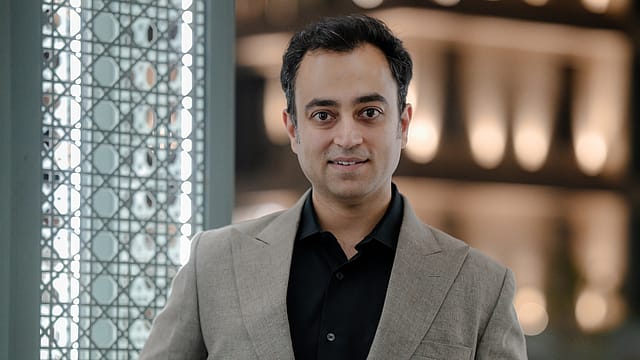
Nitin Lalwani, the second-generation entrepreneur, spent his early years in Spain.
Schooling, neighbourhoods, the rhythm of daily life—everything European. His paternal family had lived there for years.
Gujarat entered the picture much later, when his nuclear family decided to move back to India roughly 15 years ago. The decision, he says, had less to do with nostalgia and more to do with opportunity.
The family already had roots in Surat through the maternal side. Nitin’s uncle, Jaiprakash Aswani, had built a business there over decades.
Like many Sindhi entrepreneurs, the journey began in trading. Textiles first. Then exports. Then manufacturing and weaving. Over time the operation stretched across the textile value chain.
For years, it worked beautifully.
From Textile to real estate
Then textiles did what commodities eventually do—they squeezed margins until creativity had nowhere left to breathe. “My uncle likes to generate value and also give value,” says Nitin. “But textiles had become very commoditised.”
So, the founder looked elsewhere. Travel helped. Jaiprakash Aswani spent a fair amount of time in Europe and developed a quiet fascination with architecture—the
design, the aesthetics, the finish of buildings. Indian real estate, especially in tier-two cities at the time, rarely chased that kind of visual ambition.
Surat, he felt, could do better. So, the group entered real estate.
The idea was simple: build premium residential projects that looked better, felt better and delivered more than what buyers expected. “At that time the market was very unorganised,” says Nitin. “When we delivered more than what we committed, customers really appreciated it.”
Reputation followed. So did relationships with developers, contractors and suppliers.
And those relationships would soon prove extremely useful.
Around 2012, the second generation—Nitin and his cousin Navin—entered the business. Construction across India was booming. Cities were expanding, towers were rising, and the pace of building had accelerated dramatically.
The cousins started asking a straightforward question: if the group was already building projects, why not produce the materials that go into them?
From Developer to Materials Maker
The first answer came in the form of AAC blocks.
AAC blocks are lightweight concrete blocks that replace traditional red clay bricks, helping buildings rise faster while reducing structural load.
Autoclaved Aerated Concrete blocks were beginning to gain traction as a modern alternative to red clay bricks. They were lighter, offered better insulation and reduced structural load. They also helped address a nagging construction problem: seepage and leakage through traditional brickwork.
The technology looked promising. The brand name came easily. “Asco” from Aswani Construction. “Lite” from the lightweight nature of the blocks. Ascolite.
Convincing builders, however, was another story.
Red clay bricks had ruled Indian construction for decades. Contractors trusted them, engineers were used to them and switching meant risk.
So, the founders had to do something unusual: they went to the market themselves. “We worked shoulder to shoulder with the sales team,” Nitin recalls. “We had to explain the product, demonstrate it, and convince people to try it.”
Trial orders trickled in. Then something surprising happened. The company invested in a large manufacturing facility in Surat.
Within the first year, utilisation climbed to nearly 70 percent. For a new manufacturing business, that was a strong start. For a while the ride looked smooth.
Then competition arrived.
Within a few years AAC blocks began drifting toward the same destiny as bricks and cement before them: commoditisation.
More manufacturers entered the market, supply increased and prices began sliding. Revenue remained stable, but margins tightened.
For many companies that would have been the moment to retreat. Aswani Industries did the opposite. “We realised we couldn’t remain just a block company,” says Nitin.
If builders were already buying blocks from them, why not supply the materials used alongside those blocks? Adhesives came next. Then ready-mix plasters. Then tile adhesives. Then waterproofing solutions.
Block by Block: Building the Business
Gradually, Ascolite stopped being a single-product company and became a construction materials platform.
From ₹90.41 crore in FY21 to ₹206.74 crore in FY25, the company has more than doubled its revenue in five years.
AAC blocks today contribute roughly 40% of the business, ready-mix mortars about 20%, while tile adhesives and waterproofing products together account for the remaining 40%.
The company expects to close FY26 with revenues of around ₹215 crore, and is still bootstrapped and profitable.
On paper, that growth may appear to be slowing—from ₹206 crore to ₹215 crore. Nitin doesn’t seem particularly bothered. “We are building the business block by block,” he says with a smile. Ascolite, he underlines, is not a blitzscale story.
But construction materials rarely are. The industry itself comes with built-in constraints.
Credit rating firm Brickwork Ratings flags a few of them for Ascolite. Demand for AAC blocks and related products remains closely tied to the health of the construction sector.
When real estate slows, suppliers feel it almost immediately. Add to that the cyclical nature of the business, constant pricing pressure and raw material volatility, and the operating environment begins to look a lot less predictable.
Margins tell part of that story. The company’s EBITDA margin dipped to 12.21% in FY25 from 18.68% a year earlier, reflecting the impact of fluctuating input costs. For Aswani Industries, none of this is entirely new. Construction materials have always been a tough game.
The bigger challenge, however, lies elsewhere. For most of its existence, Ascolite has lived almost entirely in the B2B world. Developers knew the brand, contractors trusted it, purchase managers approved it and site engineers specified it.
Consumers, meanwhile, had no idea it existed. And that matters in a category where brand recall can be powerful. Companies like Pidilite Industries have spent decades building retail trust. And then there are players like Sika AG that dominate the high-end construction chemicals market.
The Missing Block: Brand Visibility
That transition is easier said than done, reckon branding and marketing experts. In construction materials, consumer brands are built slowly—through dealer networks, contractor loyalty and years of advertising that create recall among homeowners.
“Moving from a contractor-driven brand to a consumer brand is a completely different game,” says Ashita Aggarwal, professor of marketing at SP Jain Institute of Management & Research. “In B2B, performance sells the product. In B2C, perception and performance sell it,” she says, adding that visibility is the name of the game.
Indeed, shift from contractor brand to consumer brand often hinges on one thing: visibility.
In B2B markets, relationships and product performance carry the weight—developers, engineers and contractors already know which brands work on site.
Consumers operate differently. When homeowners walk into a hardware store, they usually reach for the names they recognise. “Brand recall becomes the real currency in B2C,” says Aggarwal. “You could be huge in B2B, but if the homeowner hasn’t heard of you, you’re effectively starting from scratch.”
That insight captures the dilemma Ascolite now faces. Its biggest strength—contractor network—also became its biggest limitation.
The brand needed to step outside construction sites. The push into retail began cautiously around 2020. A separate team was hired to build the B2C business. Separate strategies, separate leaders, separate distribution thinking.
Then Covid arrived and everything paused.
When markets reopened, however, demand surged. Construction activity resumed, stalled projects restarted and the entire sector experienced a burst of pent-up demand. That wave helped Ascolite gain its early retail foothold.
Today the company has a sizeable presence in Mumbai, while Gujarat and Maharashtra remain its strongest markets. Retail still accounts for only a portion of the business, but it is growing.
The transition has also forced the company to rethink how brands actually grow. “Big brands operate on pull sales,” says Nitin. “Customers walk into stores asking for them.”
Ascolite still operates largely on push sales—convincing distributors, educating contractors and demonstrating product performance on site.
That difference shapes everything from hiring decisions to go-to-market strategy.
Playing the Long Game
In fact, one of Nitin’s early lessons came from hiring. “At first I thought we should hire only from the same industry,” he says. “The idea was that knowledge transfer would be instant. Plug and play.”
It didn’t work that way. Many of those executives had spent years working in pull-driven brands—companies where distributors and customers already asked for the product by name.
“As a brand in the making, we are still in a push ecosystem,” he explains. The better hires, he says, often came from adjacent industries. “They don’t come with baggage. They don’t have fixed mindsets about how things must work.”
Another learning came from watching how the two sides of the business behaved. “B2B businesses are great for building topline,” he says. “But B2C businesses are more sustainable and stronger on the bottom line.”
The reason is simple: B2B demand can swing sharply with construction cycles. B2C demand takes longer to build but tends to be more stable once the brand gains traction.
In hindsight, he believes the company should have started the consumer journey earlier. “We were a bit late,” he admits. “You have to start building the brand early.”
For now, though, Aswani Industries continues to grow the old-fashioned way—bootstrapped, profitable and cautious with capital. External funding remains a possibility but not an immediate priority. “As long as we don’t cover at least half the states in terms of penetration, we won’t raise money,” says Nitin.
Instead, the company is expanding the way many regional manufacturing firms do: deeper products, stronger distribution and gradual geographic expansion.
The ambition is clear: ₹1,000-crore company within five years.
Meanwhile, on construction sites, Ascolite already belongs. The real question is: can it enter Indian homes too?