India’s ₹15 vs ₹150 Water Battle: Can Premium Brands Justify the Markup?
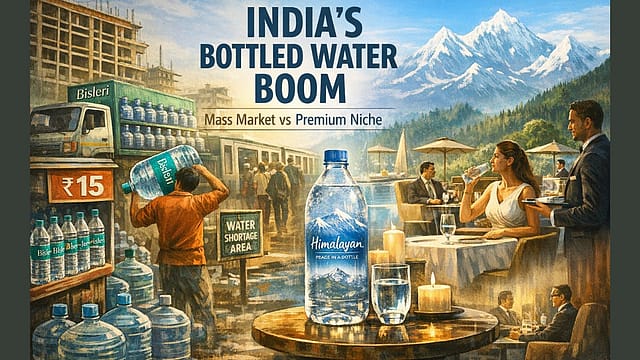
For some consumers, packaged water is a considered choice—used in offices, hotels, restaurants or during travel. For others, it is a necessity, filling gaps where access to safe, reliable water remains inconsistent. The launch of Peace in a Bottle by Himalayan, a natural mineral water brand from Tata Consumer Products, brings this dual reality into focus—not because the brand misreads its audience, but because it reflects how differently bottled water is consumed across India.
How fast is the bottled water market growing in India?
India’s packaged water market is expanding but not for a single reason, and not uniformly. The market was expected to grow from $8.28 billion in 2025 to $9.14 billion in 2026, reaching $14.97 billion by 2031, at a CAGR of 10.39% between 2026 and 2031, according to Mordor Intelligence. Growth is being driven by urbanisation, increased mobility, rising health awareness and uneven water infrastructure.
The Modi Years
02 Oct 2026 - Vol 05 | Issue 40
A Nation Rebuilt
Why do people rely on packaged drinking water in India?
In several urban and semi-urban pockets, packaged water is a convenience or quality choice—during work hours, dining out or travel. In other regions, it acts as a fallback where municipal supply is unreliable, inconsistent or perceived as unsafe.
Government initiatives such as the Jal Jeevan Mission have expanded tap water access. Yet last-mile quality concerns, service continuity issues and groundwater depletion continue to shape consumption patterns. Bottled water, as a result, spans both discretionary and functional use cases.
This diversity of demand has produced a sharply segmented market—one in which scale-led mass brands and narrowly positioned premium players coexist but rarely compete on the same terms.
How do mass bottled water brands make money?
Mass brands have benefited most from necessity-driven consumption.
Bisleri International reported an 82.8% increase in profit to ₹316.95 crore in FY24, while revenue from operations rose 14.8% to ₹2,689.69 crore. Total consolidated revenue increased 18.32% to ₹2,814.04 crore, according to data accessed via Tofler. The performance underscores the strength of a volume-led model in a category where repeat consumption, dense distribution and price discipline outweigh differentiation. Bisleri holds approximately 38% share of the organised bottled water market.
Recent developments suggest the category is fragmenting further rather than converging.
At one end, Campa Sure—launched by Reliance in September 2025—foregrounded affordability with a ₹15 price point in a campaign featuring Amitabh Bachchan. Coming shortly after a GST reduction on packaged drinking water to 5%, the move reinforced bottled water’s positioning as an accessible product in price-sensitive contexts.
Why are bottled water brands priced so differently?
Price has emerged as a marker of use case and portfolio tiering, rather than a simple mass-versus-premium divide. Large players increasingly operate across multiple price points and formats, reflecting varied consumption occasions.
Bisleri, for instance, prices its core packaged drinking water aggressively across formats—from 20-litre jars and multi-litre packs for daily household or office use, to smaller bottles for on-the-go consumption—underscoring water’s role as a basic utility in many settings. At the same time, it operates Vedica, its Himalayan spring water brand, positioned at a significantly higher price point and targeted at premium retail and hospitality channels.
A similar portfolio logic applies across the industry. Himalayan, from Tata Consumer Products, is not priced or distributed as everyday drinking water but positioned for selective consumption environments. Imported natural mineral waters such as Evian and Perrier sit even higher, largely consumed in on-trade, modern retail and premium dining contexts.
The result is a layered market where pricing reflects occasion, format and channel intent and not a single hierarchy of brands.
How are premium bottled water brands differentiating themselves?
At the other end of the spectrum, premium brands are refining their positioning around experience, provenance and meaning. Interestingly, there is no attempt to compete on everyday affordability.
This is where Himalayan’s latest campaign fits into the broader industry narrative. Rather than reiterating source and purity—attributes that have increasingly become the price of entry—the brand has shifted its messaging toward emotional refreshment. The Himalayas are framed not just as a geographical origin, but as an idea associated with calm and balance.
Anuraag Khandelwal, Chief Creative Officer at 82.5 India, who worked on the campaign, said the intent was to move the category conversation forward. “When every brand sounds the same, talking louder doesn’t help. Thinking deeper does. In this category, provenance is the price of entry. What truly differentiates a brand is the emotional payoff,” he said, adding that the Himalayas were positioned “not just as a place, but as a state of mind.”
Can premium water justify higher prices beyond purity?
From a business standpoint, this reflects how premium bottled water brands are attempting to defend higher price points in a market where functional superiority is increasingly difficult to claim.
Ashita Aggarwal, professor of marketing at SP Jain Institute of Management and Research, observed that as purity becomes a baseline expectation, premium brands may need to position themselves around contextual relevance, supported by provenance, sensory profile, packaging design or mineral composition. “Premium players will have to move from being pure to being the best water for a certain occasion or usage,” she said.
“There is an innate desire to be at peace in everyday chaos. The ‘Peace in a Bottle’ campaign brings to life the idea that these moments of calm can exist even within fast-paced environments,” said Partha Biswas, President and Head of RTD Business at Tata Consumer Products.
Where is premium bottled water actually consumed?
Importantly, this positioning does not attempt to address the full breadth of bottled water consumption in India. Industry observers believe premium brands operate in selective contexts—hotels, corporate environments, premium dining and curated retail—where bottled water is a deliberate choice rather than a default purchase.
The coexistence of these strategies points to a larger truth about the category. Packaged water in India is not a single market, but several overlapping ones. In some settings, it is an essential utility. In others, it is a lifestyle signal or quality upgrade.
What is the future of premium bottled water in India?
As the market continues to grow—driven by infrastructure gaps and evolving lifestyles—segmentation is likely to sharpen. The question for premium bottled water brands is not whether mass players will dominate volumes—they already do—but whether meaning, context and experience can justify a smaller, defined place in an increasingly commoditised category.
For now, the industry’s direction suggests both models will coexist—serving different needs, at different prices, in the same bottle-shaped market.