Foxed by Fame? Why Shah Rukh Khan Is a Big Bet for Foxtale
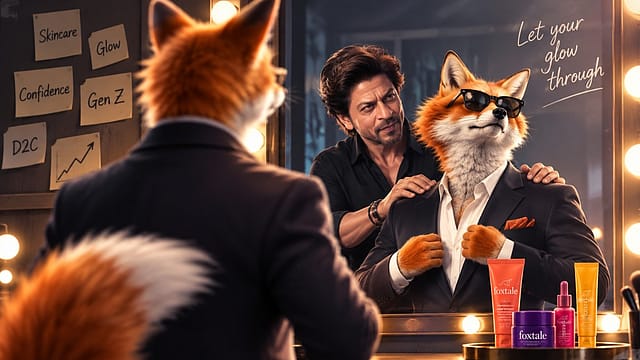
There is nothing particularly surprising about a beauty brand appointing Shah Rukh Khan as its brand ambassador. Celebrity endorsements have long been part of the Indian advertising playbook, and Foxtale is hardly the first new-age consumer brand to use a superstar to build awareness.
What makes Foxtale's latest move interesting is not that it has Shah Rukh Khan. It is why it has him now, and what the association says about the brand's next phase.
Four years after its launch, Foxtale has appointed Khan as its brand ambassador across serum, moisturiser, sunscreen and face mask categories, while unveiling a new brand philosophy, “Let Your Glow Through”. The brand says the philosophy is rooted in its belief that lasting skincare results come from understanding the source rather than merely treating the surface. It also says Khan represents confidence, authenticity and substance, qualities that fit the new positioning.
Rise of the Pivotal Power
18 Sep 2026 - Vol 05 | Issue 38
The BRICS declaration is a strategic victory for Modi

On the face of it, the association works. Shah Rukh Khan brings scale, recognition and cultural familiarity that few Indian celebrities can match.
But there is a more interesting question for Foxtale: does Shah Rukh Khan strengthen what Foxtale has already built, or does he signal a move towards the conventional brand-building playbook that new-age beauty brands once set out to disrupt?
That question becomes more relevant when viewed against Foxtale's business trajectory.
According to regulatory filings accessed through Tofler, Foxtale Consumer Private Limited's total revenue rose 144.1% to ₹206.2 crore in FY25 from roughly ₹84.5 crore in FY24. Revenue from operations increased 138.7% to ₹198.7 crore from ₹83.2 crore. But expenses doubled, rising from ₹139.3 crore to ₹278.9 crore. The company consequently remained loss-making, with its net loss widening from ₹54.8 crore in FY24 to ₹72.7 crore in FY25.
That creates a more nuanced picture than simply calling the business loss-making.
Foxtale's revenue grew much faster than its expenses. Its operating loss increased from ₹54.9 crore to ₹78.1 crore, but the operating loss margin improved materially, from about 66% of operating revenue in FY24 to 39.3% in FY25. Net loss margin also improved from 64.9% to 35.2%. The business was still burning money, but it was beginning to generate more revenue for every rupee of operating loss.
In other words, Foxtale was scaling faster than it was improving profitability, but the gap was moving in the right direction.
Its balance sheet also points towards an equity-funded expansion rather than a debt-led one. Assets jumped nearly fourfold to ₹352.1 crore, while net worth rose to ₹293.5 crore. Borrowings were shown at zero, leaving the company with a debt-to-equity ratio of zero.
That matters when looking at the Shah Rukh Khan decision.
Because this is not simply a young brand buying attention.
It is a young brand that has already demonstrated the ability to grow rapidly and is now trying to determine what kind of brand it wants to become.
From digital discovery to brand stature
Foxtale built much of its identity in a different era of Indian beauty.
It belongs to the generation of brands that grew through digital discovery, creators, social media, consumer insights and product-led conversations. Its own celebrity strategy has previously been described as using personalities as “cultural catalysts”, rather than relying purely on traditional endorsement.
That distinction is important.
A celebrity attached to a sunscreen campaign is one thing. A superstar becoming the face of the master brand is another.
The Shah Rukh Khan association operates at the latter level.
He is representing multiple core categories while appearing at the centre of Foxtale's new brand philosophy. And the campaign is already moving beyond digital screens. The first phase of its outdoor campaign spans more than 70 billboards across Mumbai, Bengaluru and Delhi. Foxtale's VP-Growth Avichal Pugalia has described visibility and recall across markets as an important part of the company's growth journey.
This is not just a campaign anymore. It is brand-building at scale.
And perhaps that is precisely the point.
A digital-first brand can acquire consumers through Instagram, creators, marketplaces and performance marketing. But eventually, the problem changes from “Can consumers discover us?” to “Can consumers remember us?”
Shah Rukh Khan is exceptionally good at solving the second problem.
“I guess Foxtale is actually trying to say that we have grown up. And now that we have grown up, we have a big star endorsing us,” says brand strategy expert Harish Bijoor. “However good your product is, and however good your micro-endorsers have been, it’s good to have an umbrella brand endorser. It looks like Shah Rukh is playing that role, with that quiet line.”
The word that stands out is “grown up.”
But growing up can come with a cost
Foxtale's challenge now is to make sure scale does not come at the cost of distinctiveness.
The company's FY25 numbers show just how aggressively it has been scaling. Operating revenue grew nearly 2.4 times, while total expenses doubled. The company also moved from ₹83.2 crore of operating revenue in FY24 to ₹198.7 crore in FY25.
That is impressive top-line growth. But ₹72.7 crore of losses is also significant for a company whose operating revenue is below ₹200 crore.
The financials therefore raise an important question about the next stage of the business: how much more can Foxtale spend to acquire scale before scale itself has to start paying for the business?
This is where the Shah Rukh Khan association becomes strategically interesting.
Celebrity-led brand building is expensive, and so is mass-market visibility. But if Foxtale's ambition is to move from being a digital-native skincare company to a broader beauty brand, it may need to make precisely these investments.
The question is not whether the company should advertise.
It is whether the advertising is building an asset that can outlive the campaign.
That is the difference between buying awareness and building brand equity.
Is SRK an extension of Foxtale or a departure from it?
This may ultimately determine whether the partnership works.
Foxtale's earlier growth was built around a very different kind of credibility. Consumers could discover a product through creators, read reviews, compare ingredients and decide whether it addressed a specific concern.
Shah Rukh Khan cannot replace that ecosystem.
Nor does he need to.
His role can be different.
A creator can explain the product.
A consumer can validate it.
The product can deliver the result.
And Shah Rukh Khan can make the brand itself more memorable.
That division of labour makes sense.
The problem would begin if Foxtale starts treating celebrity equity as a substitute for product equity.
That would be particularly risky because the brand's own financial trajectory suggests that the next phase cannot be about growth at any cost. It needs to demonstrate that the scale it has bought can eventually translate into healthier economics.
The positive sign is that its operating and net margins improved despite the widening absolute loss. Its operating margin stood at -39.3% in FY25, compared with roughly -66% a year earlier, while net margin improved to -35.2% from -64.9%. The business is therefore not simply spending more and losing more in proportional terms. It is generating significantly more revenue relative to the size of its losses.
That is the part of the story that matters.
The real bet is bigger than Gen Z
It would be easy to frame this as a question of whether Gen Z needs Shah Rukh Khan.
It does not.
But that is not really the question Foxtale is asking.
The brand may instead be asking whether it can take the credibility it built among digitally savvy skincare consumers and turn it into broader mainstream brand recognition.
That is a different ambition.
Foxtale says it has built a community of more than 10 million consumers and has expanded beyond its original skincare proposition into body care, lip care and fragrance.
As the portfolio expands, the need for a strong master-brand identity becomes greater.
This is where Shah Rukh Khan could make sense.
He is not necessarily there to tell someone which serum to buy.
He is there to make Foxtale itself easier to remember.
And that is perhaps what makes the association more interesting than a straightforward celebrity endorsement.
The question Foxtale now has to answer
Foxtale is at an inflection point.
Its FY25 numbers show a company that has achieved extraordinary top-line growth but has yet to turn that growth into profitability. At the same time, its margins improved substantially, suggesting that the underlying economics are moving in a better direction even as the company continues to invest in expansion.
Now it is adding another layer to that expansion: mass brand building.
The Shah Rukh Khan partnership can help Foxtale move from being a brand consumers discover to a brand consumers recognise.
But recognition alone is not enough.
The bigger challenge is to make sure that as Foxtale becomes more visible, it does not become less distinctive.
There is a reason the new generation of beauty brands disrupted the old playbook in the first place. They understood that consumers no longer wanted to be told what to buy simply because a famous person said so. They wanted proof, relevance, transparency and products that solved an actual problem.
Foxtale should not abandon that advantage in its pursuit of scale.
Shah Rukh Khan can give the brand a much bigger stage. The business still has to prove that what it is putting on that stage deserves attention.
Foxtale may have grown up. Its next challenge is to prove that growing bigger can also mean growing stronger.