Captain Cool vs Hitman: Solar’s War of Trust
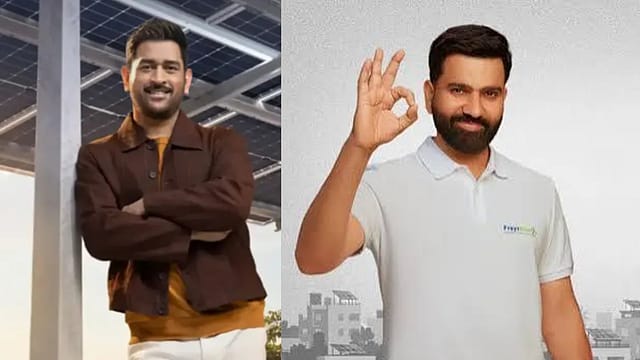
India has room in its heart for MS Dhoni and Rohit Sharma.
Its rooftop may be less accommodating.
Captain Cool is batting for SolarSquare. The Hitman has taken guard for Freyr Energy. Two men whom Indian fans happily applauded in the same blue jersey now lend their reassurance to competing solar businesses.
Cheering for both was easy. Signing two installation orders for the same roof would be an expensive expression of sporting affection.
Here is solar advertising’s delicious problem: it has recruited two wonderfully familiar answers to the same unfamiliar question. Whom do you trust with your roof, your money and the promise of smaller electricity bills?

Losing Memory
16 Oct 2026 - Vol 05 | Issue 42
The making of a medical and social emergency
Dhoni, says one brand. Rohit, says the other. Lovely. Now what?
THE TRUST DERBY
This contest makes sense because rooftop solar asks a household to make several decisions at once. There is equipment to understand, an installation to organise, paperwork to navigate and a savings proposition to evaluate.
An unfamiliar company must persuade a family to begin that conversation. A familiar captain can get it through the door.
Both endorsements draw on something cricket has already supplied: years of public familiarity, leadership and emotional investment. The marketing wager is that some of that reassurance will travel from the player to the provider.
But a brand cannot own trust simply because it has hired someone trusted. Especially when the competition has hired someone else the same household trusts.
Marketing and branding experts reckon that a celebrity can reduce the anxiety of considering an unfamiliar category. But when competing brands use equally trusted personalities, the endorsement gets them onto the shortlist. "The brand still has to supply a reason to be chosen,” says Ashita Aggarwal, professor of marketing at SP Jain Institute of Management & Research.
That is where this becomes more interesting than a contest between famous faces. Freyr and SolarSquare are giving reassurance different jobs.
HITMAN BRINGS A RISHTA
Freyr’s ‘Rishta Pakka’ uses a traditional Indian wedding-proposal setting to explain rooftop solar. Under the ‘Solar Ho, Toh Freyr Ho!’ campaign, the film works through subsidies, potential savings and the journey from a proposal and loan approval to design, installation and tracking.
It is an astute cultural setting. A rishta is a familiar framework for an unfamiliar commitment: ask questions, consider the future, seek reassurance and then decide whether this relationship belongs in your home.
Solar gets introduced to the family.
The comedy makes the decision approachable. Rohit supplies recognition while the film gives viewers something practical to recognise: the steps involved in getting started.
Freyr also describes an offering spanning design, installation, financing assistance, subsidy support, monitoring and after-sales service.
The strategic opportunity is to become the name attached to making adoption manageable. Its challenge is to ensure viewers remember Freyr alongside Rohit. A famous guest can dominate the wedding album.
CAPTAIN COOL TAKES OWNERSHIP
SolarSquare puts Dhoni’s familiar temperament to work.
The caption accompanying his film begins: “People often ask me how I stay so cool.” It then connects that coolness to handing over the worry of home solar: the company takes responsibility from installation to servicing and promotes guaranteed savings. The post is marked as a paid partnership.
The reading is straightforward. You can relax because someone else is accountable.
SolarSquare’s website gives that reassurance a more concrete form. Its GoodZero offering advertises a generation guarantee with a money-back provision, proactive service visits and an app for tracking power generation.
A guarantee gives the buyer something to examine beyond the celebrity. Its value depends on the terms: what is covered, for how long, how performance is measured and what happens when a claim is made. The advertised promise alone cannot settle those questions.
Dhoni’s relationship also extends beyond appearing in the advertising. He has invested in SolarSquare through his family office, Midas Deals.
That gives his association a financial dimension. It also makes the commercial interest explicit. An investor’s confidence remains different from independent verification of a household’s prospective savings.
Freyr makes the relationship inviting. SolarSquare makes responsibility the route to relaxation. Both must turn those ideas into reasons to choose their particular business.
FEDERER, NADAL AND THE CELEBRITY DRAW
There is a useful global parallel in luxury watches. Roger Federer belongs to the Rolex family; Rafael Nadal has a longstanding relationship with Richard Mille.
A tennis fan can admire both men without becoming confused about the brands. The companies have identities, products and design languages beyond their ambassadors. Richard Mille’s Nadal collection makes the association especially tangible through watches developed around lightness and resilience.
The lesson for solar is the work surrounding the famous face.
Dhoni’s calm and Rohit’s familiarity can give their brands a voice. The harder task is making the company recognisable when the cricketer is absent: in the quotation, the explanation of savings, the installation and the service experience.
The comparison has limits. A luxury watch and a rooftop installation involve very different motivations and obligations. Solar must support its emotional appeal with a clear account of what the household is buying and who will remain responsible.
The roof cannot run on reflected glory.
BOTH CAPTAINS COULD WIN
There is a flip side to the versus framing. These campaigns could help each other expand consideration of rooftop solar.
Freyr’s explanation may prompt a family to investigate the category. SolarSquare’s promise may make it ask tougher questions about accountability. Either conversation could benefit another provider that offers a convincing proposal.
That is a possibility, rather than a documented outcome. The campaigns establish competing pitches; they do not establish switching, market-share gains or an advertising feud.
Nor does the customer’s choice end with these two brands. Another company or a trusted local installer can still win through a better explanation, a suitable system, credible service and a competitive quotation.
The strongest use of an endorser is to make a specific brand promise memorable. In a long-term purchase, that promise must then become visible in the customer’s experience. "Otherwise, people remember the cricketer and struggle to explain why they chose the company,” says Aggarwal.
For both brands, that is the examination after the applause.
THE SCOREBOARD IS THE ELECTRICITY BILL
A household can love Dhoni, admire Rohit and still ask both sales teams awkward questions.
What assumptions underpin the savings estimate? What exactly is included in the price? Who handles a problem? Which commitments appear in the agreement?
Those questions do not spoil the advertising. Answering them is how the advertising earns its confidence.
Freyr has a chance to make a technical purchase feel like a relationship the family understands. SolarSquare has a chance to make Dhoni’s coolness stand for a company taking responsibility. Each needs its promise to survive contact with the customer’s experience.
For a household choosing between them, whichever brand wins the order, one beloved captain loses the sale. He can keep the applause. The winning company inherits the obligation. Because the electricity bill has never given anyone extra marks for captaincy.