Brand Ravi Shastri: The Man, the Meme & the Longest Happy Hour
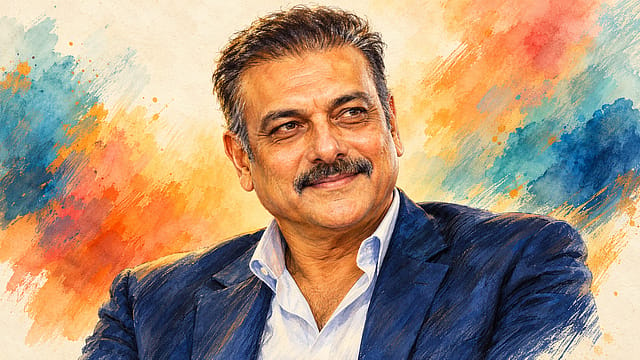
Ravi Shastri is promising “cold ones”. Naturally, expectations have been set. Then come the ice-cream cans.
Ob & Gob’s festive film puts Shastri alongside comedian Yuvraj Dua at a house party, where the promised “cold ones” turn out to be the brand’s sundae cans.
The product is frozen. The joke arrives preheated.
That is the advantage of casting Shastri. Advertising can begin halfway through a conversation because the audience already carries the opening lines in its head: the voice, the swagger, the drinks break, the gentleman seemingly capable of announcing last orders with the urgency of a World Cup final. Ob & Gob supplies the can. Public memory supplies the misdirection.

Losing Memory
16 Oct 2026 - Vol 05 | Issue 42
The making of a medical and social emergency
Welcome to Brand Ravi Shastri, where the happy hour has become a remarkably durable creative platform.
THE INTERNET WROTE HALF THE BRIEF
The drinking mythology has material beyond anonymous memes.
In a 2016 interview, Shastri spoke candidly about his younger days, nightlife and socialising. “If you got out for zero also you’d be having a drink,” he recalled.
That is his account of an earlier life. Every subsequent photograph, expression or scripted commercial need not be treated as a breathalyser.
The more revealing branding moment came in 2021. Confronted with the memes, Shastri declined to supply the wounded reaction that keeps an internet joke alive. “Have a drink on my name,” he said at a March press conference, describing the jokes as banter. He joined the conversation.
Commercially, that matters. A celebrity who can tolerate exaggeration gives writers room to work. Shastri can be impressive and ridiculous within the same film without either performance entirely cancelling the other.
The internet supplied a caricature. He supplied permission to laugh. Advertising found a recurring character.
DRAVID BROKE CHARACTER. SHASTRI ORDERED ANOTHER ROUND
CRED understood the distinction.
Its May 2022 film placed Shastri in a party-coach universe, repurposing the famous Chak De! India motivational-speech device around the impending end of happy hours. Sporting authority remained intact. Its application became gloriously inappropriate.
That separates the film from CRED’s angry Rahul Dravid. Dravid’s surprise was behaving unlike Dravid. Shastri’s surprise was being even more Shastri.
One idea overturns an established image. The other turns up its volume. The humour depends on recognition: the commanding delivery, the seriousness of the instructions, the absurdity of what deserves such seriousness.
A lesser version would simply have placed a famous former cricketer in a nightclub. This version gave the nightclub a head coach.
Marketing and branding experts reckon that when a celebrity participates in the humour, the audience is invited to laugh with him. Shastri can play an exaggerated version of himself without appearing embarrassed by it. "That gives writers considerable freedom, provided they develop the character rather than keep repeating the same drinking joke,” says Ashita Aggarwal, professor of marketing at SP Jain Institute of Management & Research.
BEFORE THE MEMES, THERE WAS VIMAL
His advertising history predates the feed.
An old Thums Up commercial featured him with Sunil Gavaskar and Sandeep Patil. Vimal’s 1987 World Cup advertising placed him alongside Vivian Richards and Allan Border.
The fashionable sporting personality was already available. Social media subsequently gave audiences new ways to circulate, exaggerate and participate in it.
His advertising portfolio stretches across travel, biscuits, dating, sports streaming, innerwear, pet care, property and beverages. Those associations span different periods and include campaign appearances as well as formal ambassador relationships.
The breadth is revealing. Different advertisers can select different versions of the same recognisable man. The coach lends authority. The commentator supplies instant identification. The public personality supplies a joke. Sometimes all three turn up for the shoot.
SWAG DOES NOT REQUIRE A YOUTH CERTIFICATE
Bumble’s 2023 Special Delivery film made that flexibility its subject.
Shastri wrestled with the prospect of offering dating commentary to younger audiences, experimenting with their vocabulary before returning to his own style. The creative premise served Bumble’s message about being yourself.
The age gap became useful material. His attempts to speak the audience’s language worked because the familiar Shastri kept showing through.
MakeMyTrip’s 2024 Asli Star campaign offered another variation. His attention-grabbing bathrobe posts belonged to an advertising exercise, subsequently revealed through the campaign.
The episode complicates the apparently spontaneous pleasures of celebrity internet culture. Sometimes the internet discovers a personality. Sometimes the personality has a media plan. Shastri’s apparent ease helps the machinery feel entertaining. He can flirt with absurdity without looking as though he needs the audience’s permission to enjoy himself. That is a more interesting asset than merely looking young.
WHEN THE PERSONALITY BECOMES THE PRODUCT DEMONSTRATION
Britannia 50-50 offers a sustained examination of the model.
Its association began with Maska Chaska in 2022 and developed through Golmaal films, a sweet-and-salty dual persona and an interactive Shastri avatar. Britannia described technology designed to reproduce his appearance, voice and mannerisms.
The personality had become detailed enough to simulate.
There is a useful product connection here. Sweet and salty can become contrasting performances. Cricket advice can become Golmaal advice. His familiar authority provides the setup; the unexpected answer supplies the release. Yet the creative team recognised the danger. Sarvesh Raikar of Lowe Lintas reportedly pointed out that Britannia 50-50, cricket and Shastri were powerful ingredients requiring balance, lest one overwhelm the others.
Does the character help explain the biscuit, or does the biscuit sponsor another character sketch?
Shastri gives advertisers a character audiences already recognise. His voice, confidence and willingness to laugh at himself make the humour easier to establish. The challenge is to connect those qualities to something specific about the product. "Otherwise, viewers remember another entertaining Shastri performance while the brand pays for a guest appearance in his show,” adds Aggarwal.
Sting’s February 2026 Sound of Six campaign attempted a different connection. With Yuvraj Singh and Shastri, it attached the brand’s distinctive sound to cricket’s big-hitting moment.
The voice has a defined job: linking the sporting action to the brand name. Recognition becomes more useful when the creative idea gives it somewhere specific to go.
THE PARTY GUEST CAN STILL SELL AUTHORITY
His property association provides an instructive counterpoint to the ice-cream film.
An October 20 interview identifies Shastri as ambassador for a partnership between TheBlock. and CENTURY 21 UAE & India, connected with real-estate tokenisation.
A party reveal and a property proposition need different things from their celebrity. The first exploits a familiar expectation. The second seeks credibility and attention.
His comic persona has evidently not exhausted his usefulness as an authoritative public figure. But cricketing stature cannot establish expertise in every category.
The distinction matters because the same recognisable personality can perform very different commercial functions. Making an unfamiliar proposition feel approachable is valuable. Explaining why that proposition deserves a customer’s money remains the advertiser’s responsibility.
EVERY ENDORSEMENT NEEDS A SOBER LOOK
The portfolio also contains a less comfortable strand.
According to media reports in March 2025, Shastri’s promotional posts for betting company Stake attracted questions about advertising compliance, with ASCI expressing concerns. The reporting raised the possibility of scrutiny; it did not establish a final regulatory finding against him.
Affection for a celebrity can make people more receptive to a proposition. It cannot establish the product’s quality, suitability or risks. The greater the consequences of the purchase, the more carefully the association needs to be examined. "The brand still owes consumers that explanation,” says Aggarwal. Nor does a good performance demonstrate effective advertising.
Without comparable evidence on brand recall, consideration or sales, an entertaining film remains an entertaining film. Claims about commercial success need their own scorecard. Shastri’s achievement as an advertising personality is his range: he can retain the authority to deliver the line while surrendering enough dignity to make it funny.
Perhaps his most saleable quality is how little he appears to strain for relevance. Shastri can enter a dating-app film, deliver nonsense with dressing-room conviction and leave with his dignity cheerfully rearranged.
There is something appealing about that ease in a celebrity economy so anxious about looking foolish. He gives the joke room to breathe. For a former India coach, it is an unusual commercial qualification: knowing when to stop defending.