Apple Folded. Samsung Roasted. Duolingo Gatecrashed
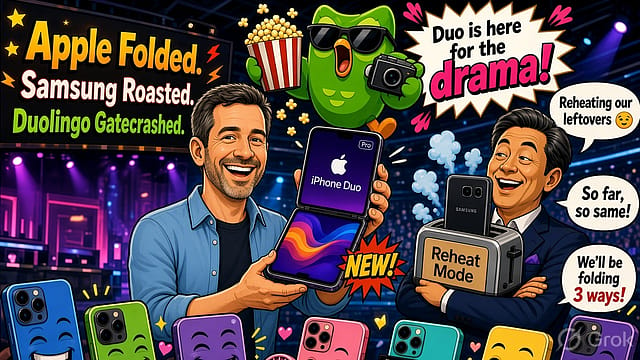
Apple spent years developing a phone that could fold. Samsung needed seconds to turn it into toast.
As Apple unveiled the iPhone 18 series and its first foldable smartphone at the “Surprise and shine” event in California, Samsung Mobile US began running an unofficial commentary track on X.
Before Apple reached the most anticipated part of its presentation, Samsung posted: “So far, so same.”
The hashtag delivered the invitation: #ItsTimeToSwitch.
When Apple displayed the redesigned cameras and body of the iPhone 18 Pro, Samsung returned with another poke: “It’s feeling very familiar. Is this a Sims sequel…”
Then Apple made Samsung wait for the foldable. Samsung used the delay to unfold another punchline: “Making us wait? Fine. We’ll be over here, folding 3 ways.”

Zeroing In on ECI
09 Oct 2026 - Vol 05 | Issue 41
Constitutional legitimacy versus political opportunism
It was a reference to the Galaxy Z TriFold, Samsung’s three-panel device—and a reminder that the Korean company had moved beyond the conventional book-style fold while Apple was preparing to announce its first one.
Finally, the iPhone Duo appeared. Samsung removed it from the oven.
“Let us know when you’re done reheating our leftovers 😉”
And then Duolingo gatecrashed.
The language-learning app, whose green owl has become less mascot and more internet troublemaker, inserted itself into the online exchange. A launch keynote had become a group chat. Apple was introducing hardware; its rivals and professional social-media hecklers were manufacturing entertainment around it.
Samsung’s posts reportedly attracted more than a million impressions. Apple supplied the event, the audience and the cultural moment. Samsung borrowed all three without buying a ticket.
That makes this more than another episode of corporate trolling.
Samsung has spent seven years building the modern foldable-phone market. Apple has now entered that market with a $1,999 device that analysts expect could redraw the category. Samsung owns the history, the hardware head start and the punchlines. Apple may still leave with the customers.
Welcome to the oldest trick in competitive advertising: make fun of the rival before the rival makes you nervous.
Samsung and Apple: From Courtroom Enemies to Comedy Partners
The Samsung–Apple rivalry did not begin with emojis. It began with patents, injunctions and lawyers carrying diagrams of rectangular phones into courtrooms.
Apple sued Samsung in 2011, alleging that Galaxy smartphones and tablets copied elements of the iPhone and iPad. The dispute grew into a multinational smartphone war. By July 2012, the companies were reportedly involved in more than 50 lawsuits across the world, with billions of dollars at stake.
The legal conflict eventually subsided. The advertising conflict discovered a charger. Samsung realised early that Apple’s greatest marketing advantage could also become its most useful comedic prop: the behaviour of Apple loyalists.
In 2011, its “The Next Big Thing Is Already Here” campaign showed consumers waiting in long lines for a new iPhone while Samsung users walked past with larger screens and 4G connectivity. The product comparison was embedded inside a social insult. Samsung was not merely saying its phone possessed better specifications. It was asking whether queuing for an iPhone had become a substitute for thinking.
Samsung extended the ambush into the physical world. During the Australian launch of the iPhone 4S, it opened a temporary store close to Apple’s Sydney outlet and reportedly offered a Galaxy S II to a limited number of customers for A$2.
People had gathered for Apple. Samsung positioned itself next door and rented the attention.
The jokes became sharper in 2014. Samsung’s “Wall Huggers” campaign showed iPhone owners crowded around airport charging points because their batteries could not survive the day. Galaxy users, equipped with removable batteries and power-saving features, looked liberated by comparison.
“Wall hugger” escaped the advertisement and entered the technology vocabulary. That is the jackpot for rivalry marketing: the insult becomes a category description.
In 2017, “Growing Up” followed a loyal iPhone user through years of storage warnings, water anxiety, dongles and long queues before he switched to Samsung. One Apple customer in the queue had a haircut shaped like the iPhone X notch. Samsung turned a design element into a visual punchline.
A year later came “Ingenius”, a series set in a shop resembling an Apple Store. Customers asked awkward questions about download speeds, multitasking, expandable storage and the headphone jack. The employee playing the resident genius repeatedly discovered that the rival Galaxy could do things the iPhone could not.
Samsung had found its recurring character: Apple’s disappointed customer.
There was, however, a flaw in mocking Apple’s decisions. Samsung occasionally followed them.
It ridiculed Apple for removing the headphone jack and then removed the port from its own flagship devices. It joked about Apple abandoning chargers in the box before doing something similar. Online advertisements that had aged badly reportedly began disappearing.
The leftovers line is consequently dangerous. In technology, today’s absurdity often becomes tomorrow’s product roadmap.
Why Is the iPhone Duo Such a Perfect Target?
Because Samsung can make a legitimate claim to being there first. It launched the original Galaxy Fold in 2019, survived the embarrassment of early review units suffering display failures, delayed the release, repaired the device and continued refining the category through several generations.
The experiment was expensive and occasionally uncomfortable.
Samsung educated suppliers about folding displays, developers about changing screen sizes and consumers about why a phone should open into a small tablet. It endured visible creases, hinge anxiety, dust questions, bulky bodies and the suspicion that foldables were engineering demonstrations searching for a mass-market purpose.
Apple watched.
Seven years later, it introduced the iPhone Duo with a 5.4-inch external screen, a 7.6-inch internal display, a precision hinge, the A20 Pro chip and software designed for multitasking across the larger canvas. It starts at $1,999 and will become available on October 23.
For Samsung, “reheated leftovers” is, therefore, more than a gag. It is a compressed history of the category.
But Apple’s lateness carries its own power.
Apple did not invent the portable music player, smartphone, tablet, smartwatch or wireless earbud. It has repeatedly entered existing categories after other companies absorbed the first failures, then combined hardware, software, distribution and cultural prestige into products that made those categories feel newly inevitable.
The iPhone Duo could repeat the pattern.
Apple has joined a foldable market led by Samsung and Huawei, but early analyst projections suggest it could quickly capture a substantial share. Reuters reported that some analysts expect Apple to secure as much as 40 per cent of the foldable segment following the launch.
Samsung spent seven years answering whether foldable phones could work. Apple can now ask whether millions of iPhone users want one. That is why the roast contains a faint smell of defensive cooking.
Pepsi Taught Brands to Make the Leader Say Its Name
Brand rivalry works most naturally for the challenger. The leader wants consumers to believe the category begins and ends with it. The challenger needs the comparison because proximity to the leader creates relevance.
Pepsi understood the arrangement long before social media.
The Pepsi Challenge, launched in 1975, asked consumers to taste unlabelled cups of Pepsi and Coca-Cola and choose the one they preferred. Pepsi did not need to prove it was the world’s most famous cola. It merely needed to create doubt around the world’s most famous cola.
The campaign helped transform a product contest into the “Cola Wars”.
For decades, Pepsi used youth, celebrity and irreverence to antagonise Coca-Cola’s inheritance of nostalgia and authenticity. Coke had Santa Claus, family tables and the contour bottle. Pepsi wanted Michael Jackson, Madonna, pop culture and the next generation.
The duel remains useful because every joke arrives preloaded with meaning. Consumers already understand the combatants.
At the 2019 Super Bowl in Coca-Cola’s hometown of Atlanta, Pepsi plastered the city with lines including: “Pepsi in Atlanta. How Refreshing” and “Hey Atlanta, Thanks For Hosting. We’ll Bring The Drinks.”
In 2026, Pepsi reportedly borrowed Coca-Cola’s famous polar-bear territory for a Super Bowl commercial in which a cola-drinking bear suffered an identity crisis after preferring Pepsi Zero Sugar in a blind taste test.
A rival’s brand assets became raw material. Samsung is doing something similar with the fold. It cannot own Apple’s launch. It can try to own the conversation around it.
Burger King Made Trolling Part of the Menu
If Pepsi professionalised the rivalry, Burger King turned it into performance art. McDonald’s possesses more restaurants, a larger advertising budget and far greater revenue. Burger King possesses the freedom to behave like the smaller, louder sibling at the dining table.
That asymmetry created some of advertising’s best provocations. In 1981, Burger King used a young Sarah Michelle Gellar in a commercial claiming its burgers were larger than McDonald’s. McDonald’s sued.
Decades later, Burger King’s attacks became more inventive.
For “Scary Clown Night” in 2017, it offered free Whoppers to customers who arrived dressed as clowns—turning Ronald McDonald’s identity into Halloween horror. In Germany, an advertisement screened before the film It ended with the message: “The moral is: never trust a clown.”
“Whopper Detour” went further. Customers could unlock a one-cent Whopper through Burger King’s app when they came within 600 feet of a McDonald’s outlet. Burger King converted thousands of rival restaurants into activation points for its own promotion.
Even an attempted truce became an ambush.
In 2015, Burger King publicly proposed creating a one-day “McWhopper” with McDonald’s for Peace Day. McDonald’s declined. Burger King still received the publicity—and acquired the moral high ground for having offered peace.
The pattern resembles Samsung’s launch-night behaviour. McDonald’s and Apple are powerful enough to stage the main event. Burger King and Samsung arrive with markers and begin writing jokes on the invitation.
The challenger gets to be funny. The leader risks looking rattled if it replies.
When BMW and Audi Played Chess With Billboards
Automotive advertising moved the rivalry onto the street.
The most famous example began in California when Audi placed a billboard promoting the A4 with the challenge: “Your move, BMW.”
BMW reportedly answered from a nearby billboard with a photograph of the M3 and one word: “Checkmate.”
The exchange subsequently acquired additional unofficial and digitally manipulated instalments online, which only strengthened the mythology. Consumers wanted the feud to continue badly enough to help write it themselves.
That is a critical transformation. A rivalry succeeds when the audience stops behaving like spectators and begins taking sides.
Apple and Samsung have cultivated precisely that tribalism. The argument is no longer confined to processors, cameras, operating systems or hinges. It touches identity. An iPhone or Galaxy device can signal taste, technological philosophy, social status and membership of an ecosystem.
Samsung’s posts are built for those tribes to distribute. Its marketing team supplies the first punch. Apple and Android loyalists perform the unpaid amplification.
India Had Rivalry Advertising Before It Had X
India’s advertising history also began serving competitive mischief long before brands could quote-post one another.
The Amul Girl, introduced in the 1960s, emerged after Amul sought an answer to Polson butter and its established butter-girl imagery. The resulting mascot outlived the rivalry, became a chronicler of Indian public life and transformed topical wordplay into one of the country’s most recognisable advertising formats.
Later brand battles became more direct.
Pepsi and Coca-Cola carried their global rivalry into Indian cricket and cinema. Pepsi’s “Nothing Official About It” famously ambushed Coca-Cola’s official sponsorship territory around the 1996 Cricket World Cup.
The challenger did not own the tournament. It owned the line people remembered.
Bajaj Avenger’s “Feel Like God” campaign later took a teasing swipe at Royal Enfield’s “Made Like a Gun” mythology. Zomato and Swiggy built parallel personalities through outdoor advertising, notifications and social posts that made food-delivery competition resemble two witty administrators running India’s appetite.
The lesson travels across categories: a rivalry gives advertising something many campaigns lack—a plot. There is a protagonist, an opponent, a history and the promise of another episode.
Why Did Duolingo Enter an Apple–Samsung Fight?
Because Duolingo no longer behaves like a language-learning utility on social media. Its green owl behaves like a creator who happens to have an app.
The mascot has flirted with celebrities, threatened learners over broken streaks, staged its own fictional death and inserted itself into cultural conversations far beyond vocabulary lessons. Its consistency gives Duolingo permission to gatecrash.
A conventional brand joining the Samsung–Apple exchange might appear desperate for impressions. Duolingo’s intrusion feels native to its established personality. Duo the owl sees a crowded conversation and assumes it is an invitation.
There is also a linguistic gift in the product’s name. Apple called its foldable the iPhone Duo. Duolingo’s mascot is also called Duo. The brand did not need a media plan; Apple had accidentally placed its mascot inside the keynote.
Duolingo, therefore, became the third character in the story without manufacturing the rivalry. It merely recognised the opening faster than most advertising approval chains could organise a meeting.
Samsung needed seven years of foldable history to earn its punchline. Duolingo needed four letters.
The Joke Works But It Also Advertises Apple
MArketing and branding experts reckon that the power of Samsung’s intervention lies in how little explanation the joke requires.
“A brand rivalry becomes culturally powerful when consumers understand the joke before the brand explains it," says Ashita Aggarwal, professor of marketing at SP Jain Institute of Management & Research. Samsung is using seven years of foldable leadership as the setup and Apple’s late arrival as the punchline. "Duolingo then turns the exchange into platform entertainment rather than conventional comparative advertising,” she adds.
But the attention comes with a strategic cost.
“Every Samsung joke also tells millions of consumers that Apple now has a foldable,” says Aggarwal. Samsung may win the social-media moment while helping Apple establish the iPhone Duo as the category’s biggest arrival. The roast works brilliantly for engagement, but it must eventually bring consumers back to a reason to buy Samsung.
That distinction separates a sharp post from a successful campaign. The “folding three ways” message presents a product advantage. “Reheating our leftovers” offers historical ownership. “So far, so same” attacks Apple’s perceived lack of design novelty. Together, the posts construct an argument: Samsung innovates first; Apple follows later and charges more.
Yet they also place Apple at the centre of the story. The brand doing the mocking can win the laugh while the mocked brand retains the launch, search interest, media coverage and purchase consideration. Sometimes the punchline is free advertising wearing boxing gloves.
Did Samsung Roast Apple or Reveal Its Own Anxiety?
Both can be true.
Samsung earned the right to tease Apple’s late entry. It built foldable phones when the screens broke, hinges creaked and consumers wondered whether the entire format would survive. The iPhone Duo enters a road Samsung helped pave.
But Samsung is no longer mocking a hypothetical device.
It is confronting a $1,999 iPhone capable of pulling Apple’s enormous installed base into the foldable market. Apple’s presence can attract developers, strengthen component supply chains, increase consumer confidence and turn a niche into a legitimate premium category.
That helps Samsung.
It also threatens Samsung’s ownership of the category.
The most effective brand feuds are powered by an imbalance. Pepsi needs Coke. Burger King needs McDonald’s. Audi’s challenge helped place it beside BMW. For years, Samsung needed Apple as the cultural giant against which Galaxy could appear faster, freer and more adventurous.
The iPhone Duo alters the roles.
In foldables, Samsung is the incumbent. Apple is the late-arriving challenger with the larger ecosystem and the louder launch.
Samsung has the experience. Apple has the gravity. Duolingo has the popcorn. Apple folded. Samsung roasted. The owl gatecrashed. And somewhere beneath the emojis, a seven-year-old category war finally became the main event.